

Objectives of the service
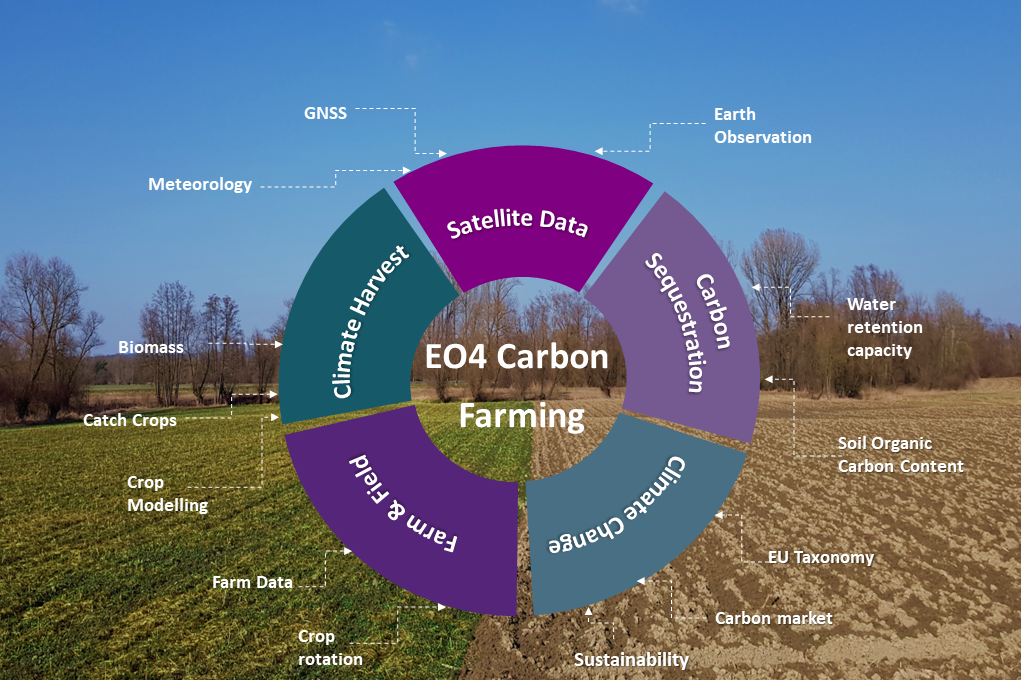
The objective of the planned offering is to provide a commercial service for monitoring, reporting and verification of Carbon Farming.
Carbon Farming means all activities agriculture can undertake for sustainable reduction and sequestration of CO2 from the atmosphere. One challenge in Carbon Farming is to independently assess and verify the actions taken as well as their impact on carbon sequestration.
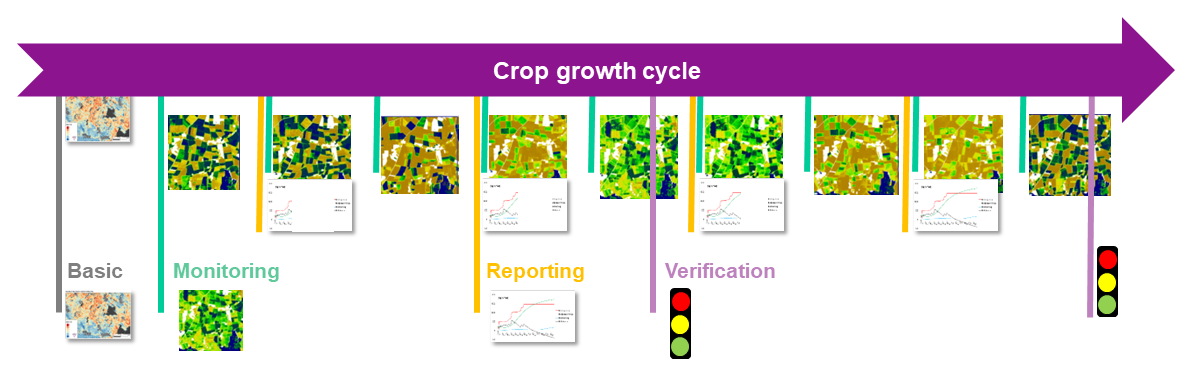
The EO4CarbonFarming MRV Tool includes functionalities to monitor the carbon in plant and soil, to report on required measures like crop rotation and catch crop planting, and to verify them. Additionally, their impact can be evaluated. This enables performance assessment of sustainability measures and more resilient farming practices. Reliable determination of field carbon stocks is key to monitoring the climate impacts of carbon farming and to developing business models.
Users and their needs
There are two main customer groups. Customers with performance-based remuneration for sustainability services, such as carbon certifiers, governmental agencies, NGOs and the agri and food industry, but also agricultural service companies.
Both groups have in common that they need reliable and cost-efficient reporting and verification for the sustainability measures that have been performed by the farmer. The first group additionally needs an independent assessment of the success of the carbon sequestration measures, while the second group needs an objective data source for their service offers and monitoring during the crop growth cycle as input for their decision support. All of these needs can be fulfilled with the EO4CarbonFarming MRV Tool.
The offering will initially target customers in Germany and Austria and can be expanded in the future.
Service/ system concept
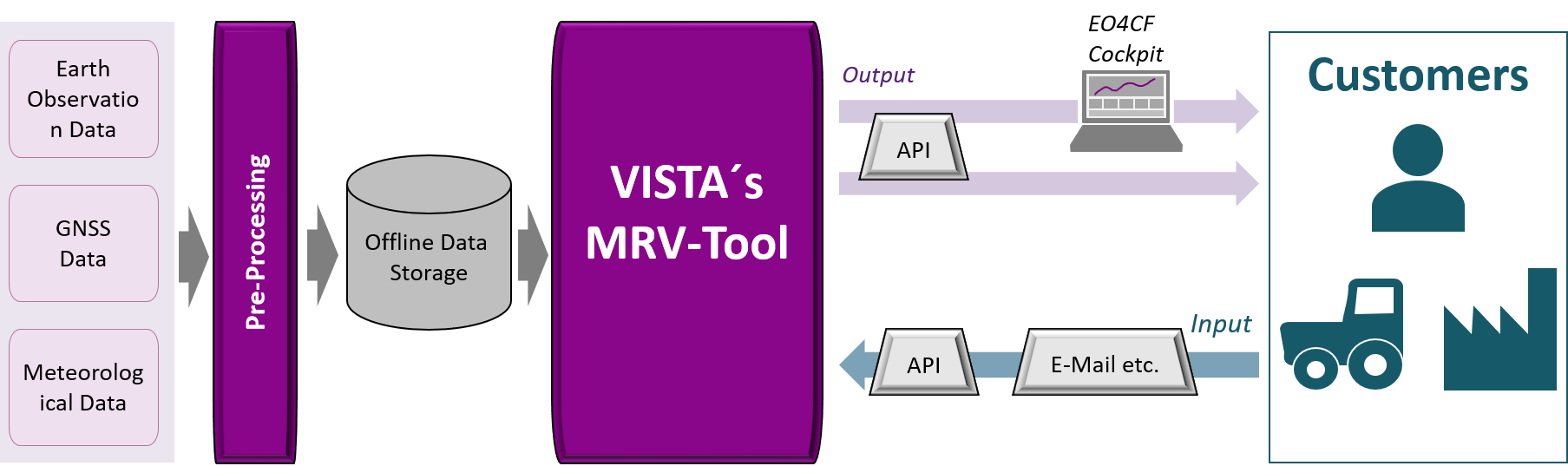
At the center of the service is Vista’s MRV-tool, gathering and processing information from different sources. Satellite data are integrated with field data and the sophisticated crop growth model PROMET.. The tool receives the data fully automated via API and delivers the outputs via API or visualized in the “EO4CF Cockpit”.
The MRV-tool delivers the outputs:
-
soil organic carbon
-
carbon stock in soil and plant
-
catch crop detection
-
proof of crop rotation
-
cover crop type classification
-
detection of harvest and tillage events
Space Added Value
High-resolution satellite imagery is essential to the service and will be integrated with GNSS-located in-situ data.
For the calculation of soil organic carbon content maps, Earth Observation data are used as input, giving a new degree of detail in comparison to soil sampling. Showing the variability of the soil organic carbon content within fields allows to monitor the success of specific sustainability measures e.g. to build up organic material in specific parts of the field.
For the monitoring of crops during the growing season, optical satellite data analysis with a radiative transfer model to derive variables like leaf area, chlorophyll content and fraction of brown leaves is planned. Additionally, coherence and backscatter of radar data will be analysed to derive harvest dates, soil moisture and soil management information.
Current Status
The main phase of the demonstration project was successfully concluded in March 2025.The EO4CarbonFarming solution met all objectives set and has succeeded in achieving first sales already in Europe but also in Asia. Yet, several additional user requirements became clear during the course of the activity. So, based on this user feedback, the project has now entered the extension of the original demonstration project.
The new project requirements were captured and embedded into the design of the system architecture. All relevant development activities addressing the technical requirements of new potential customers have been completed, and the system now demonstrates all newly desired features, leading to a successful On-Site Acceptance Test milestone meeting in May 2026.
New features include the following: extended cover crop monitoring, detection of harvest and tillage events, ordering capabilities of the service, uploading the required input data, and accessing and visualising the results through the same user account with a single login.
Formularbeginn
Formularende

The Business Plan, including the market analysis and competitor analysis, has been updated to reflect the new service components and their impact on the overall business case.
Following the completion and verification of the system’s technical functionalities, the overall solution will be trialled by pilot users to demonstrate the applicability and functionality of the system in operational conditions.
The next phase of the project will be the final review, where the pilot phase results will be analysed, new commercial agreements will be established, leading to the full successful commercialisation of the EO4CarbonFarming service.