


Objectives of the service
Dark Vision delivers unparalleled insights to end users ranging from government, security agencies, commercial organisations, NGO’s and International funding organisations. Derived primarily from the use of innovative space-based nighttime imagery, Dark Vision will provide an understanding of how artificial light at night impacts our planet ranging from the effects on human health, ecology, the environment and biodiversity..
A wide range of nighttime imagery data from Space-based sensors will be used to provide global coverage from a granular detail (able to identify street lighting) up to national scale mapping of light sources by land use type.
Users and their needs
Use case 1: mapping light pollution - utilising techniques developed within our consortium to process data from publicly available archives and strategic partners to deliver a snapshot and assessment of the light pollution present within a given environment. National Governments and agencies responsible for light pollution seek to classify the origin of light pollution by land use type.
Use case 2: improving population distribution estimates. Spatial databases of human population have found use in disease burden estimation, epidemic modelling, resource allocation, disaster management, accessibility modelling, transport and city planning, poverty mapping and environmental impact assessment amongst others. The use of nighttime imagery can help to identify areas of countries that are lesser developed and where statistics may not include dwellings and therefore underestimate population figures.
Service/ system concept
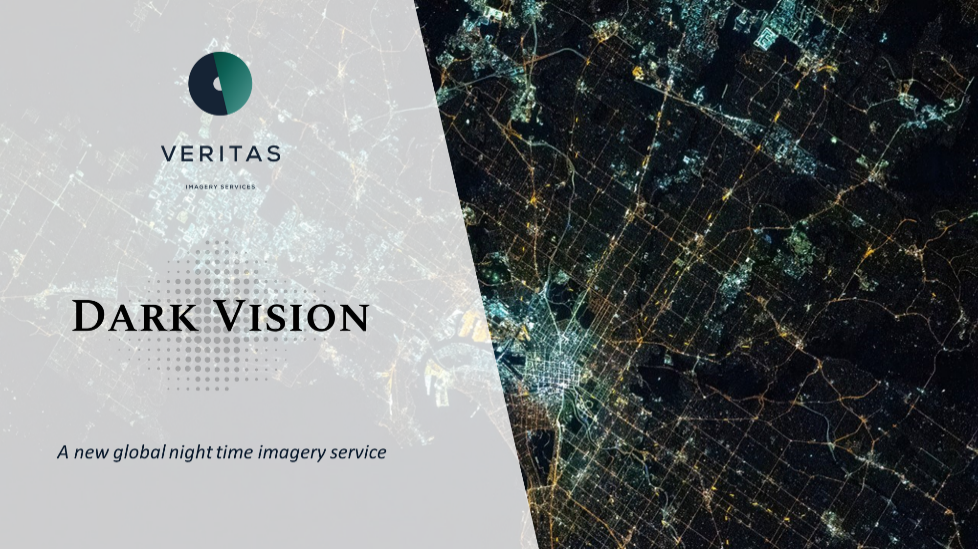
The Dark Vision service will use a range of nighttime imagery sources to meet customer requirements. The layering and intercalibration of sensors will allow very high-resolution identification of nighttime features (for example individual streetlamps) through to nationwide classification of artificial light pollution, categorised by land use. The service utilises open and commercial data sources and provides a greater understanding of the impact of light pollution on the environment and how this may be used as a proxy for human presence and activity.
Space Added Value
The service will incorporate data from several Earth Observation missions. These will primarily include: ISS, SDGSAT-1, NOAA-20, and various commercial providers/sensors. The use of a combination of space assets that we propose meet the service demands by offering the temporal, spatial and spectral characteristics that cannot be achieved by other sensors. Space assets also offer advantages as they cause less pollution than the deployment of ground or aerial sensors and data can be collected without requiring people to be present in the locality.
Current Status
Completed
Prime Contractor(s)

Subcontractor(s)
