
Objectives of the service
Use a bold image to start your webpage. It can be a photo or an infographic like this. Remember that you project webpage can be a powerful marketing tool.
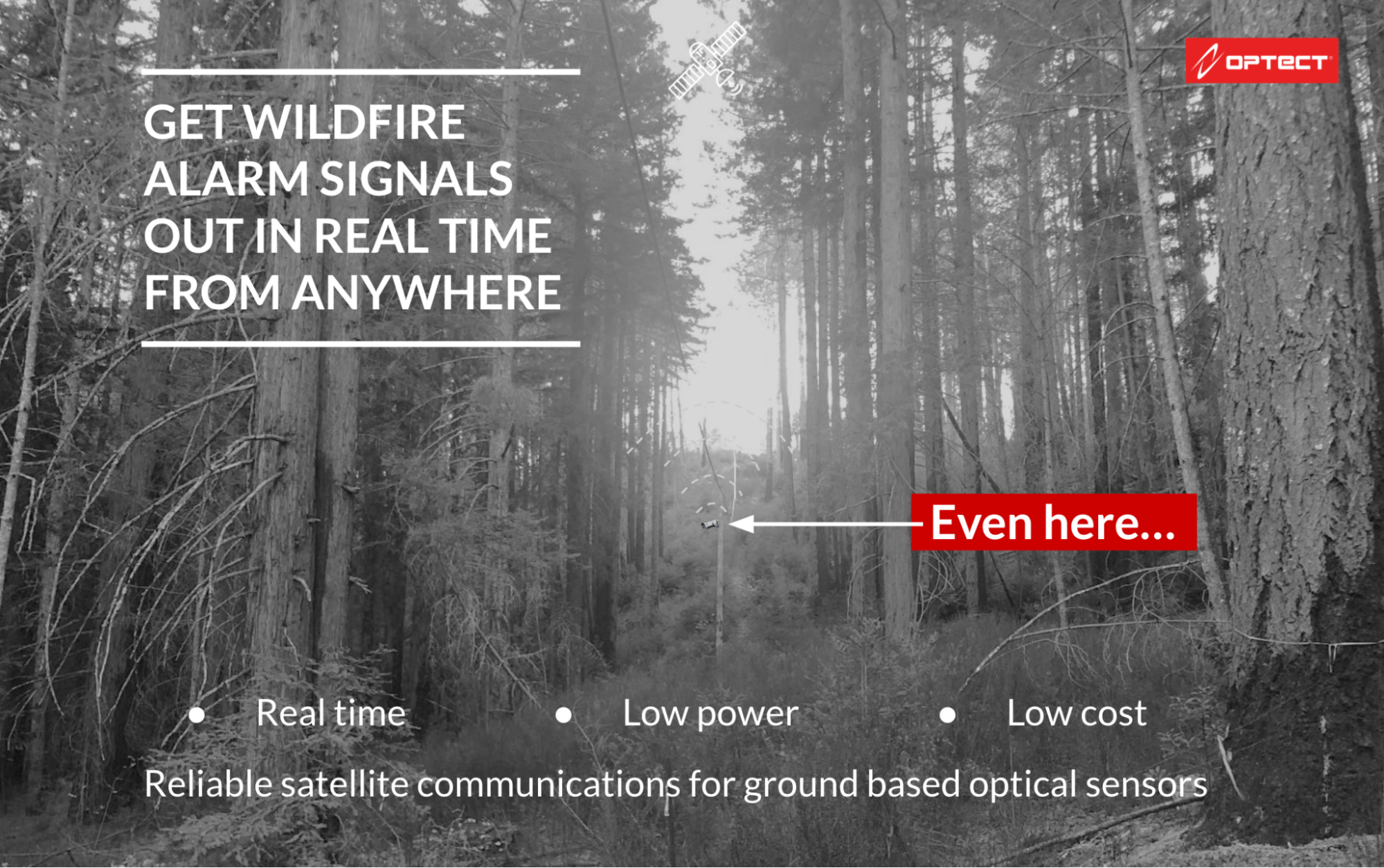
Customers are placing Optect wildfire detectors in remote and difficult-to-access locations and need real-time alarm signals transmitted reliably. Detectors are often installed where only partial sky visibility is available, making satellite communications unreliable. The only power source available is solar and battery power, so energy efficiency is important. The cost of communications hardware and ongoing fees must also remain low to ensure large-scale viability.
The project delivers these capabilities by combining device-to-device and device-to-satellite communications within one integrated system. Redundant paths are incorporated into the network so that each alarm can reach the cloud even if one route is blocked. Low cost satellite solutions are already available in key regions and are expected to be rolled out worldwide. Radio frequencies that penetrate dense vegetation and solid obstacles ensure that every detector transmits reliably regardless of its installation location.
Each detector connects to a compact electronics board sealed within an IP68-rated enclosure and running Optect’s embedded communications protocols. Priced at roughly $200 per unit with a service fee below $5 per month, the solution delivers reliable, real-time wildfire alerts in a practical, energy-efficient and highly affordable form that can be deployed at scale.
Users and their needs
The primary user communities for this system are asset managers in wildfire-prone regions, particularly those living or operating within the Wildland–Urban Interface (WUI) as well as infrastructure operators managing power lines, communication towers, and remote utility sites. These users, typically in the US, Canada and Australia, face direct and frequent exposure to wildfire risk and require dependable, real-time detection to safeguard lives and property.
Typical challenges include limited mounting points, obstructed vantage positions, and unreliable connectivity during wildfire events. The system therefore must function autonomously, maintain communication resilience, and deliver rapid, actionable information.
User needs can be summarised as follows:
-
Early and reliable fire detection to enable immediate response and minimise damage.
-
Operation from limited or obstructed vantage points, such as under tree canopies or near structures.
-
Robust communication, functioning even when cell coverage is weak or fails.
-
Real-time alerts to ensure threats are addressed before escalation.
-
Simple installation and low maintenance.
-
Scalability and integration with existing safety systems (e.g. suppression units, secondary detection equipment).
-
Rugged, weather-resistant hardware capable of withstanding harsh outdoor environments.
Service/ system concept
The system provides real-time wildfire detection and alerts to users, helping them respond quickly before fires spread. It continuously watches for signs of small flames and instantly notifies the user when danger is detected. The information supplied includes fire location, detection time and system maintenance alerts for each device.
Users gain the ability to see and react to fire threats immediately, even when they are away from the site. Alerts can be viewed on a mobile app, control panel, or monitoring dashboard, allowing rapid decisions such as activating sprinklers, sounding alarms, or calling emergency services.
In simple terms, each detector acts as an ultra-reliable fire watch. When a fire is detected, it sends a message through the network to the user’s system or phone.
At a high level, the architecture consists of:
-
Local detectors that sense flames or heat in real time.
-
A communication link (radio, satellite, or Wi-Fi) that transmits data securely.
-
A cloud or local gateway that collects and interprets alerts.

Space Added Value
The system uses Lacuna and Skylo satellite networks to ensure continuous connectivity for wildfire detection and alerting, even in remote areas where terrestrial networks fail. These space-based communication assets enable each detector to transmit real-time fire alerts, system status, and location data without reliance on cell coverage, which is often unavailable or disrupted during wildfires.
By combining Lacuna’s low-power IoT connectivity with Skylo’s real-time satellite links, the system achieves both broad coverage and rapid data transmission, adapting dynamically to site conditions and user needs. This hybrid satellite approach provides a level of resilience and reach unmatched by purely ground-based systems.
The added value lies in guaranteed message delivery, global accessibility, and resilience to fire-induced infrastructure failure. Competing fire-detection systems relying on cellular or Wi-Fi networks cannot maintain reliable communication during disasters. With space assets, alerts remain live and actionable, enabling immediate response regardless of location or terrestrial network status.
Current Status
Prototype development
Images to follow
Detailed requirements discussed with several key stakeholders in the wildfire community, including senior level wildfire advisors in Canada, Utility Companies and Property Wildfire Defense Firms. Work has started on the first prototype system.
Prime Contractor(s)