

Objectives of the service
The UAS market is one of the fastest-growing sectors, currently undergoing a phase of adaptation and standardization, particularly in the context of integration with manned airspace (the U-Space concept). European regulations (EU 2019/945, EU 2019/947) mandated operational risk assessment, which for most flights in the "Specific" category requires conducting the Specific Operations Risk Assessment procedure.
The core element of SORA is the determination of the Intrinsic Ground Risk Class (iGRC), which depends on the number of people exposed to danger in the event of a drone failure. At the start of the project, there was a lack of standardized, impartial, and dynamic data regarding population density. Operators relied on static census data or subjective estimates, leading to non-transparent authorization processes and overly conservative risk assessment.
The main goal for HOPE was to create a services defined as: "Data-driven input for Specific Operations Risk Assessment", which would:
-
Provide dynamic population density maps for a specified time and location, meeting the iGRC requirements (SORA).
-
Verify the service by obtaining positive feedback and acceptance from regulators (Civil Aviation Agencies, Air Navigation Service Provider) and users (UAS Operators).
-
Prove economic effectiveness and prepare the service for commercial introduction at a key moment of regulatory transition.
Marketing codename: "HOPE – Your fast track to SORA approval"
Users and their needs
HOPE is built to solve the key challenges identified by drone operators, CAA (Civil Aviation Authorities), and ANSP (Air Navigation Service Providers). We provide the solution to critical pain points through:
-
Objective iGRC Determination: Replacing subjective, time-consuming assessments with a data-driven, standardised analysis of population density.
-
Predictive Mission Planning: Offering the unique capability to forecast population density for missions planned weeks in advance, a feature currently unmatched by competitors.
-
GRC Mitigation Support: Providing direct guidance and tools for the most challenging step of the SORA process—the transition from Intrinsic Ground Risk Class (iGRC) to Final Ground Risk Class (GRC).
-
Suburban and Rural Optimization: Delivering population density layers calibrated for the suburban and rural areas where most BVLOS operations are planned."
Service/ system concept
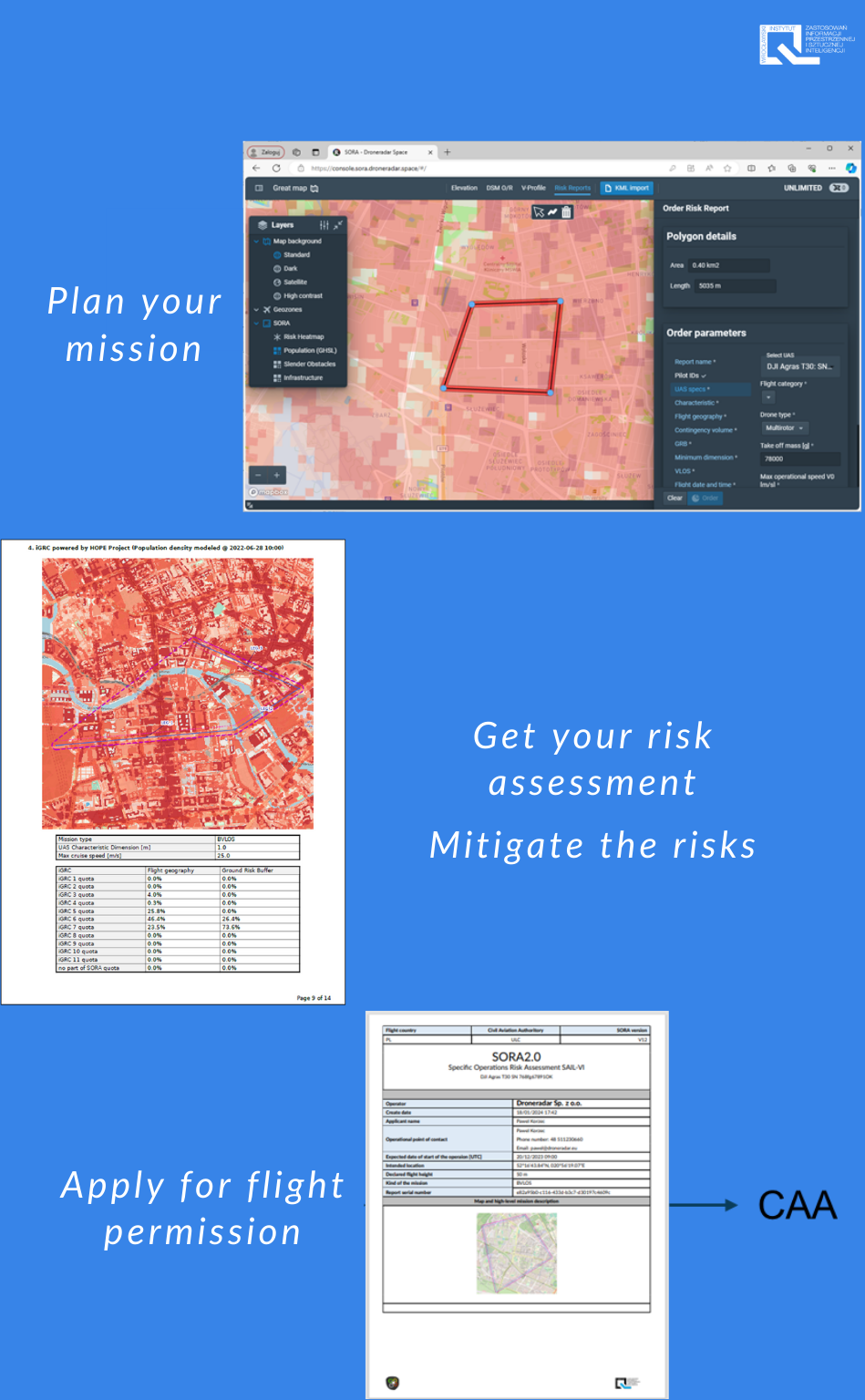
HOPE service guides UAS operators through four logical steps to streamline compliance with the SORA (Specific Operations Risk Assessment) methodology and secure flight permission.

Step 1: Know Your Potential iGRC
This is the initial phase where an operator determines the Intrinsic Ground Risk Class (iGRC) of the intended operation area.
-
Action: user interacts with HOPE portal to visualise population density layer calibrated for the area of interest.
-
HOPE Value: service uses GHSL+ population density data—recalibrated with Earth Observation assets like Sentinel-1 and Sentinel-2—to provide a high resolution data.
Step 2: Plan Your Mission in Details
Once the potential risk is identified, user defines the specific parameters of their flight.
-
Action: operator uploads their planned flight path (e.g., KML file) or draws the mission area directly within the portal. They input critical operational data, such as maximum flight speed and maximum height.
-
HOPE Value: system can use its unique population forecasting capability to predict density for missions planned weeks in advance, allowing for proactive risk management and mission time optimisation.
Step 3: Assess the Ground Risk and/or Prove Risk Mitigation Measures
This is the core risk assessment and mitigation stage, where HOPE provides its highest value.
-
Action: system generates a detailed risk assessment report, quantifying the risk based on the defined flight path and the population density data, as well as releases the known&planned mass-event waring.
-
HOPE Value: HOPE simplifies a challenging step of converting the Intrinsic Ground Risk Class (iGRC) to the Final Ground Risk Class (GRC). It provides the necessary data and guidance to select and prove appropriate risk mitigation measures, which is a key pain point identified by regulatory bodies like the CAA/ANSP.
Step 4: Apply for Flight Permission
The final step is leveraging the comprehensive data to secure regulatory approval.
-
Action: user utilises the generated risk report and associated documentation to apply for a flight permission from the Civil Aviation Authority (CAA).
-
HOPE Value: HOPE is marketed as the "fast track to SORA approval" because it provides all the data-driven inputs needed for an objective and predictable authorisation process, significantly reducing planning time.
Space Added Value
HOPE – Your fast track to SORA approval
HOPE is uniquely positioned as the tool that simplifies the complex SORA process, significantly shortening planning time and increasing the predictability of CAA/ANSP authorisation.
-
Key Product Differentiation:
-
Advanced Population Forecasting: an unparalleled ability to forecast density for operations planned weeks in advance.
-
iGRC → GRC Mitigation Support: Directly supporting the most difficult part of the regulatory approval process.
-
-
Space Asset Advantage: We leverage Earth Observation (EO) Space Assets to ensure unparalleled data accuracy. This includes:
-
Sentinel-1 (SAR Data): Crucial for technical validation by providing data on building cubature. This is essential to properly model population propagation and eliminate underestimations in densely built-up areas.
-
Sentinel-2 (Optical Data): Important source of data, ensuring information and validity through advanced processing layers."
-
Current Status
The HOPE – Human mObility PrEdiction project has concluded the Demonstrator phase with full operational success and has achieved all its objectives. HOPE has identified and successfully addressed a critical gap in the UAS operation value chain by providing standardised, dynamically modeled population density data essential for the objective determination of the Intrinsic Ground Risk Class (iGRC) according to the SORA methodology.
-
Technical Maturity Confirmed (Technical KPIs met/exceeded).
-
Market and Regulatory Validation Achieved (NPS 86%, strong willingness to purchase and critical CAA/ANSP support).
-
Unique Value Identified (population forecasting and iGRC→GRC support) at a critical moment for the UAS market.