


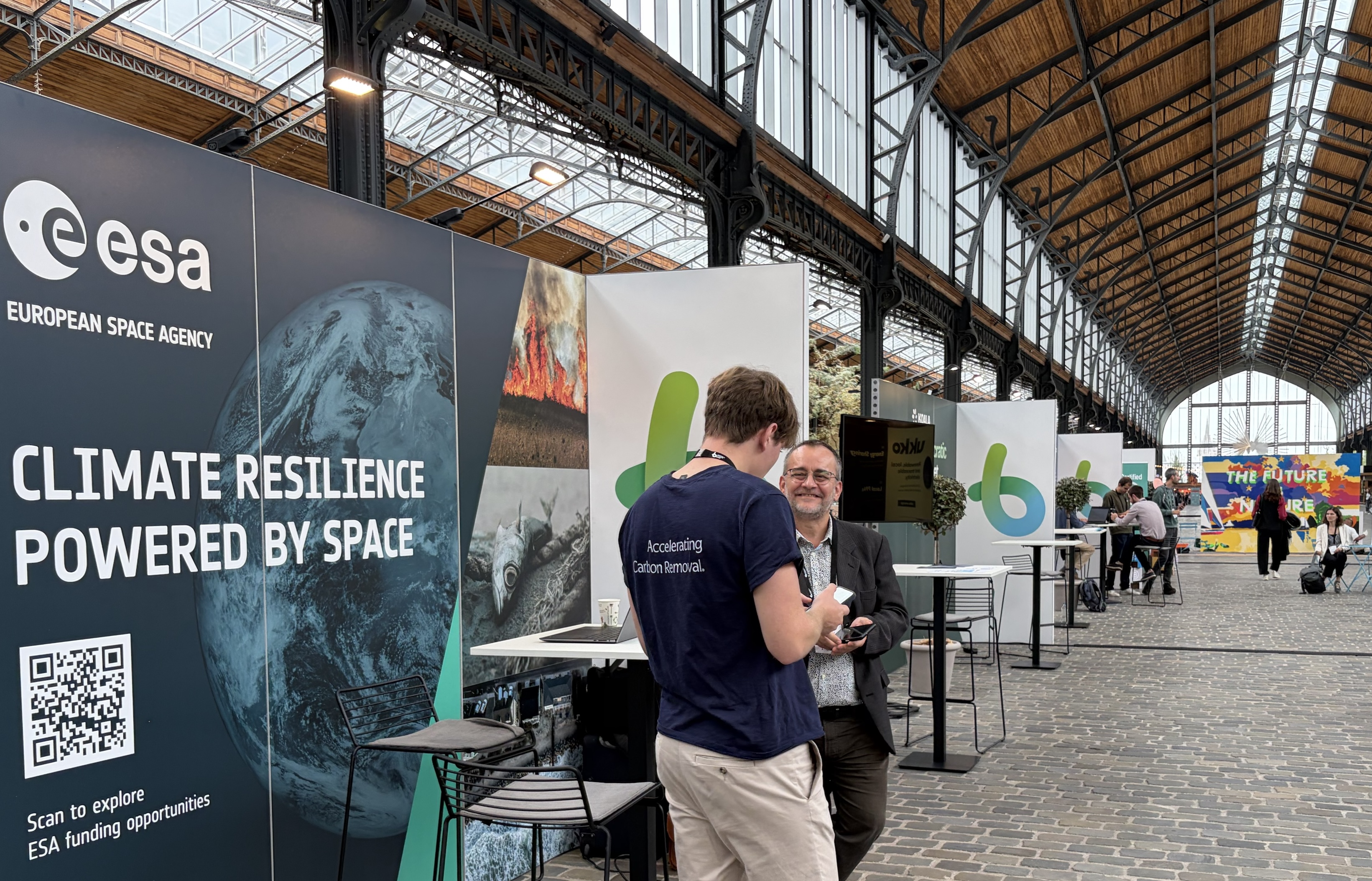
European institutions, Member States, industry, cities, investors and innovators converged on the Belgian capital for Brussels Climate Week 2026 12-15 October, to shape the future of Europe’s climate-industrial transition. ESA’s Business Applications and Space Solutions (BASS) team were there to share the many ways space can be part of the solution for the impacts of climate change.
The four-day event was built around five core themes: Tech & Innovation, Energy, Industry, Urban and Nature. It was an opportunity for the ESA BASS team to highlight the potential for space technology and data to mitigate across all these areas the impacts of climate change and to address environmental challenges.
BASS Climate Resilience Lead Liz Barrow took to the stage on Nature day, to share examples of how space-enabled solutions are already having a positive impact, and importantly to announce the ESA BASS Environmental Crimes funding call, which is opening for applications next week.
Ms Barrow said: “Climate change is impacting all sectors, from energy to agriculture, from fashion to sports, from cities to the oceans – for all these sectors, space can have a real, tangible role as part of the solution.
“Coastal erosion, forestry and illegal, unreported and unregulated fishing activities are some of the areas where our BASS projects are already making a big difference, while also supporting innovative European businesses, and helping them grow.
“Environmental Crimes are an important focal point for us in the coming year, with our new funding call opening next week. We will be inviting applications covering a broad scope, ranging from poaching and illegal mining to corporate greenwashing fraud – I look forward to seeing what comes through and the meaningful impact that we will be able to achieve together with these projects.”
There are many ways space data can be used both to both deter and intercept illegal activities but also to support good practise:
- Detect and monitor: for example using AI on satellite imagery to spot early access roads for illegal mining or canopy gaps from unauthorised logging.
- Track and trace: for example deploying satellite-connected tracking devices and geofencing to trace high-value commodities, regulated goods, or waste containers across international borders.
- Verify: For example using authenticated satellite location tags to independently prove that an agricultural cargo was grown on legally compliant land, protecting a retailer from greenwashing penalties.
To find out more about The Environmental Crimes funding call opening on 19 October, join us on 21 October for a webinar and Q&A.