



Objectives of the service
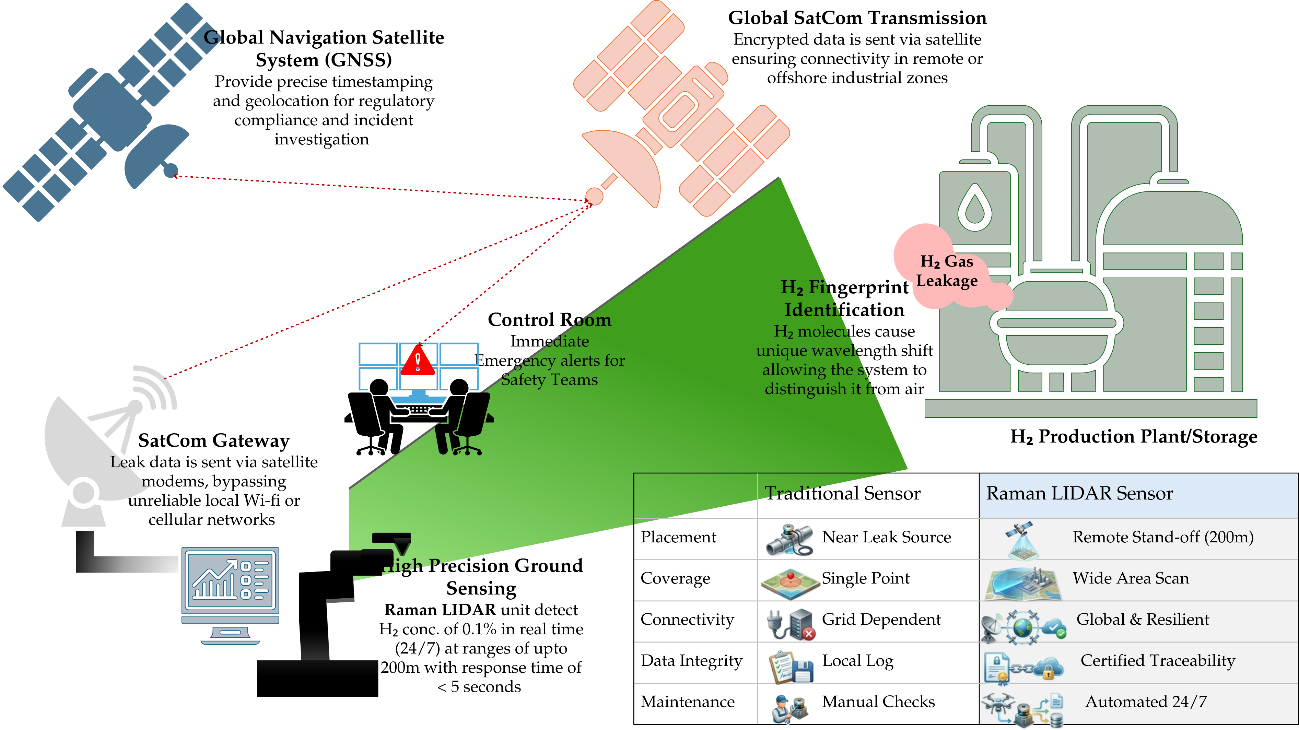
Industrial operators, safety regulators, and insurers face stringent compliance mandates but lack wide-area solutions for continuous hydrogen leak monitoring. Traditional point sensors offer limited spatial coverage and are unsuitable for expansive industrial environments.
To resolve this, the proposed service delivers a monitoring solution for early leak detection across clean-energy infrastructure. A ground-based, commercial off-the-shelf Raman Light Ranging and Detection system scans distances up to 200 metres to identify low-concentration hydrogen releases. This unit connects to a secure gateway, relaying real-time alerts via satellite communications to an encrypted cloud platform. The system aims to embed global navigation satellite system coordinates and timestamps to ensure regulatory traceability.
This 12-month study aims to validate sensor performance under controlled leak scenarios at Teesside University, verifying sensitivity and response times. Furthermore, the project will assess the required system architecture, user requirements, and defines a commercialisation roadmap. The activity aims to establish a pathway toward a full demonstration project, supporting Europe's transition to clean energy through enhanced industrial safety.
Users and their needs
The targeted user community consists of industrial hydrogen producers, pipeline operators, storage facility owners, safety regulators, and insurers located primarily in the United Kingdom and Europe. Active participants engaged during this study include regional network operators and clean-energy cluster stakeholders.
These communities have distinct operational and regulatory needs:
-
Early Leak Detection: Spotting hydrogen releases at less than 1% concentration within a 10-second window to protect personnel and assets.
-
Wide-Area Site Coverage: Monitoring expansive, open industrial assets continuously with minimal hardware maintenance and high uptime.
-
Data Traceability: Accessing secure, encrypted records embedded with location and timestamps for compliance auditing.
-
Commercial Scalability: Implementing safety systems under affordable subscription models to minimise upfront capital expenditure.
Meeting these needs presents several key challenges for the project. The team must manage optical signal noise from environmental dust and weather variability while maintaining laser radar calibration stability. Furthermore, the system should interface high-frequency sensor data streams with satellite gateways without protocol incompatibility and minimal message latency.
Service/ system concept
Information Delivered and User Capabilities
When deployed, the service provides industrial site operators, safety regulators, and insurers with a digital dashboard displaying clear safety insights. The system delivers automated leak alerts, gas concentration levels, and a traceable history of data.
Key features include:
-
Safety Alerts: Users receive notifications the moment a leak is spotted.
-
Records: Events include a timestamp and location data.
This capability transforms operational safety. Instead of relying on manual inspections or localised point sensors, operators gain continuous, wide-area visibility over their entire facility. This allows teams to isolate leaks, mitigate unplanned shutdowns, and prove compliance to regulators and insurers.
How the System Works
The system operates using a ground-based Raman LiDAR device which scans the air across the industrial site. If hydrogen gas escapes, the laser beam bounces off the gas molecules to identify the leak's size and location.
This detection unit passes the data to an on-site communication gateway. Because these facilities are often in remote areas, the gateway uses a built-in satellite link to beam the alert safely up to space and back down to a secure cloud platform. The cloud platform processes the information and displays it on the user dashboard.
Space Added Value
The service uses two primary space asset classes: Satellite Communications (SatCom) and Global Navigation Satellite System / Positioning, Navigation and Timing (GNSS/PNT). SatCom provides the resilient data path between the ground-based Raman LiDAR hydrogen detection unit, the AmbaSat gateway and the cloud reporting environment. This is particularly valuable for hydrogen production, storage, transport and refuelling sites where terrestrial connectivity may be unavailable, unreliable or vulnerable during abnormal events. GNSS/PNT provides trusted event location and time metadata for each detection, supporting traceability, incident reconstruction and compliance reporting.
The added value over conventional methods is not the sensor alone, but the combination of wide-area standoff detection, resilient communications and verifiable event records. Current approaches based on fixed-point sensors, manual inspection or terrestrial-only connectivity can leave coverage gaps, increase maintenance burden and reduce confidence in remote alerting. By combining Raman LiDAR sensors with SatCom and GNSS/PNT, the proposed service supports remote, scalable and auditable hydrogen safety monitoring across distributed industrial assets, improving operational resilience for operators, regulators, insurers and emergency responders.
Current Status
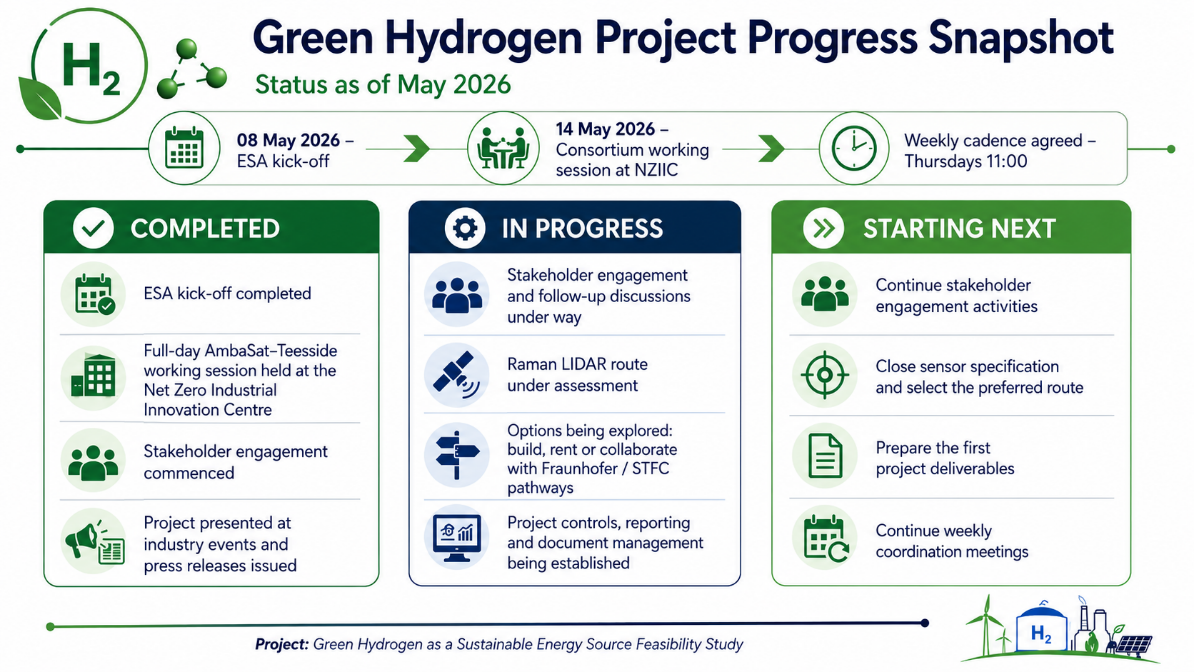
The project formally commenced with the ESA kick-off meeting on 08/05/2026. On 14/05/2026, AmbaSat and Teesside University held a full-day working session at the Net Zero Industrial Innovation Centre to review the ESA deliverable templates, project summary, Gantt chart, work packages, milestones and project web page requirements. Weekly project meetings have been agreed for Thursdays at 11:00, with SharePoint and Trello being set up for document control and action tracking.
Current work is focused on preparing the stakeholder questionnaire and confirming the Raman LiDAR route. Teesside University is assessing build and rental options, AmbaSat is approaching Fraunhofer. Next activities include stakeholder engagement launch, sensor specification closure and preparation of the first project deliverables.
Prime Contractor(s)

Subcontractor(s)
