



Objectives of the service
Microgravity-enabled life sciences have reached a stage where the supply side has advanced faster than
customer adoption. The study therefore asked not whether microgravity can produce scientifically
interesting results, but whether a service provider can turn those results into offerings that pharma and
biotech customers buy, use and repeat. It screened five microgravity life-science use cases across the drugdevelopment
lifecycle and examined two in depth: protein crystallisation for biologics formulation, which
connects to concrete Chemistry, Manufacturing and Controls (CMC) problems such as viscosity, particle
homogeneity, stability and syringeability; and 3D disease and translational models for oncology and central
nervous system (CNS) research.

Protein formulation showed the clearest near-term buying logic: a documented formulation limitation, a
recognisable budget owner in CMC and a published scientific benchmark. The objective of the service is to
help a pharmaceutical team determine whether microgravity crystallisation solves a valuable formulation
problem that the best terrestrial approaches cannot, and to deliver the evidence for a specific development
decision.

Users and their needs
The users are not “pharma” in general; the service maps to specific internal users, decision owners, budget owners and contracting routes. Interview evidence (pharma R&D leaders, biotech executives and supply-side providers) shows that large pharma organisations are complex and typically risk-averse, so a provider must enter through the right function and address a specific decision.
The priority users are the formulation, drug-product, analytical and biologics-development teams of pharma and biotech companies developing protein therapeutics with unresolved formulation constraints; CMC leadership is the likely economic owner. Merck, Bristol Myers Squibb, Eli Lilly, AstraZeneca and Sanofi have already flown experiments on the ISS. Platform biotechs are selective early adopters, CROs and CDMOs act as customers, analytical partners or channels, and translational teams working on oncology and CNS models form a later, selective collaboration track.
Core needs are: reaching a target concentration, lower viscosity, more uniform particles, easier delivery and better stability without losing molecular quality; evidence measured against the best terrestrial alternative, not only against an Earth control; and a low-risk, co-funded first engagement with a defined scope and decision. Customers engage only around tightly defined decisions.
Countries of the targeted users: Europe first, close to European pharma and biotech customers and aligned with European implementation pathways.
Service/ system concept
The service supplies customers with a comparative evidence package rather than a mission report. A staged campaign joins customer problem definition, terrestrial screening, experiment design, orbital processing, sample return and pharmaceutical analytics in one managed service. The package links the experiment configuration, a matched terrestrial (1g) control and the best optimised terrestrial comparator, telemetry, sample-handling records, returned-sample analytics and deviations, and interprets them against success criteria agreed before flight. It supports a GO, CONDITIONAL GO or NO-GO development decision. Value arises through an orbital production pathway, where the material cannot practically be made on Earth, or a discovery and translation pathway, where flight reveals a mechanism that improves a ground process.
The system is an end-to-end workflow: define the customer problem and target product profile; analyse the terrestrial limitation and alternatives; screen and develop methods on the ground; freeze sample allocation and qualify payload interfaces; run autonomous orbital processing; return and recover the material; perform comparative analytics; and review the evidence with the customer. The reference payload is SpacePharma’s Spactory module, with four independent cartridges of 2 L nominal liquid capacity each. Candidate hosts are the ISS or other crewed stations, return-capable free flyers, Space Rider (first flight planned for 2028) and future commercial stations. One accountable integrator coordinates the pharma design partner, payload, host and launch, return, analytics and quality roles.

Space Added Value
The space asset used is sustained in-orbit microgravity with controlled processing and physical sample return, accessed through hosted autonomous laboratories on crewed stations or free-flying platforms.
Reduced sedimentation and buoyancy-driven convection change transport and crystal growth, which can produce more homogeneous particle populations than terrestrial baselines; clinostats, random-positioning machines and short zero-g analogues do not fully reproduce long-duration microgravity growth.
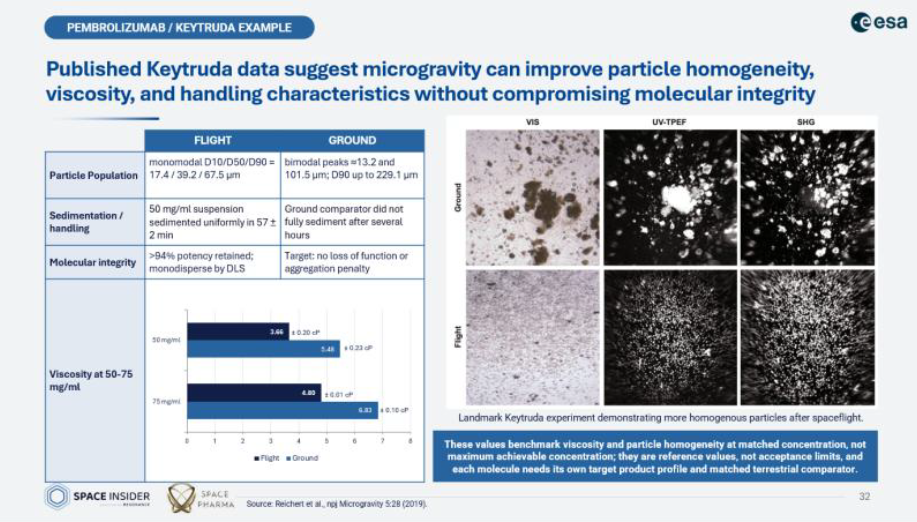
The clearest public benchmark is the published pembrolizumab (Keytruda) microgravity crystallisation study:
a monomodal flight particle-size distribution around D50 39.2 μm versus bimodal ground populations; lower flight viscosity at 50 and 75 mg/ml; uniform flight sedimentation around 57 ± 2 min; and binding activity retained above 94% relative potency. Later Earth experiments using rotation and thermal control also produced uniform crystals, showing both a real microgravity effect and how orbital insight can improve terrestrial processing.
The added value is therefore molecule specific. Each candidate is tested against a hierarchy of terrestrial comparators, from a matched 1g protocol to optimised crystallisation, the best conventional formulation and alternative administration routes. Returned material and a complete process record turn an orbital effect into decision-grade formulation evidence.
Current Status
The study was completed in October 2026. Phase 1 screened five use cases across six dimensions, selected drug formulation and 3D disease models as priorities, tested customer desirability and commercial viability through expert interviews and end-user deep dives, and mapped European supply-side capability, business models, market sizing, regulatory considerations and public and philanthropic funding. Its Business Case and Proof of Concept were accepted at the Business Case Review on 16 July 2026. Phase 2 refined the protein
formulation service, its comparator strategy and evidence requirements, and the final work package turned them into a demonstration mission blueprint.
The study concludes that a staged, customer-led protein formulation service is feasible and recommends a BASS Demonstration Project: a customer-led ground feasibility phase followed, once its entry gates are met, by an orbital demonstration. The first mission tests whether a microgravity advantage survives the best terrestrial alternatives, anchored on a published reference antibody alongside the design partner’s molecule. It runs in seven stages, from molecule and partner selection to the customer decision, with decision gates
that allow an early stop if a ground route meets the target. The funding plan combines ESA BASS co-funding for the space-specific share with life-science grants and in-kind contributions from space-infrastructure and pharma partners.
The next step is to recruit one or two pharma design partners and confirm the host before design freeze.

Prime Contractor(s)

Subcontractor(s)
