



Objectives of the service
Have you ever been stuck in traffic?
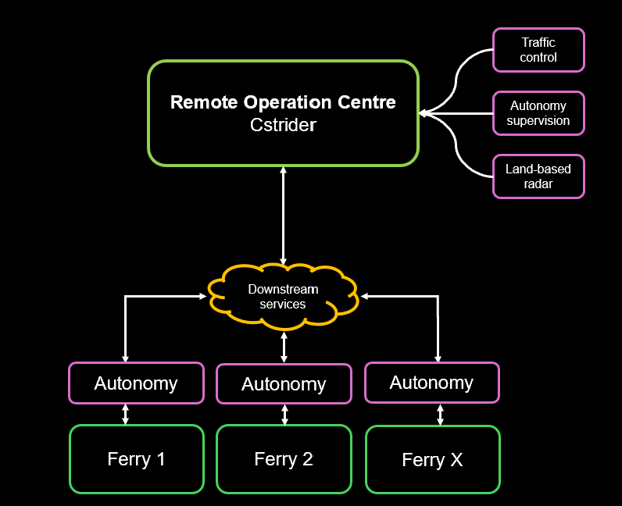
Water-based transport has been one of the most efficient ways to move people and goods for centuries. By reclaiming waterways through an energy-efficient and cost-effective system, including electric-powered passenger vessels and a shore-side control centre, Remote Operation Centre, we can create virtual bridges that reduce travel time, connect the city districts, generates new travel patterns and make waterfront areas more assessable. The Remote Operation Centre enables monitoring, controlling and supervising multiple vessels across different areas and cities.

With route optimization and on-demand operation capabilities of several vessels a control room could offer real-time situational awareness for safe and energy-efficient operations, including automated route planning, docking, and mooring. Continuous oversight via Starlink ensures real-time monitoring and faster incident response, reinforcing trust with regulators and the public. It also dramatically reduces reliance on scarce onboard crew.
This feasibility study evaluated the operational feasibility and value of supervising multiple potential autonomous electric ferries from a centralized Remote Operation Centre. The goal was to assess both technical and commercial viability of integrating systems and services into a multi-ship Remote Operation Centre.
Users and their needs
~75% of all European citizens lives in cities and 90% of those cities have waterways available in the city centres. Most of them are undeveloped when it comes to passenger transport. Cstrider’s main customer is European cities, transportation operators and real estate owners/developers. The end users are city residents and tourists. Cstrider contributes to accelerate electrification and reduce emission from transportation. Cstrider represents the future of urban passenger transport, offering a flexible and environmentally friendly solution that can be tailored to the unique needs of each city. By having a flexible system, we adapt to customized needs of each city.
For transport operators and cities, the Remote Operation Centre represents a pathway to:
- Scale autonomous ship operations across their fleet.
- Interface to city public transport traffic control
- Enable optimization of multimodal urban mobility and public transport
- Enable co-operation with un-automated traffic on inland waterways
- Reduce the cost of onboard crew while ensuring high safety standards through supervision.
- Enable operations in remote areas where mobile network coverage is limited or inconsistent.
- Comply with upcoming regulations requiring oversight of autonomous ships.
Service/ system concept
Our starting point was the Cstrider system design and strategy, which primarily leverages existing hardware and integrates in a new context with new functionalities and features. Vessel autonomy platform is one of them. The system is based on Cstrider expedient ship design and complete system optimization. The primary technical challenges for the Remote Operating Centre involve defining communication interfaces, finalizing downstream services, and designing the human-machine interface.
Space Added Value
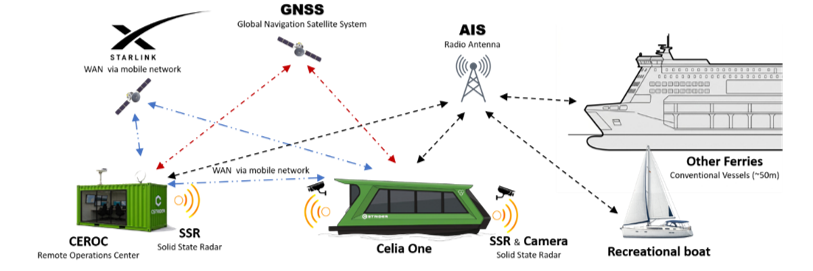
Our ships feature high levels of automation, supported by a shore-side traffic Remote Operation Centre. Leveraging advanced space technology, such as satellite communication and navigation. The project included redundant communications, precise positioning, situational awareness through electro-optical sensors, earth observation maps and land-based radar. Moreover, it also includes utilisation of sensor fusion to optimize ship fleet and route. We co-developed with partners and suppliers, focusing on the remote supervision layer to enable fleet coordination and optimization for energy and transport efficiency.
Current Status
Feasibility study; Completed and PoC validated
CEROC concept
Cstrider system was operated from CEROC, Cstrider multi-ship Efficiency Remote Operation Centre. From here you can control and monitor one or several vessels.
The CEROC can easily be fitted in a 20ft container to enable rapid deployment. It can also be installed in public transport traffic control centre or standard office.
The container-based system accommodates 1-2 certified operators that, by using multiple screens and joint fleet overview, supervises a fleet of up to 10 autonomous electric ferries at different locations at the same time - live video, Radar, AIS, chart and energy – all from one CEROC

Demonstration & PoC
A live test was performed with mixed simulated and two real vessels at different locations; one physically at CEROC demo location, one in Trondheim, Norway
During the validation, customers participated on-site, contributing to operational assessments and providing feedback.

Customer and user feedback emphasized the following key points:
- Clear operational overview and intuitive HMI layout
- Potential for scalability to larger vessel fleets
- Interest in participating in a full-scale demonstration project
- Positive feedback was received from suppliers, project partners and passengers visiting demo
Feasibility study result
- Automated ferry operations create new employment opportunities, including entry-level positions that do not require a university degree or extensive training. Working in a remote operation centre differs considerably from traditional seafaring roles and with CEROC we shaping the role of the next generation of seafarers.
- Business case for the CEROC supports a multi-ship system with > 5 vessels in the system, with outright sales as only option. One operator in the control centre is needed for every 3 vessels.
- Cstrider, Zeabuz and BTH have successfully completed a cross border multi-ship remote ferry operation demonstration and successfully validated how this concept increasing autonomy levels and improving situation awareness.


