



Objectives of the service
DecubiMat addresses the major challenges in long-term and outpatient care: high staff workload, time-intensive manual documentation, and the risk of pressure ulcers among immobile patients. Care facilities often struggle with limited personnel, rising administrative costs, and strict legal documentation requirements. The DecubiMat solution provides an automated pressure monitoring and documentation system based on optical cavity sensor technology that creates real-time 3D pressure distribution maps. Alerts and historical data are displayed via a centralized dashboard and integrated securely through the BLACKPIN application. This product and the associated service reduce manual repositioning and documentation work by up to 50%, enabling caregivers to focus on direct patient care while improving efficiency, compliance, and quality of life for patients. Relatives benefit from greater transparency and reassurance, while healthcare regulators gain reliable, encrypted, and audit-ready documentation. The DecubiMat feasibility study aims to validate the system’s effectiveness in real care environments, optimize the technology’s usability, and demonstrate measurable improvements in care quality, staff workload, and compliance with national healthcare standards.

Users and their needs
The DecubiMat solution targets stationary and outpatient care facilities (initially in Germany), including nursing homes, disability care, daycare centres, and rehabilitation clinics. These organizations and their staff are the primary users of the solution. The project activity directly involves caregivers, nurses, patients, and relatives. Validation and usability assessment are supported by academic partners.
Targeted user communities and needs:
Care facilities:
-
Reduce costs and workload related to pressure ulcer prevention and documentation
-
Ensure compliance with legal and data protection requirements
Improve efficiency in staff resource allocation
Care providers:
-
Automated repositioning reminders and continuous pressure monitoring
-
Simplified and faster documentation processes
-
Reduced physical and emotional strain through clear workflows
Patients:
-
Continuous, non-invasive pressure monitoring enabling early intervention
-
Improved comfort and reduced risk of pressure ulcers
Relatives:
-
Transparent and secure access to care-related information
-
Increased trust and reduced anxiety regarding care quality
-
Supporting accurate patient repositioning by providing artificial intelligence–driven instructions based on pressure distribution data.
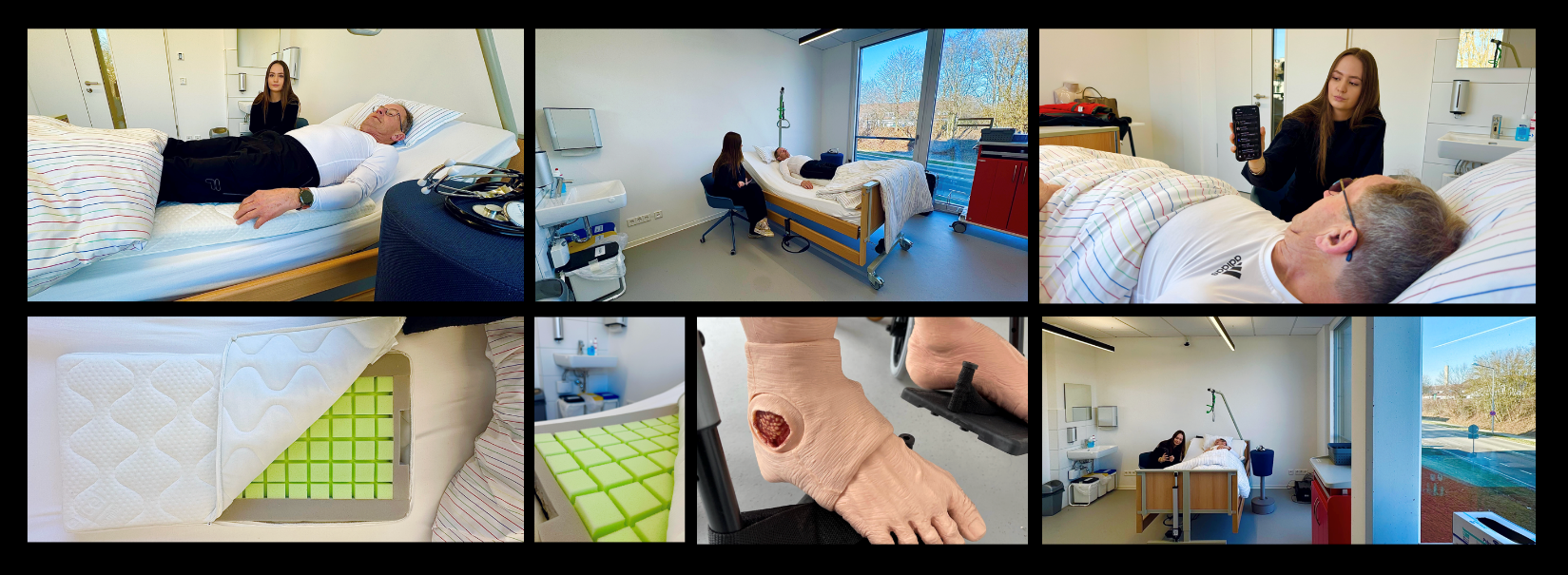
Key project challenges include integrating diverse user needs into an intuitive and easy-to-use system, achieving full regulatory and data protection compliance, and ensuring reliable monitoring and usability for non-technical care staff in daily practice.
Service/ system concept

DecubiMat is a modular, secure, and scalable platform for preventing pressure ulcers. It provides caregivers with real-time information about patient pressure points, movement patterns, and care recommendations. Users can view on pressure maps digital twins from the patients, receive live alerts, track patient repositioning, and document care activities securely through the cross-platform Flutter app or a centralized dashboard. The system works as follows: a sensor bed mat collects live pressure and movement data. The connectivity module transmits this data via Bluetooth to the AI data analysis software, which identifies pressure risks and movement types. Processed information is sent to the dashboard and the Flutter app, giving caregivers actionable guidance and notifications. The platform’s backend (BLACKPIN and Microsoft Azure) manages authentication, user roles, secure data storage, notifications, and system logs. A Matrix server ensures structured communication between front-end modules and backend. Firebase provides push notifications for timely care reminders. The system is accessible remotely via public internet, allowing secure monitoring from multiple devices.
Space Added Value
DecubiMat uses space-grade optical sensor technology from Kinotex. Kinesthetic Textiles is a hollow-space optical sensor, developed by Kinotex Sensor GmbH under contracts with NASA and the Canadian Space Agency (CSA) for integration in Canadarm2 on the International Space Station (ISS). This space-qualified sensor, with a TRL of 9, has demonstrated exceptional durability in extreme operating conditions, including temperatures from -90°C to +300°C, exposure to radiation, and mechanical stress.

For this project the target is to prevent pressure ulcers in healthcare. The optical cavity sensor provide high-resolution 3D pressure mapping, enabling real-time monitoring of patient positioning. This precision allows early detection of high-risk pressure areas and supports targeted repositioning to prevent ulcers before they develop.
The sensors are non-conductive, immune to electromagnetic interference, and highly durable, making them suitable for intensive clinical environments. Their flexible, mat-like design allows easy integration on various bed types without requiring specialized mattresses.
Compared to conventional electric pressure sensors, DecubiMat combines the sensor technology with GDPR-compliant documentation and TI-Messenger-compliant communication, offering live notifications, automated repositioning records, and seamless coordination through the app. This integration enables proactive, efficient care while reducing manual documentation effort.
By combining space-grade sensors with secure digital communication, DecubiMat delivers a modular, regulation-aligned solution that surpasses current systems in precision, reliability, and flexibility, specifically tailored to the needs of long-term and outpatient care.
Current Status

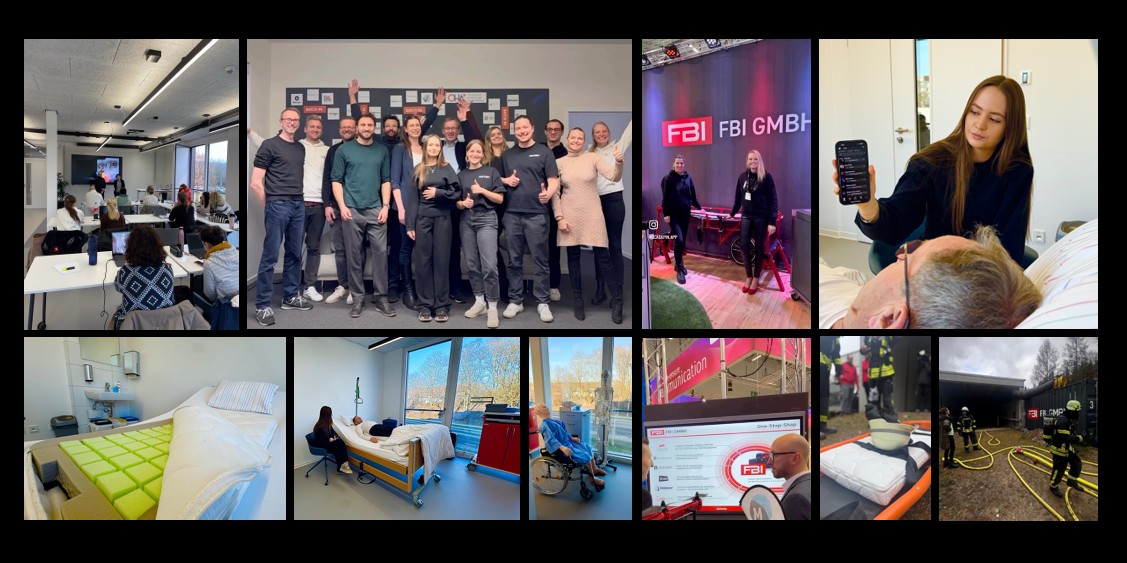
Kicked off in October 2025, the Feasibility Study is currently in the system integration phase. Key achievements include the final handover of the UI/UX documentation to developers, reaching 75% implementation of the AI turn-detection pipeline, and completing the mattress sensor layout in calendar week 6. We also finalized the Azure infrastructure setup and designed the gateway for communication between the AI and Blackpin apps. A reporting shooting also took place with SWR as part of the tunnel rescue operation using the Sensor Bed Mat. In this context, we exhibited the mat at PMRexpo. Currently, work is focused on conducting local mock tests of the software infrastructure and setting up the IoT architecture. In the coming weeks, the team will deploy the repository in a new resource group and conduct initial tests of the first sensor series put into operation for the proof of concept implementation. The Mid-Term Review took place on 30 March 2026 and was successful. Next milestone is the Final Review and is expected by June 2026.
Prime Contractor(s)

Subcontractor(s)
