

Objectives of the service
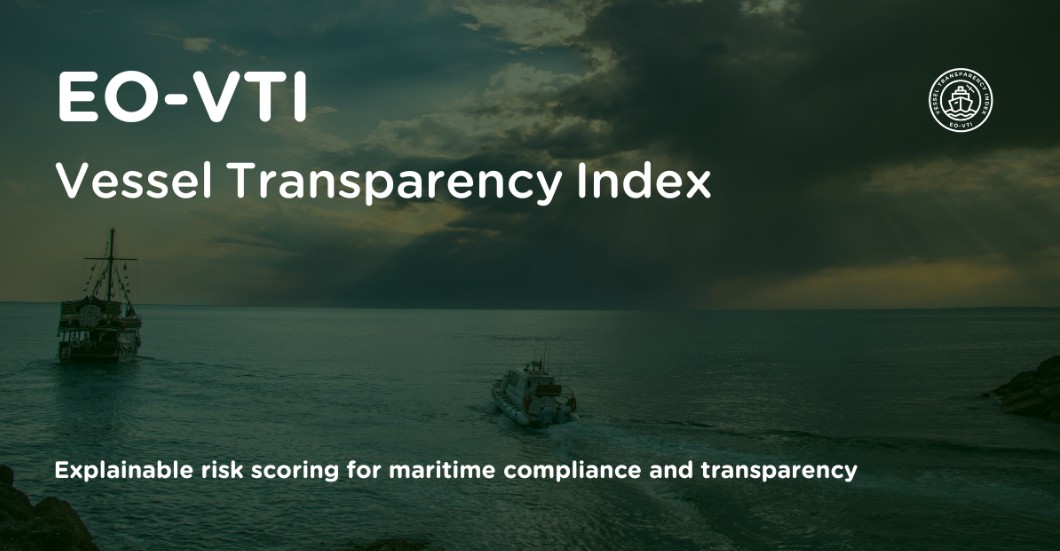
The Vessel Transparency Index addresses a lack of transparency in global maritime activity. Insurers, financial institutions, regulators, and commodity traders rely heavily on Automatic Identification System data to understand vessel behaviour, yet this data can be switched off, manipulated, or spoofed. This creates blind spots around sanctions evasion, illicit trade, unreported emissions, and disputed insurance claims, while Earth Observation satellite data remains difficult to access and operationalise at scale.
In collaboration with an industry partner, EO-VTI provides an Earth Observation-enhanced Vessel Transparency Index that combines satellite imagery with vessel tracking and behavioural analytics to produce explainable, evidence-based risk insights. With the Vessel Transparency Index users can discover, visualise, and interpret satellite evidence alongside existing vessel data within a single operational workflow. The service supports both retrospective investigation and near-real-time monitoring, while communicating data confidence and limitations.
The feasibility study for the Vessel Transparency Index defines user-driven workflows, technical architecture, and performance metrics; it delivers a demonstrable proof of concept and produces a costed roadmap for a follow-on demonstration project that enables commercial deployment.
Users and their needs
The service targets maritime risk and compliance professionals who require reliable, evidence-based insight into vessel behaviour but are constrained by incomplete or manipulated tracking data.
Targeted user communities and countries include:
-
Maritime insurance companies (United Kingdom, Norway, Singapore)
-
Trade finance institutions (United Kingdom, Europe, Singapore)
-
Commodity traders (United Kingdom, Europe)
-
Government regulators (United Kingdom, Europe)
User needs include:
-
Independent verification of vessel location and activity when Automatic Identification System data is missing, spoofed, or unreliable
-
Timely access to satellite evidence to support claims investigation, sanctions screening, and compliance decisions
-
Clear, explainable outputs that show confidence levels, data gaps, and limitations
-
Integration into existing operational tools without requiring specialist Earth Observation expertise
Key challenges include:
-
Variable satellite coverage, revisit time, and weather constraints
-
Balancing cost, latency, and resolution of Earth Observation data
-
Translating complex satellite data into usable, decision-ready insights
-
Ensuring transparency and trust in risk scoring methodologies
We collaborate directly with insurers and trade finance users to validate workflows, technical feasibility, and usability within real operational constraints.
Service/ system concept
The service supplies users with insight into vessel behaviour by combining Earth Observation data with existing vessel tracking and historical records. Users can see where a vessel was likely operating, whether its reported movements are reliable, and what evidence supports that assessment. The service highlights suspicious behaviour such as unexplained tracking gaps, deceptive routing, or high-risk interactions, and presents the findings with confidence indicators and supporting evidence.
When deployed, users can search for vessels or events, trigger satellite evidence around periods of interest, view imagery and timelines alongside vessel data, and receive an explainable transparency score that reflects data quality, coverage, and risk. The service supports both historical investigation and ongoing monitoring.
At a high level, the system combines satellite data sources, vessel tracking data, and analytics services into a single workflow, delivered through an industry partner’s platform, so users can access all critical information within one interface.
Space Added Value
The service uses a combination of space-based vessel tracking and Earth Observation satellite assets to provide insight into maritime activity. This includes exactEarth (Spire), ORBCOMM, Sentinel-1 (AIS on S-1), Sentinel-2, and Landsat 8/9. We will also make use of a large range of commercial data provided by SkyWatch and other Earth Observation data providers.
Space-based AIS enables global vessel tracking beyond the ~40 km range of terrestrial AIS receivers, which is critical for detecting long-range spoofing or dark operations. Terrestrial AIS receivers can also be switched off, spoofed, or manipulated. Satellite Earth Observation provides direct evidence of vessel presence and behaviour.
This approach enables more reliable and holistic compliance, risk assessment, and emissions transparency than existing solutions that depend on single data sources or post-incident manual analysis.
Current Status

The project has completed its kick-off and onboarding phase. European Space Agency project systems and cloud infrastructure accounts have been set up, the core delivery team has been onboarded, and coordination with our primary industry partner has been established.
Initial technical progress includes the early development of a backend Earth Observation data pipeline, and we have started to engage data providers to broaden coverage and reduce supply risk. System architecture work has also begun, including the setup of Amazon Web Services infrastructure.
Our current work in progress focuses on data scoping, architecture definition, and customer workshop 1.