

Objectives of the service

HotPay aims to develop and validate a satellite-enabled heat index service designed to support the development of heat-based parametric insurance products.
Extreme heat is one of the fastest-growing climate risks globally, affecting sectors such as agriculture, livestock, outdoor labour, and small businesses. However, the scalability of parametric insurance for heat risk is currently limited by the lack of reliable, spatially consistent, and independently verifiable indicators that can trigger payouts.
The objective of the service is therefore to generate satellite-derived heat indicators that are:
-
spatially explicit and independently verifiable
-
suitable for insurance trigger mechanisms
-
scalable across regions with limited ground weather infrastructure
-
integrable into digital parametric insurance platforms.
The service focuses on indicators such as consecutive days above defined temperature thresholds and other heat-stress metrics that can be used to automatically activate insurance payouts.
The initial validation will focus on India, a country highly exposed to extreme heat events, providing a relevant environment to test both technical feasibility and operational usability of the service.
Users and their needs
HotPay serves a multi-layered ecosystem where beneficiaries of payouts differ from customers who pay for the service. The Kick-Start focuses on validating requirements for paying entities while ensuring relevance to end users.
Primary users (payout beneficiaries):
-
Agricultural producers (priority): dairy farmers and livestock owners exposed to heat stress, causing measurable productivity loss without physical asset damage. Initial testing focuses on cattle farms.
-
Outdoor urban workers (priority): construction workers, gig workers, and informal laborers in cities, directly impacted by heat-induced income loss. Daily temperature exceedance aligns naturally with parametric triggers.
-
Secondary users: Industrial operators, such as factories or data centers, are explored for operational disruptions but are not the primary focus.
Customers (paying entities):
-
Parametric insurance platforms: parametric players integrate EO-derived indices into digital workflows, enabling scale across insurers, products, and geographies.
-
Insurance and reinsurance companies: require reliable indices to reduce disputes, improve actuarial confidence, and enable deployment in data-scarce regions.
-
Distribution partners and public actors: cooperatives, microfinance institutions, and organizations may act as intermediaries, co-funders, or early deployers, supporting adoption in vulnerable populations.
HotPay ensures both operational relevance for end users and technical, auditable indices for paying customers, making the service verifiable, scalable, and commercially viable.
Service/ system concept
HotPay transforms satellite thermal observations into insurance-ready heat indices through an automated Earth Observation processing chain.
he system integrates satellite thermal datasets with contextual land and environmental information to produce spatially explicit indicators that can be directly linked to insurance trigger conditions.
The processing workflow includes:
-
automated ingestion of satellite thermal datasets
-
Thermal data sharpening and Land Surface Temperature processing
-
integration with land cover and vegetation context
-
definition of heat indices (e.g. consecutive days above critical thresholds, including using humidity)
-
spatial aggregation to insurance-relevant units
-
historical validation against past heatwave events.
The resulting indicators are delivered as structured datasets that can be integrated into parametric insurance platforms for trigger monitoring and event verification.
The architecture is designed to be scalable across regions and compatible with digital insurance infrastructure, enabling repeatable monitoring without reliance on ground sensor networks.
Space Added Value
The service relies on satellite Earth Observation as the primary data source, enabling large-scale monitoring of extreme heat events.
HotPay primarily uses data from Sentinel-3 for land surface temperature measurements, complemented by contextual information from Sentinel-2 and additional historical datasets such as Landsat Program where necessary.
Satellite data provides several critical advantages for parametric insurance applications:
-
consistent spatial coverage, including regions with limited weather stations
-
independent verification of heat events
-
historical time series for index calibration
-
transparent and auditable data sources suitable for financial products.
By leveraging space infrastructure, the service enables the creation of robust
Current Status
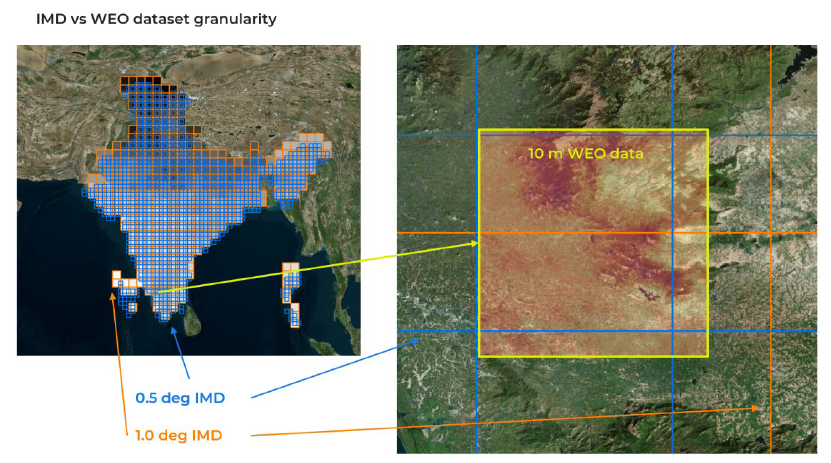
The HotPay project is currently at the feasibility study stage within an ESA Kick-Start activity.
The ongoing work focuses on validating the technical, operational, and economic feasibility of a satellite-enabled heat index service for parametric insurance.
Key activities include:
-
definition of user requirements with insurance and insurtech stakeholders
-
development of a prototype EO processing chain for heat index generation
-
historical validation of satellite-derived indicators using past heatwave events in the areas of interest
-
assessment of commercial and market viability.
The activity aims to deliver a technically validated service concept and a clear pathway toward operational deployment.
Following the feasibility phase, the project is expected to progress toward demonstration and commercial implementation, initially targeting heat-risk insurance solutions in India with potential scalability to other climate-vulnerable regions worldwide.
Prime Contractor(s)