
Objectives of the service
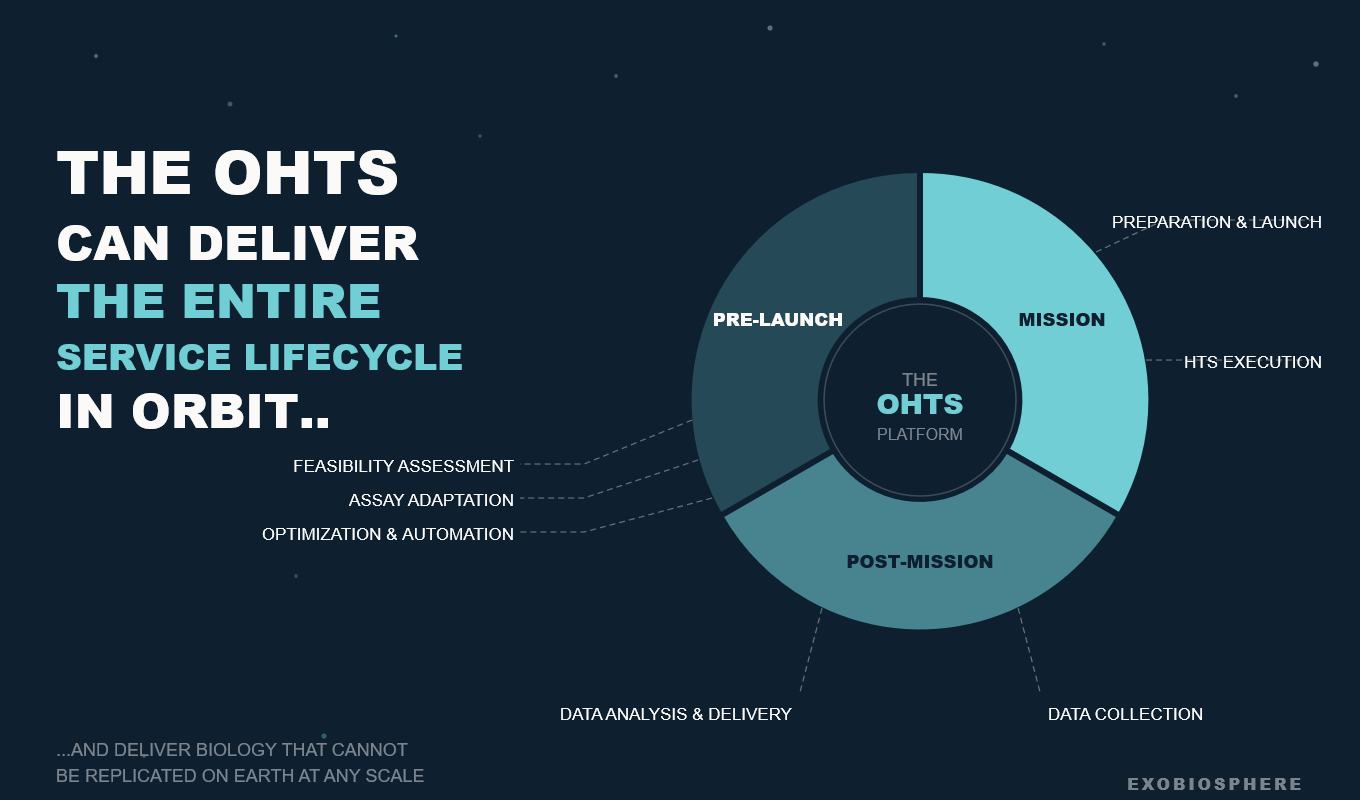
development: standard terrestrial models, rodent systems and conventional two-dimensional cell cultures, fail to replicate human disease biology with sufficient fidelity, contributing to high attrition rates and wasted research investment. Researchers need access to more physiologically relevant biological models, but no commercially available platform currently combines the unique properties of microgravity with the throughput and automation required for iterative drug discovery.
Exobiosphere addresses this with the Orbital High-Throughput Screening (OHTS) platform as a commercial service aboard crewed space stations. OHTS enables customers to run automated, high-throughput cell culture experiments, drug screening and tissue modelling, in microgravity, using standard laboratory formats compatible with existing workflows. The service delivers scientifically validated, decision-ready biological data that cannot be replicated by any terrestrial platform, regardless of scale.
The Microgravity Automated Screening and Tissue Modelling (MAST) feasibility study defines the use cases, validates customer requirements, assesses the technical readiness of the platform, and establishes the commercial and business model foundations needed to bring the service to market.
Users and their needs
Exobiosphere has directly engaged 16 potential customers across four therapeutic areas, spanning academic research centres, clinical institutions and commercial biotech companies across Europe and North America.
Neuroscience and Ageing
Research groups focused on neurodegeneration require more physiologically relevant preclinical models than conventional rodent systems or two-dimensional cell cultures can provide. Microgravity accelerates neural organoid maturation, compressing years of disease progression into commercially viable campaign timelines.
Oncology
Researchers require three-dimensional tumour models that replicate in vivo solid tumour architecture for compound screening and cancer stem cell research.
Cardiovascular and Regenerative Medicine
Researchers are pursuing human induced pluripotent stem cell (iPSC)-derived cardiac models and biofabrication of tissue constructs that demand maturation conditions beyond what terrestrial platforms offer.
Across all user groups, shared needs are:
-
Automated, repeatable high-throughput experiments in microgravity
-
Accelerated disease model timelines at commercially viable cost
-
Pharma-compatible data formats and quality standards
-
Assays compatible with existing laboratory workflows
The primary challenge is delivering these capabilities within a single, accessible, end-to-end service.
Service/ system concept
Exobiosphere delivers a fully managed, end-to-end orbital research service. Customers supply biological samples, compounds and a research brief. Exobiosphere handles everything else: from experiment design on the ground, through fully automated execution in orbit, to delivery of analysis-ready results.
At the heart of the service is the Orbital High-Throughput Screening (OHTS) platform: a compact, autonomous laboratory operating aboard commercial space stations. OHTS simultaneously runs numerous parallel individual experiments. A robotic system handles all cell maintenance, nutrient exchange, and measurements without crew involvement. A mirrored ground control system runs identical conditions on Earth, enabling direct comparison of microgravity and normal-gravity outcomes.
Customers receive three complementary data outputs: quantitative plate reader readings capturing cell viability and experiment endpoints; brightfield and fluorescence microscopy images tracking cell behaviour over time; and continuous environmental telemetry confirming experimental conditions throughout the mission. Physical samples are returned post-flight for deeper molecular analysis where required.
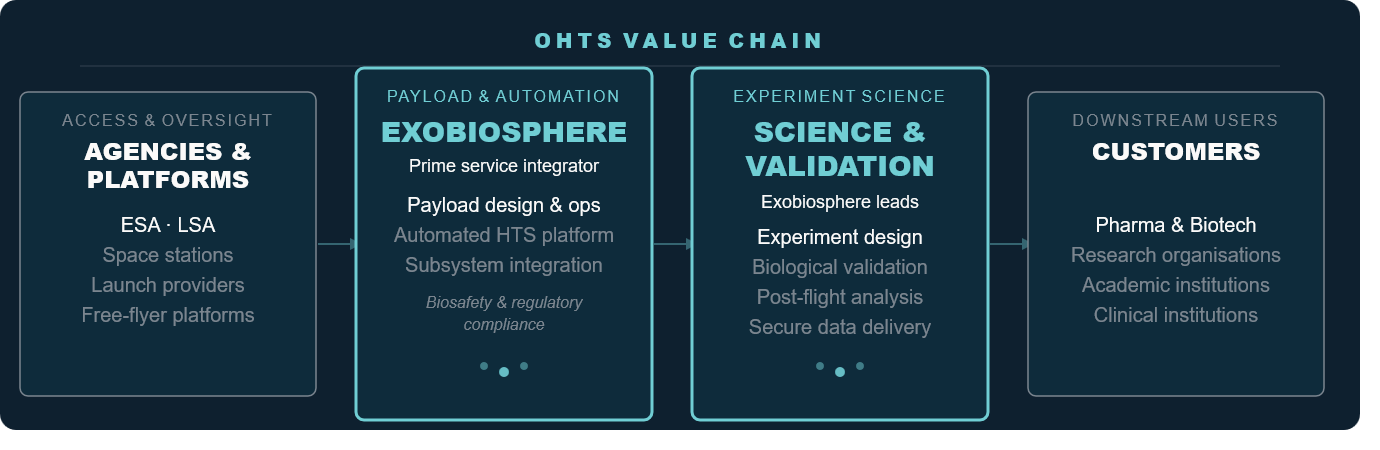
The service spans four linked value chain stages, from agency oversight and platform access, through payload operation and experiment science, to results delivery across pharma, biotech, academic, and clinical sectors.
Space Added Value
The OHTS service operates from commercial platforms in Low Earth Orbit (LEO) and is built on a single irreplaceable asset: microgravity. The near-complete absence of gravitational forces creates biological conditions that cannot be reproduced on Earth, not by rotating bioreactors, clinostats or any simulated microgravity system.
Microgravity delivers three scientifically distinct advantages. First, it accelerates disease progression: neural organoids exhibit years of neurodegenerative pathology within weeks, and cardiac models achieve maturation markers that take months to develop terrestrially. Second, cancer cells spontaneously self-organise into three-dimensional tumour structures that more closely resemble in vivo architecture than any ground-based culture system. Third, microgravity removes the gravitational forces that constrain three-dimensional tissue formation on Earth. Without these forces, cells assemble into structurally complex constructs without scaffolding and stem cells expand, opening routes to cell therapy and regenerative medicine that Earth-based methods cannot.
Compared to terrestrial alternatives (organoid platforms, organ-on-chip systems and AI-driven drug discovery tools) none can produce this class of data. Competing space platforms lack the throughput and automation to deliver it at commercial scale. OHTS is the only platform combining true microgravity with fully automated, pharma-grade high-throughput screening, generating biology that no ground-based method can replicate.
Current Status
The study commenced in February 2026 and reached its first progress milestone (MS1) in June 2026, approximately three months into the nine-month programme. Initial findings covering use case definition, customer engagement and technical platform feasibility have been compiled and submitted to ESA. Market and competitive analysis is ongoing; the business case will be consolidated at the Business Case Review milestone, currently scheduled for August 2026.
Prime Contractor(s)