

Objectives of the service
Maritime security operators including port authorities, coast guards, and naval forces face a common and growing problem: the data they rely on cannot be trusted. Automatic Identification System (AIS) vessel tracking signals are routinely spoofed or manipulated, radar and satellite feeds arrive from multiple disconnected systems, and no shared framework exists to assess or coordinate across these sources in real time.
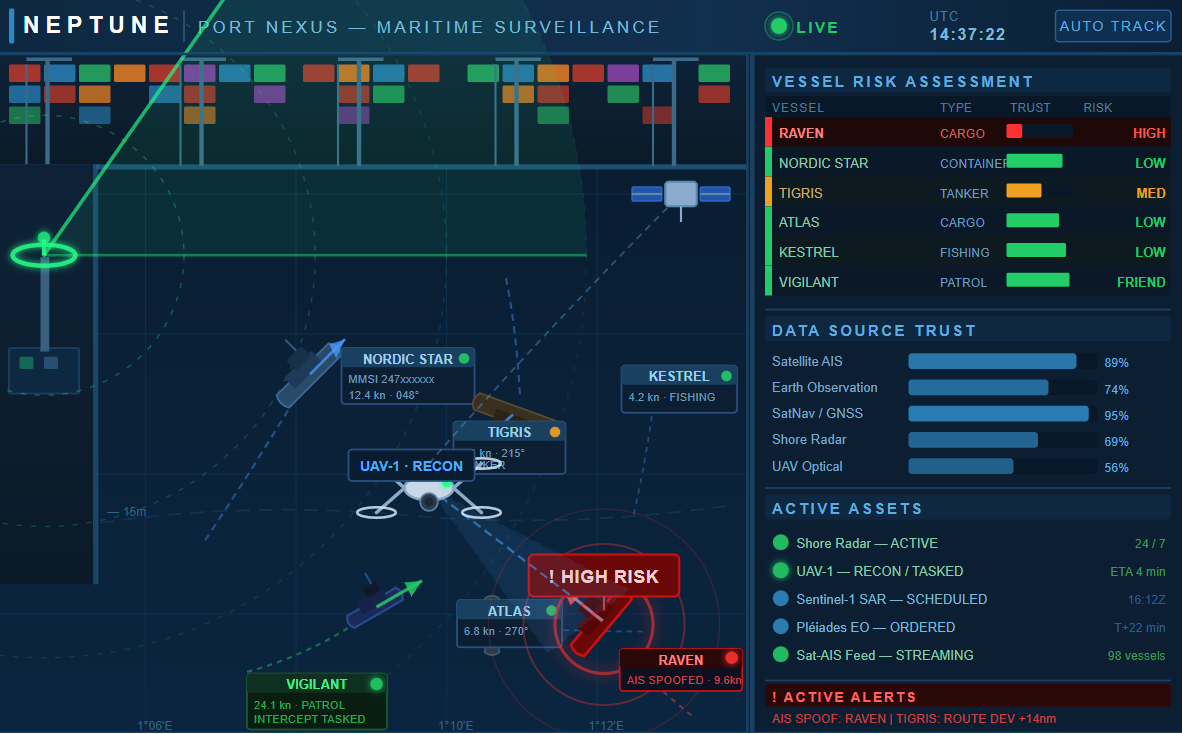
NEPTUNE addresses this by fusing AIS, radar, and satellite imagery through a dynamic trust model that continuously evaluates the reliability of each data source and its provider. When a vessel's risk score exceeds a configurable threshold, the platform autonomously tasks drone reconnaissance missions to gather additional information and reduce uncertainty, closing the loop without manual intervention.
The feasibility study examines two critical questions: whether a viable commercial route to market exists for civilian Vessel Traffic Management System (VTMS) operators alongside the existing security application; and whether the system remains technically robust in environments where Global Navigation Satellite System (GNSS) jamming or spoofing could compromise drone positioning and AIS data integrity. The project delivers market analysis, a detailed technical architecture, and proof-of-concept demonstrators validating the core approach.
Users and their needs
The primary users targeted by NEPTUNE are harbour masters and port operators responsible for vessel traffic management in high-throughput commercial ports, maritime security and law enforcement agencies operating in UK and European coastal waters, including HM Coastguard, Border Force, port state control authorities, and naval/maritime patrol units.
These users share a common operational challenge: current maritime surveillance relies on Automatic Identification System data that is increasingly subject to spoofing, jamming and deliberate manipulation by non-compliant or hostile vessels. Existing tools treat each sensor feed in isolation and provide no integrated confidence measure for the data presented to operators.
Key user needs identified through stakeholder engagement are:
-
A single fused operational picture combining AIS, radar, satellite imagery and drone reconnaissance
-
Automated flagging of vessels exhibiting anomalous behaviour or AIS inconsistencies
-
Confidence-scored alerts that distinguish genuine threats from sensor noise
-
On-demand drone tasking triggered directly from the surveillance interface
-
Standards-compliant data sharing with partner agencies (OARIS, TACSIT, ALMAS)
NEPTUNE addresses these needs through a dynamic, probabilistic trust model applied continuously across all incoming data streams.
Service/ system concept
NEPTUNE delivers a fused maritime surveillance picture to operators through a web-based dashboard, combining data from multiple sources into a single, confidence-scored vessel risk assessment. Rather than presenting raw feeds, the platform applies a dynamic trust model that weighs each incoming data stream: satellite AIS, shore radar, Earth Observation imagery, GNSS positioning and drone reconnaissance, according to its timeliness, consistency and historical reliability. The result is a continuously updated risk score for every tracked vessel, with automated alerts for anomalous behaviour such as AIS spoofing, unexpected course deviations or entry into restricted zones.
When a vessel is flagged as high-risk, operators can manually or automatically task an autonomous drone directly from the interface to obtain optical confirmation. Drone imagery is ingested and scored alongside the existing data streams in near real-time.
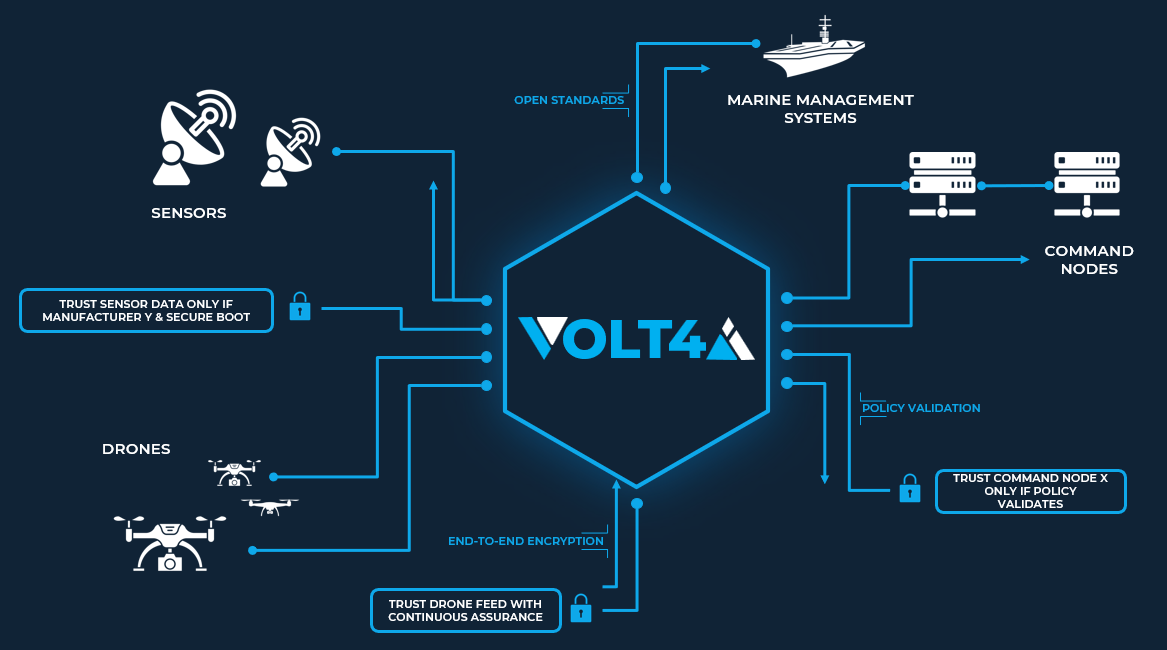
At the system level, NEPTUNE is built on NquiringMinds' Volt4AI distributed data-sharing platform, which brokers data between sensors, analysis modules and operator terminals without centralising raw data. Integration with the existing marine systems ensures outputs are formatted to compatible standards enabling seamless sharing with partner agencies and command systems.
Current Status
NEPTUNE integrates four categories of space asset, each contributing a distinct and complementary capability that cannot be replicated by terrestrial means alone.
Satellite AIS provides near-global vessel identity and position reporting, extending coverage far beyond the range of shore-based receivers and eliminating the blind spots that vessel operators can exploit by operating in open water before entering a monitored zone.
Earth Observation, drawing on Sentinel-1 SAR, Sentinel-2 optical, and commercial providers including Airbus Pléiades and Earth-I, supplies independent, physics-based confirmation of vessel presence and position. This is the critical counter to AIS spoofing: a vessel cannot falsify its radar cross-section or optical signature from space.
Satellite navigation (multi-constellation GNSS via Septentrio Mosaic-H) provides the precise timing and positioning reference needed to correlate data streams from geographically dispersed sensors and to accurately geo-locate drone-acquired imagery.
Satellite communications (Honeywell/Inmarsat BGAN L-band) enables drone uplink and real-time data relay in offshore areas where terrestrial connectivity is unavailable, ensuring the surveillance picture remains complete regardless of operating range.
The combination of these assets within NEPTUNE's trust model produces a level of detection confidence that no single-sensor or terrestrial-only system can match.
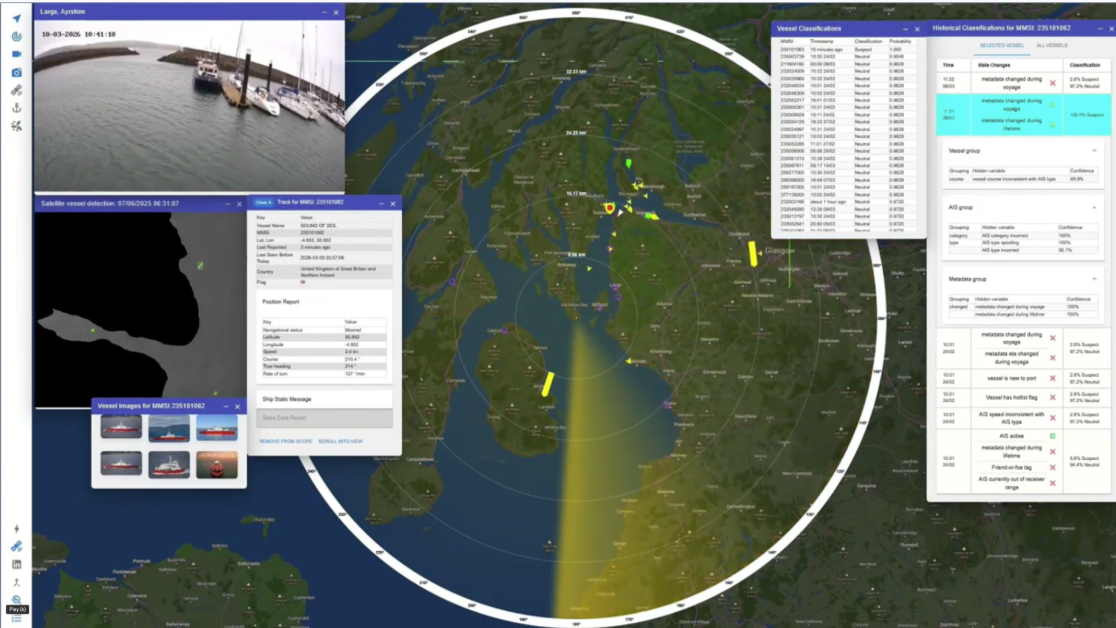
NEPTUNE draws on a substantial existing technology baseline. NquiringMinds' Volt4AI platform, a fully distributed, cyber-secure data-sharing and analytics product in active deployment, provides the direct architectural foundation for the system. Its distributed brokering model, which enables data sharing between parties without centralising raw data, is directly applicable to the multi-stakeholder maritime surveillance environment.
The MAXAD programme, an ongoing collaboration with BAE Systems and the MoD, has validated the core data trust modelling, interoperability and AI-driven risk assessment capabilities that NEPTUNE adapts for the commercial maritime domain.
Maritime domain expertise is embedded in the consortium through On the Layline, a specialist marine innovation consultancy whose director previously led the Marine Business Technology Centre in Plymouth and has established relationships with port operators and coastal authorities across the UK. This network provides direct access to the operator communities the service targets.
Prime Contractor(s)
