


Objectives of the service
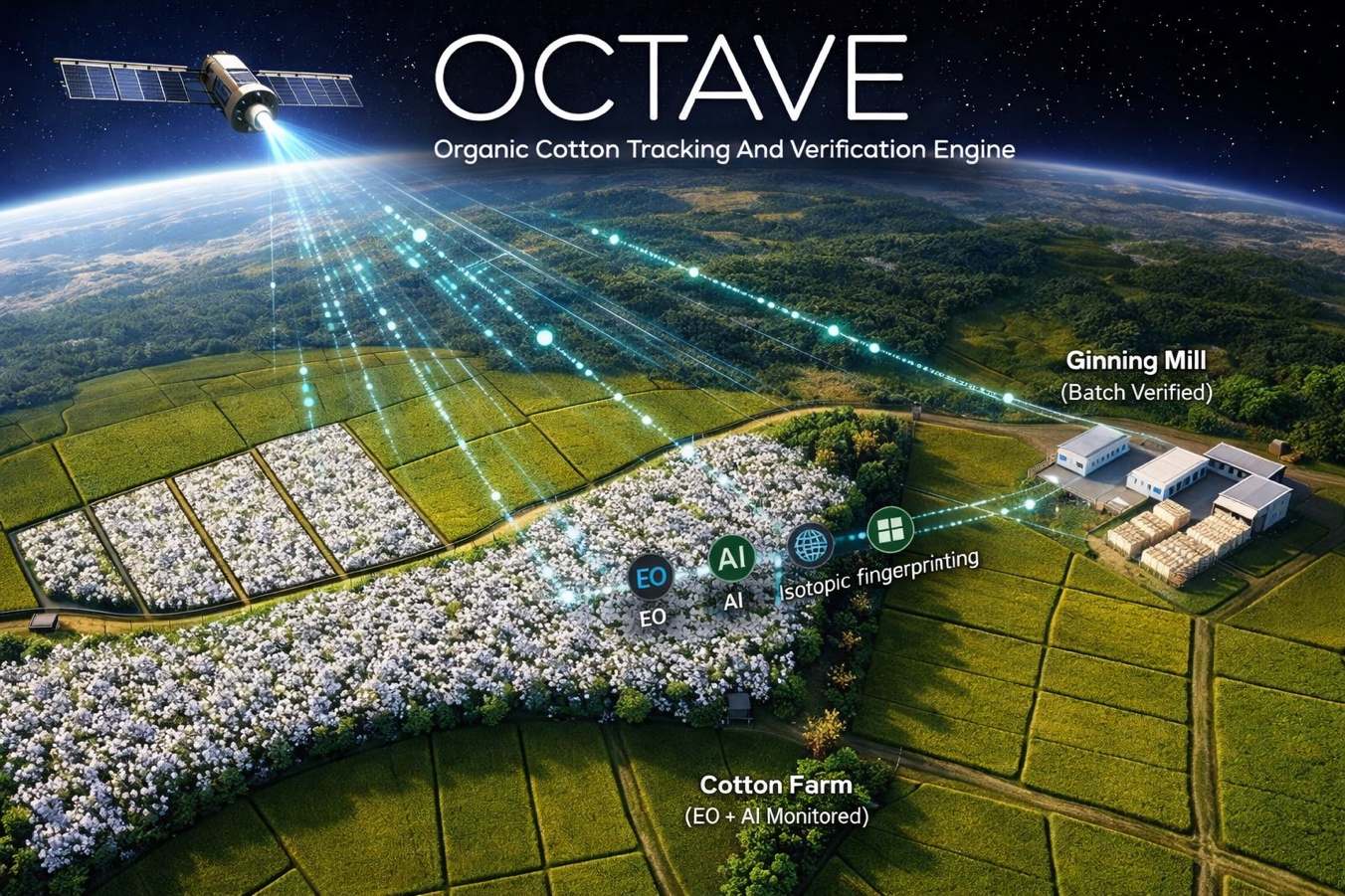
OCTAVE addressed the lack of trust in organic cotton supply chains, where users faced false organic claims, banned chemical use, hidden mixing of certified and non-certified cotton, and weak proof of origin. It also helped expose environmental harms such as excessive pesticide use, inefficient water use, land misuse, and soil degradation linked to fake organic or conventional practices.
It provided farmers, brands, certifiers, DPP providers, and regulators with a human-interference-free farm scope certificate, a blockchain-based mass-balance ledger, and GeoForensic Traceability based on Earth Observation, artificial intelligence, blockchain, and isotopic testing. The service combined satellite monitoring of farm conditions, scientific testing of cotton and soil samples, and secure digital records to verify compliance from farm to fibre.
The proof of concept engaged users, defined requirements, tested the integrated service design, and built a scalable solution that supported credible sourcing, fraud detection, and regulatory compliance in sustainable textile supply chains.
Users and their needs
TARGETED USER COMMUNITIES & NEEDS
- Cotton Farmers and Farmer Cooperatives
- TARGET REGIONS: India, Türkiye, USA, Africa
- Needs
- Fair recognition of genuine organic practices.
- Protection from false accusations and market fraud.
- Access to premium buyers and stable pricing.
- Simple, low-cost digital tools.
- Challenges
- Limited digital infrastructure and technical skills.
- Cost and complexity of traditional certification.
- Climate variability affecting yields.
- Cotton Ginners and Processors
- TARGET REGIONS: India, Türkiye, USA, Southern Europe
- Needs
- Clear separation of organic and non-organic lots.
- Trusted batch and mass-balance verification.
- Reduced audit burden and dispute risk.
- Challenges
- Operational pressure and tight margins.
- Risk of contamination and lot mixing.
- Lack of real-time verification tools.
- Fashion Brands and Textile Manufacturers
- TARGET REGIONS: EU (Italy, Germany, France), UK, USA
- Needs
- Defensible proof for sustainability and green claims.
- Compliance with emerging due-diligence and marketing regulations.
- Reduced exposure to greenwashing and reputational risk.
- Challenges
- Fragmented and unreliable supplier data.
- Complex, multi-country supply chains.
- Increasing regulatory scrutiny.
- Certification Bodies and Regulators
- TARGET REGIONS: EU, UK, global sourcing countries
- Needs
- Independent, scalable verification methods.
- Remote audit capability and reliable evidence.
- Challenges
- High inspection costs.
- Limited field access and audit scalability.
- DPP and Traceability Providers
- TARGET REGIONS: EU, UK, USA
- Needs
- Scientific proof of origin and chain-of-custody data.
- Interoperable evidence that can support digital product passport systems.
- Reliable inputs for compliance and customer-facing transparency.
- Challenges
- Weak source data from suppliers.
- Difficulty validating claims across fragmented supply chains.
- Risk of non-compliant DPP content when origin claims are not scientifically substantiated under the EU Green Claims / EmpCo framework.
OCTAVE is designed to meet these needs by providing continuous, science-based, and space-enabled traceability across all user groups.
Service/ system concept
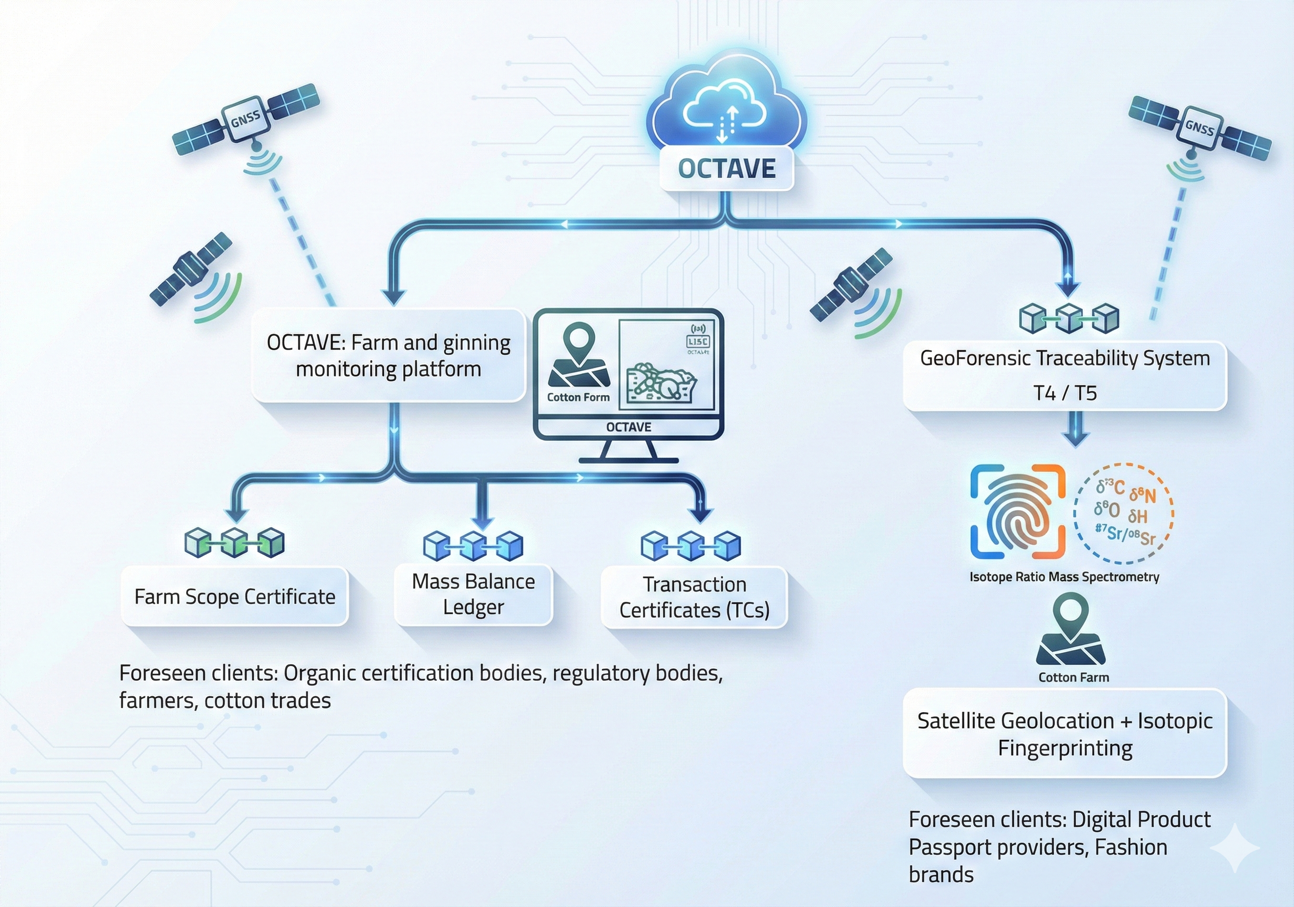
OCTAVE offered two main services: Farm and Ginning Monitoring and GeoForensic Traceability. Farm and Ginning Monitoring provided farm scope data, mass-balance ledger checks, transaction certificates, and environmental compliance information such as land use, water use, pesticide-free practices, and crop anomaly flags. GeoForensic Traceability used isotopic analysis and satellite-backed geolocation to verify cotton’s geographic origin and growing conditions.
Together, these services produced verification reports and digital traceability records that brands could use for sustainability claims, environmental disclosures, and compliance reporting. In simple terms, OCTAVE watched cotton fields from space, checked for unusual patterns that may have suggested non-organic practices, validated origin with lab tests, and linked verified farm outputs to ginning batches to prevent undeclared mixing. This created a tamper-resistant chain of evidence from farm to fibre and supported a more defensible proof-of-origin workflow across the supply chain.
Space Added Value
OCTAVE used Earth Observation and GNSS positioning assets to deliver continuous, independent verification of organic cotton farming. Core inputs included Sentinel-2 for crop health and growth monitoring, Sentinel-1 radar for cloud-free observation, Sentinel-5P for atmospheric anomaly signals, GNSS through Galileo for precise geolocation and farm boundary validation, and hyperspectral data from EnMAP, PRISMA, and CHIME for finer diagnostic detail.
PRISMA added value because it provided hyperspectral imagery across roughly 400–2500 nm with about 240 bands, which offered richer spectral information than standard multispectral data. This helped OCTAVE detect crop stress, residue patterns, soil conditions, and possible non-organic inputs more precisely, while EnMAP and PRISMA together strengthened agricultural monitoring by improving crop-trait estimation and stress mapping.
The combined value of these assets was that OCTAVE could perform season-long, scalable invisible auditing instead of relying on paperwork, occasional field visits, or supplier declarations. Compared with competitor approaches, this created a more neutral and tamper-resistant evidence base for origin proof, environmental compliance, and green-claims verification.
Current Status

OCTAVE’s proof of concept activities in India and the United States were completed, and the results validated a chain from field to lab. Ground samples were cross-checked with satellite monitoring, hyperspectral imagery, radar data, and isotope tests, including laboratory analysis at TIL in Prato, Italy.
Key achievements included end-to-end proof of concept in India and the United States, farm boundary validation, crop monitoring, and initial mass-balance linkage between farm outputs and ginning batches. Hyperspectral data added extra value by revealing crop stress, soil moisture patterns, and spectral signatures that supported origin and compliance claims, while isotope tests confirmed the scientific reliability of those observations.
The project then moved into operational validation and scale-up, with a focus on consolidating cross-region validation, refining anomaly detection, and preparing regulatory-ready outputs for brands and certifiers. This marked OCTAVE’s transition from pilot delivery to operational validation and scale-up.
Prime Contractor(s)

Subcontractor(s)
