

Objectives of the service
High-resolution night-time land surface temperature (LST) data remain largely unavailable, limiting the ability of urban planners, agricultural stakeholders, analytics providers, and researchers to accurately monitor temperature dynamics. Existing satellite products often focus on daytime observations or provide night-time measurements at resolutions that are too coarse to capture local-scale processes such as urban heat retention, frost risk, and daily temperature variability.
This service addresses this gap by delivering a consistent, high-accuracy LST product that combines daytime and night-time observations at 30-metre spatial resolution with daily coverage. The resulting data enable users to monitor temperature extremes, generate complete diurnal temperature profiles, and improve models for urban climate resilience, precision agriculture, and environmental monitoring.
The service leverages thermal infrared observations from constellr’s proprietary satellite constellation together with data from public Earth observation missions. Advanced night-time retrieval algorithms, data fusion, and super-resolution techniques ensure reliable temperature measurements even in the absence of visible light.
The project will develop, validate, and operationalise the night-time processing chain, delivering a scalable and market-ready service that expands access to high-quality temperature intelligence for commercial and public-sector applications.
Users and their needs
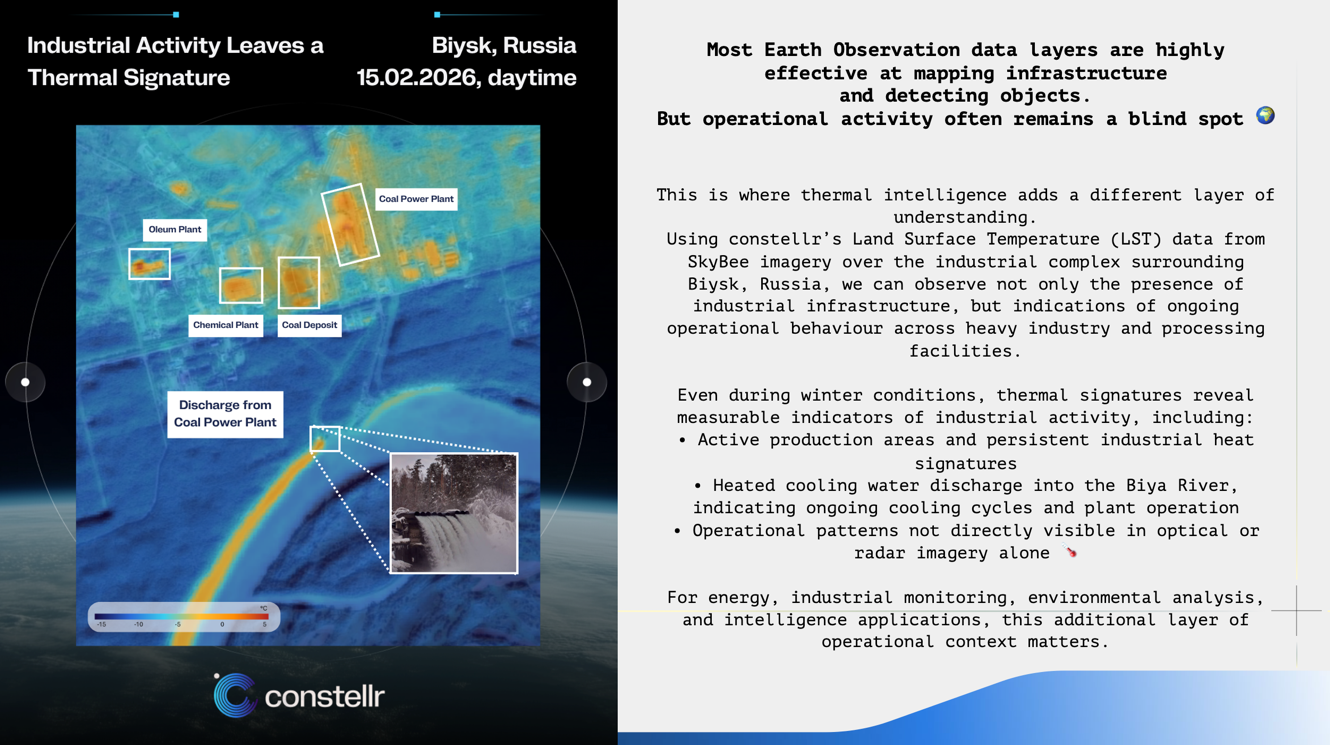
The service is designed for Earth observation analytics companies, urban climate stakeholders, environmental agencies, infrastructure operators, research organisations, and public authorities across Europe and international markets. Key application areas include urban heat island monitoring, climate resilience planning, precision agriculture, infrastructure and environmental monitoring, as well as energy activity analysis.
Users require reliable, high-resolution night-time land surface temperature data to better understand heat retention, nocturnal cooling processes, and complete diurnal temperature cycles. They also seek more frequent observations than currently available Earth observation solutions, together with scalable access to operational thermal analytics products that can be directly integrated into decision-support systems and predictive models.
A key objective of the project is to transform advanced night-time thermal observations into actionable insights that address real operational challenges. Beyond demonstrating technical performance, the service aims to deliver clear value for end users by supporting data-driven decisions in climate adaptation, resource management, infrastructure monitoring, and environmental assessment.
Service/ system concept
The service provides reliable, high-resolution night-time Land Surface Temperature (LST) data to support advanced analytics and decision-making. Using its proprietary thermal infrared satellite constellation, constellr measures the temperature of the Earth's surface during the night, addressing a critical gap in current Earth observation capabilities.
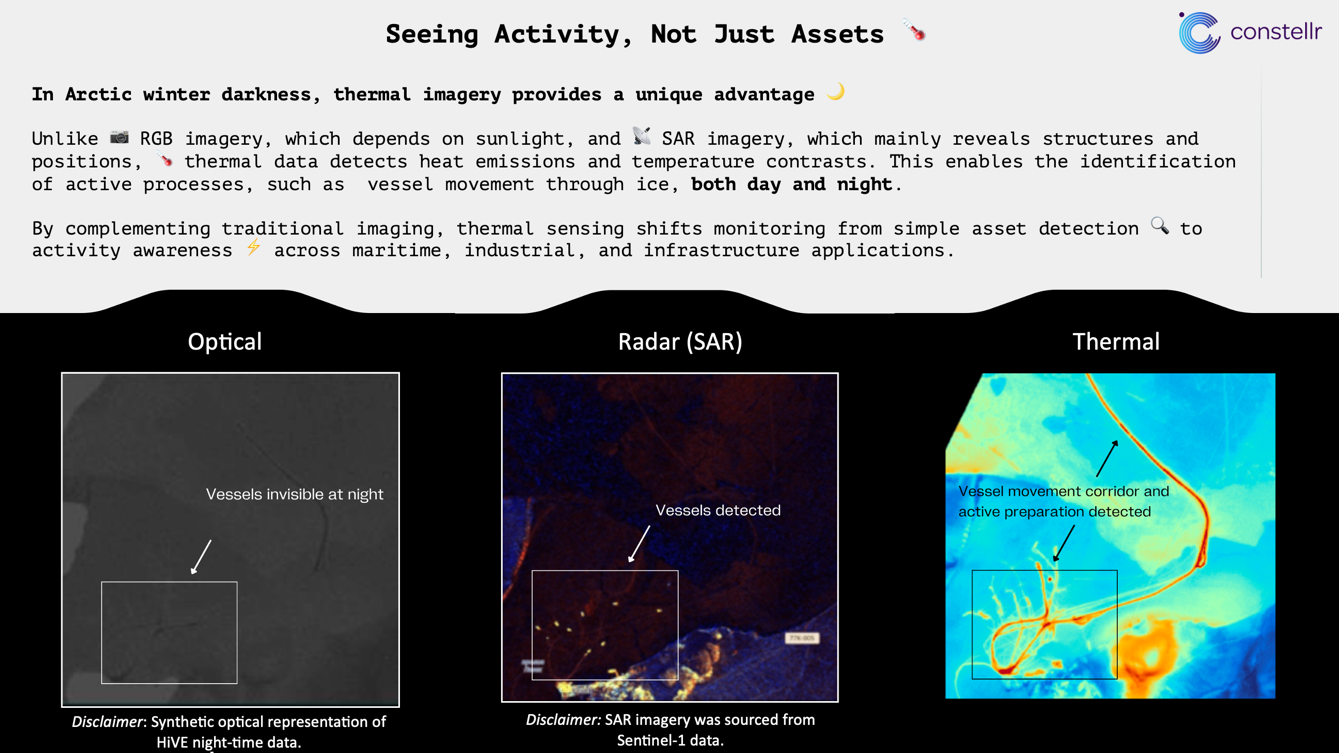
Unlike optical imagery, which depends on reflected sunlight, thermal infrared sensors measure the radiation naturally emitted by surfaces such as soil, vegetation, water, and infrastructure. Because this thermal energy is emitted continuously, temperature measurements can be acquired both day and night, enabling the monitoring of heat retention, nocturnal cooling, and frost risk even in complete darkness.
Satellite observations are transmitted to ground infrastructure, where they undergo advanced processing, quality control, and data fusion before being transformed into analysis-ready temperature products. These products are delivered through secure APIs, allowing seamless integration into existing analytics platforms and operational workflows.
Developed in collaboration with analytics providers and end users, the service supports applications in urban climate resilience, agriculture, infrastructure monitoring, and environmental management. The result is a scalable and operational solution that converts advanced thermal satellite observations into actionable insights for commercial and public-sector users.
Space Added Value
The service leverages space-based thermal infrared observations to deliver high-resolution night-time Land Surface Temperature (LST) data, addressing a critical gap in current Earth observation capabilities. By providing consistent access to temperature measurements after sunset, it enables users to capture environmental processes that remain invisible to conventional optical satellite systems.
Night-time LST data significantly enhances the understanding of diurnal temperature dynamics, improving applications such as urban heat island monitoring, climate resilience planning, precision agriculture, environmental assessment, and infrastructure monitoring. The service enables analytics providers to develop new thermal intelligence products and strengthen existing models through the integration of reliable night-time temperature information.
The space-based approach offers a unique combination of wide-area coverage, consistency, and operational scalability that cannot be achieved through ground-based measurements alone. Unlike existing solutions, which are often constrained by low spatial resolution, limited coverage, or infrequent acquisitions, the service delivers temperature observations at 30-metre resolution with daily revisit capability, enabling local-scale monitoring of heat retention, temperature dissipation, frost risk, and other critical thermal phenomena.
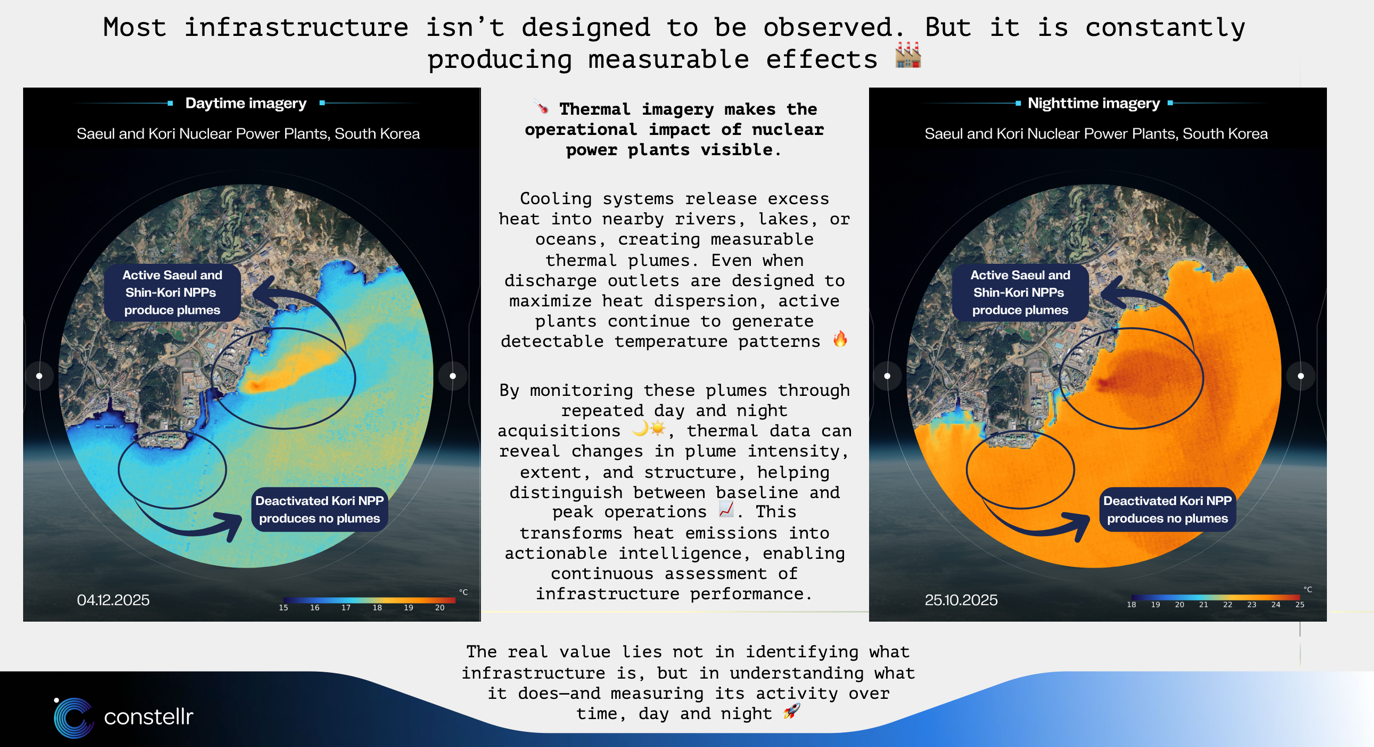
By combining proprietary thermal infrared observations with advanced processing and data fusion techniques, the service creates a new source of actionable environmental intelligence. This capability supports data-driven decision-making across commercial and public-sector applications while opening new opportunities in climate adaptation, energy monitoring, maritime intelligence, and environmental analytics.
The service also demonstrates strong potential for future climate resilience and Arctic monitoring applications, where continuous thermal observations can provide valuable insights into rapidly changing environmental conditions and support long-term sustainability objectives.
Current Status
Prime Contractor(s)

Subcontractor(s)