

Objectives of the service
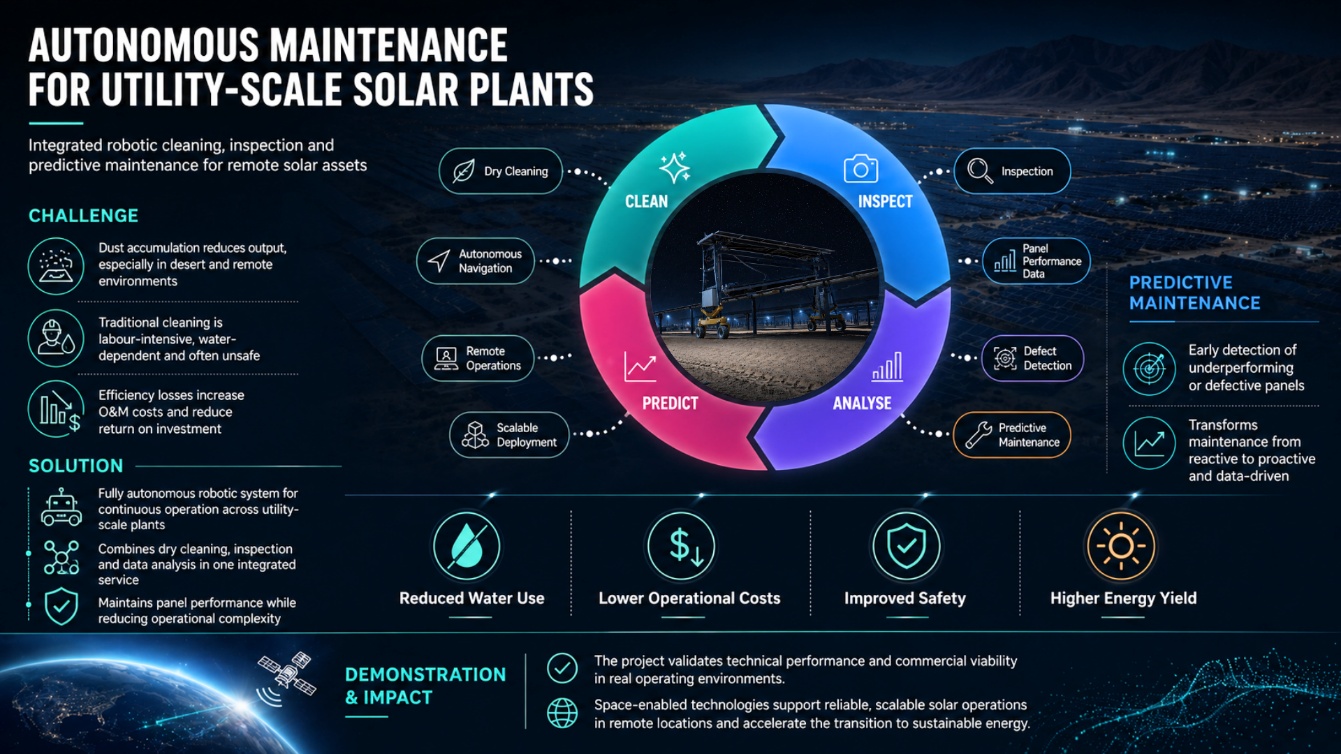
Large-scale photovoltaic plants face continuous efficiency losses due to dust and debris, particularly in desert and remote environments. Soiling can reduce energy output by 10-20%, directly affecting energy production, operational expenditure and return on investment.
PLECO demonstrates SolarCleano B1A as a fully autonomous robotic service for utility-scale solar farms. The system integrates dry cleaning, inspection and data analysis into one operational workflow, maintaining panel performance while reducing manual intervention, water dependency and safety exposure.
Beyond cleaning, the activity introduces predictive maintenance capabilities through inspection data, AI-enabled anomaly detection and cloud-based reporting. The demonstration validates technical performance, operational robustness and commercial relevance in real site conditions, with a focus on reliable solar operations in remote and harsh environments.
Users and their needs
The service targets organisations managing or developing utility-scale photovoltaic plants where energy yield, reliability, safety and cost control are critical.
Target user communities:
-
Solar plant operators responsible for performance, cleaning and maintenance
-
EPC contractors managing large solar installations
-
Energy producers and independent power producers
-
Government-backed renewable energy projects and public energy stakeholders
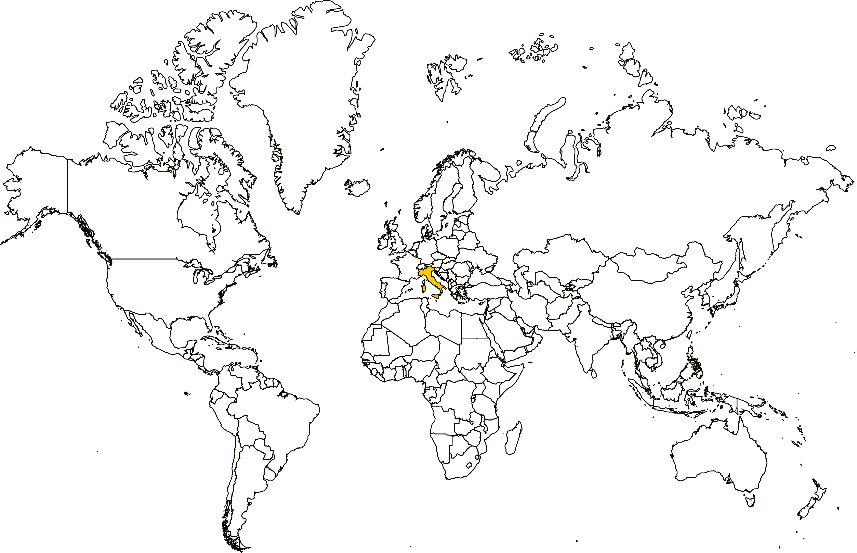
Target regions include Europe, the Middle East, North Africa, Asia-Pacific and Australia. The current demonstration activity is centred on an operational solar plant environment in Sicily, Italy.
Main user needs:
-
Maintain maximum energy output despite dust and soiling
-
Reduce operational expenditure linked to cleaning and inspection
-
Minimise water use in arid and water-constrained areas
-
Improve worker safety by limiting manual intervention on large sites
-
Operate reliably where terrestrial connectivity and infrastructure are limited
-
Access clear, actionable information on panel performance, defects and maintenance priorities
Service/ system concept
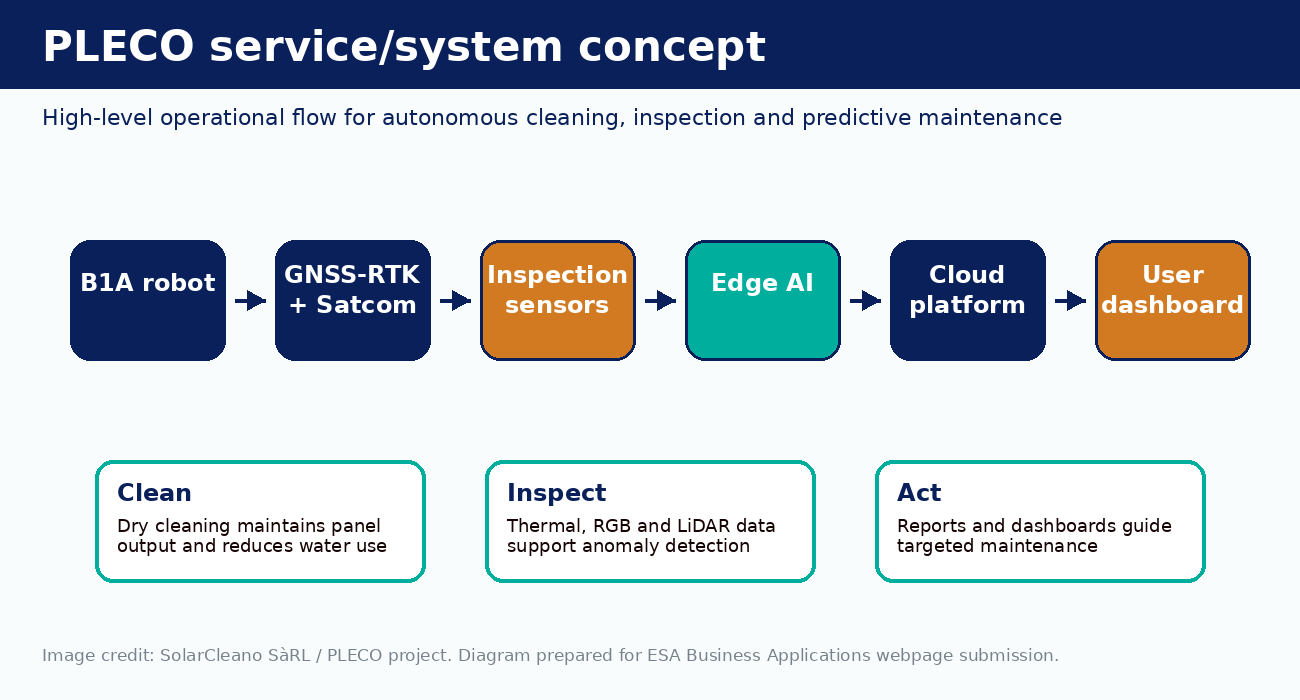
The system combines an autonomous robotic platform with advanced sensing, satellite-enabled positioning and multi-source communications. Each SolarCleano B1A robot moves along photovoltaic panel rows using high-precision GNSS-RTK positioning, performs continuous dry cleaning and simultaneously captures inspection data.
The inspection payload includes thermal imaging, RGB cameras to detect defects, anomalies and performance issues. Data is processed locally on the robot so that relevant events are identified and prioritised before transmission. This reduces bandwidth requirements while preserving operationally important information.
A cloud platform receives operational and inspection data, applies AI-driven analysis and provides dashboards and maintenance reports. From the user perspective, the service provides autonomous cleaning, remote visibility, actionable maintenance insights and support for targeted field intervention.
Space Added Value
Space assets are central to the operational value proposition because they enable precise, resilient and scalable operation in remote solar farms.
Satellite navigation:
GNSS-RTK provides centimetre-level positioning accuracy. This allows the robot to navigate accurately between panel rows in most remote desertic regions, repeat cleaning paths, geotag detected defects and support consistent autonomous operation across large sites.
Satellite communications:
Satellite connectivity complements terrestrial networks such as 4G and Wi-Fi. It supports remote monitoring and data exchange where terrestrial coverage is unavailable, unstable or insufficient for operational continuity.
Combined added value:
-
Reliable operation in isolated or harsh solar farm environments
-
Continuous monitoring and command capability despite limited terrestrial infrastructure
-
Accurate localisation of inspection findings and maintenance tasks
-
Scalable deployment model for international utility-scale photovoltaic markets
-
Higher resilience through multi-path connectivity and automated navigation
Current Status
The system is undergoing field testing in Sicily within an operational solar plant environment. The activity focuses on validating autonomous navigation, dry cleaning, inspection data capture and remote monitoring under real operating conditions.
Achievements to date:
-
Deployment of the B1A prototype on site in Sicily
-
Validation of autonomous navigation and cleaning capabilities in operational conditions
-
Initial testing of inspection functions, including data acquisition and processing
-
Integration of communication systems supporting remote monitoring
-
Establishment of the PLECO visual identity, including project logo, colour palette and graphic guidelines
-
Initial structuring of the SolarCleano PLECO webpage content, UX approach and SEO-oriented wording
Current workstreams:
-
Assessment of robustness and reliability during continuous operation
-
Refinement of navigation and cleaning performance under site-specific constraints
-
Collection of operational data to support optimisation
-
Progressive integration of predictive maintenance and advanced analytics
-
Preparation of pilot operations at the same site
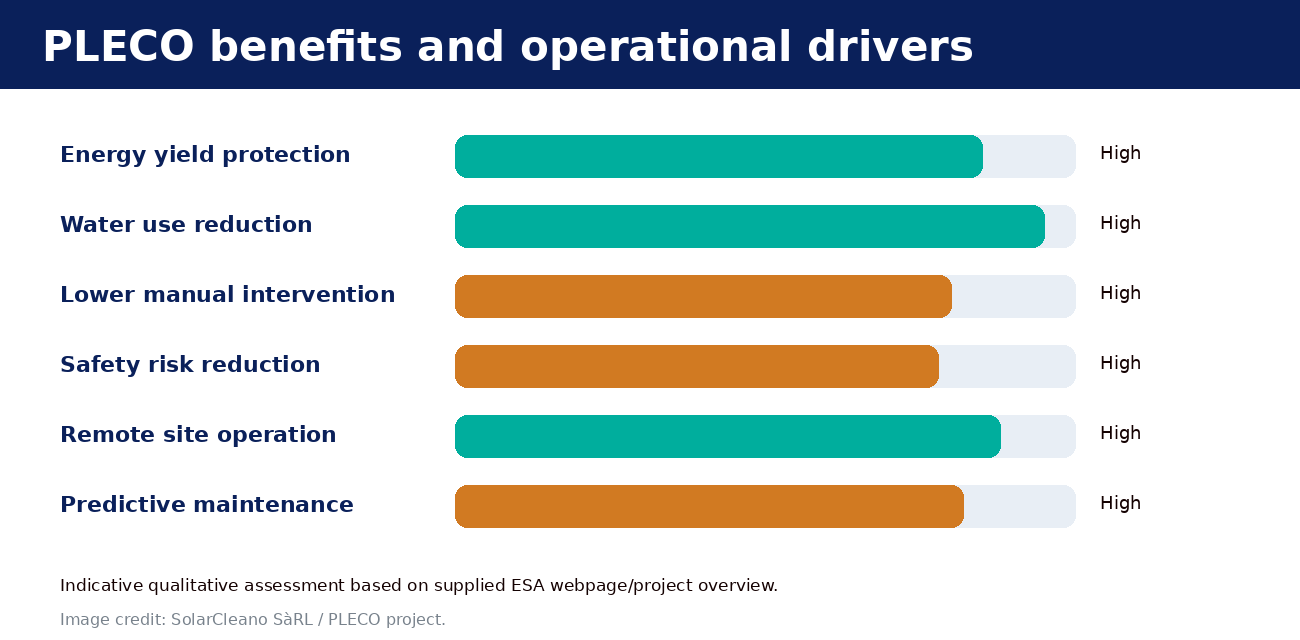
The service supports higher renewable energy output by maintaining cleaner photovoltaic panels and enabling earlier detection of underperforming assets. Dry cleaning reduces water consumption compared with conventional washing methods, making the solution relevant for arid regions and water-constrained environments.
The autonomous approach also reduces exposure to manual cleaning risks on large solar installations and supports skilled roles in robotics, data analytics and renewable energy operations.
-
Reduced water consumption through dry cleaning
-
Improved renewable energy yield from cleaner panels
-
Reduced operational risk through less manual intervention
-
Data-driven maintenance supporting longer-term asset performance
-
Contribution to sustainable energy operations and skilled job creation
Prime Contractor(s)
