

Objectives of the service
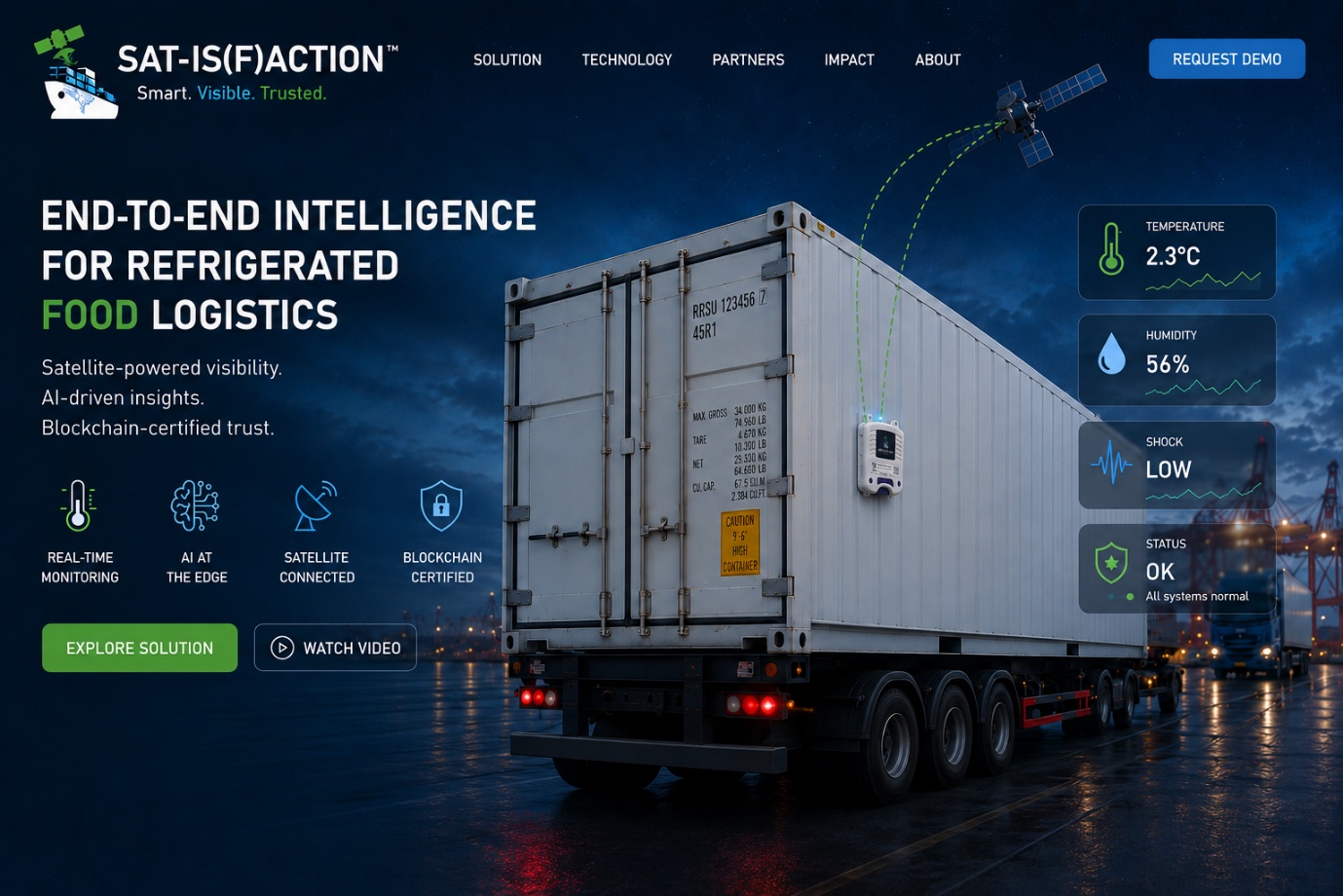
Refrigerated food transport faces frequent losses due to equipment failures, temperature deviations, and theft during multimodal journeys. Logistics Service Providers struggle to maintain continuous visibility and early fault detection across networks, while insurers lack reliable, tamper-proof data to assess risks and accelerate claims.
SAT-IS(F)ACTION™ addresses these issues by combining satellite navigation, satellite communications, artificial intelligence at the Edge, and distributed ledger technology into an integrated tracking and certification service for refrigerated containers. Smart devices installed on reefers monitor temperature, humidity, shocks, and mechanical performance. Artificial intelligence models running at the edge detect anomalies and predict potential failures in real time. When cellular coverage is unavailable, satellite links ensure that alerts and critical data are still transmitted.
All selected data are securely time-stamped and certified through blockchain technology, creating trusted evidence for insurance and logistics processes.
The activity aims to design, build, and validate this end-to-end service in operational pilots with logistics and insurance partners. It will demonstrate improved cold-chain reliability, reduced cargo losses, faster and fairer insurance claims, and the creation of new data-driven business models such as embedded and parametric insurance solutions.
Users and their needs
The service targets Logistics Service Providers (LSPs) managing refrigerated food transport and Insurance Service Providers (ISPs) offering coverage for perishable cargo.
Pilot users include Med Roll Shipping & Logistics (Italy, operating Africa–Europe routes) and SIAT – Società Italiana Assicurazioni e Riassicurazioni S.p.A. (Italy, part of the UnipolSai Group).
User communities and needs:
Challenges to meet these needs:
-
Logistics Service Providers:
-
Continuous visibility of reefer location and condition.
-
Early detection of equipment malfunctions to prevent spoilage.
-
Trusted data to demonstrate compliance with temperature and handling requirements.
-
-
Insurance Service Providers:
-
Reliable, tamper-proof data to assess risks and automate claim validation.
-
Certified event evidence enabling embedded or parametric insurance products.
-
Challenges to meet these needs:
-
Ensuring uninterrupted data transmission in areas without cellular coverage through satellite links.
-
Integrating multiple sensors, communication, and certification technologies into a cost-efficient device.
-
Delivering Machine Learning on chips to implement low power decision trees directly at the edge to provide timely alerts.
-
Establishing interoperability with existing logistics and insurance IT systems.
The targeted user countries are primarily Italy and partner countries along Mediterranean and African trade routes involved in perishable goods logistics.
Service/ system concept
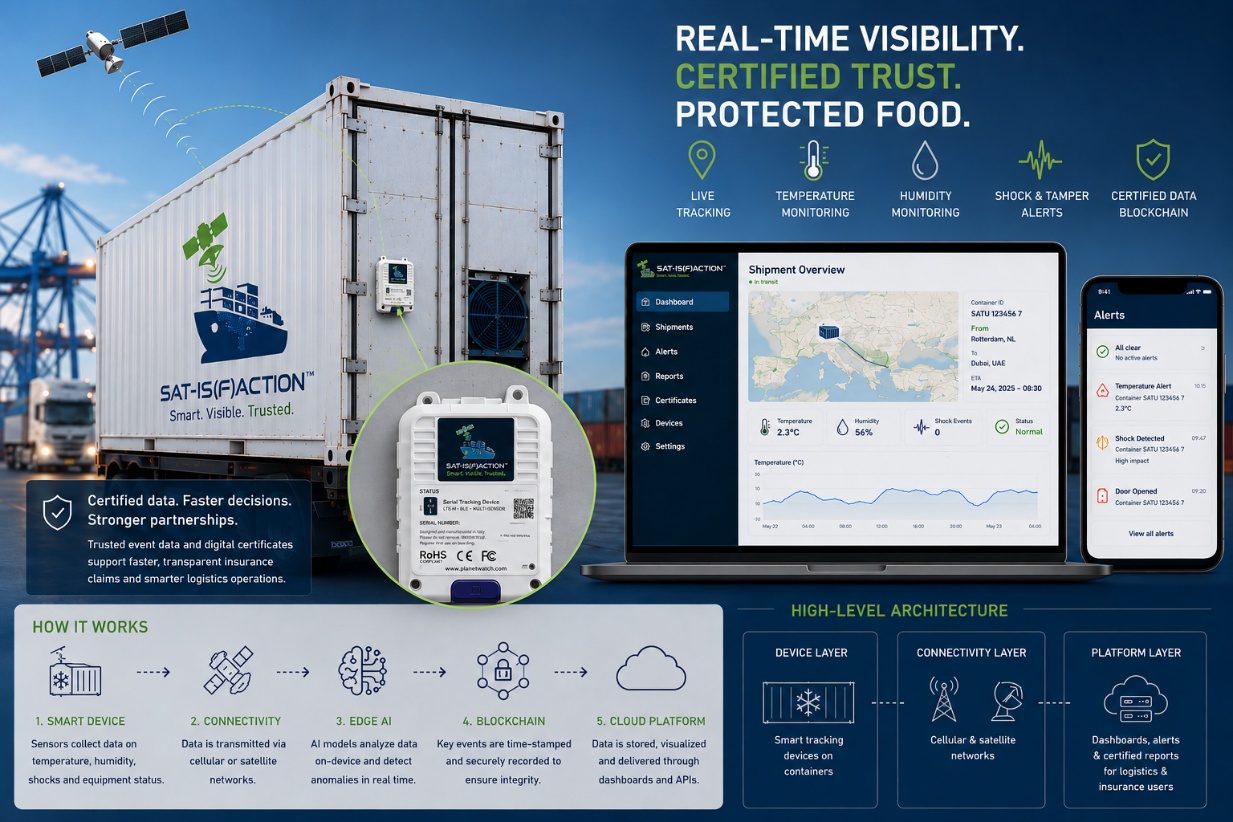
The SAT-IS(F)ACTION™ service provides real-time tracking and certified monitoring of refrigerated food containers from origin to destination. Users receive continuous information on container location, temperature, humidity, and operational status, together with alerts for shocks, tampering, or equipment malfunctions.
Through an intuitive online dashboard, Logistics Service Providers can follow each shipment, detect anomalies early, and act before cargo is damaged. Insurance partners access verified event data and digital certificates that support faster and fairer claims processing.
How it works: A smart device installed on the container collects sensor data and determines its position using satellite navigation. If mobile networks are unavailable, the information is sent via satellite communication. Artificial-intelligence software on the device analyses the data directly, identifying risks such as temperature deviation or mechanical failure. Key records are time-stamped and stored securely using blockchain technology to ensure data integrity.
At a high level, the architecture connects three layers:
-
Smart tracking devices on containers.
-
Communication networks (cellular and satellite) link devices to the cloud.
-
Data platform provides dashboards, alerts, and certified reports to logistics and insurance users.
This combination delivers trusted, always-on visibility across the cold-chain journey.
Space Added Value
SAT-IS(F)ACTION™ integrates satellite navigation (SatNAV) and satellite communications (SatCOM) to guarantee continuous, trusted visibility of refrigerated cargo across global supply chains.
-
Satellite Navigation (GNSS – Galileo, GPS, GLONASS) provides precise and reliable positioning of containers throughout multimodal transport, including ports, highways, and remote areas where conventional tracking often fails. This ensures accurate route monitoring and trusted evidence of cargo movement.
-
Satellite Communications act as a secure backup link whenever terrestrial mobile networks are unavailable, such as on ocean crossings or in isolated regions. It enables uninterrupted data transmission, ensuring that temperature deviations, mechanical faults, or security events are reported immediately.
The added value of combining SatNAV and SatCOM lies in providing truly global, resilient coverage—something current ground-only systems cannot guarantee. When enhanced with artificial intelligence for on-board anomaly detection and blockchain-based data certification, satellite assets transform the service from simple tracking to a predictive and verifiable risk-management tool.
Compared with existing solutions, SAT-IS(F)ACTION™ delivers continuous awareness, certified evidence for insurance, and proactive intervention capability—reducing losses and operational costs across the cold-chain network.
Current Status
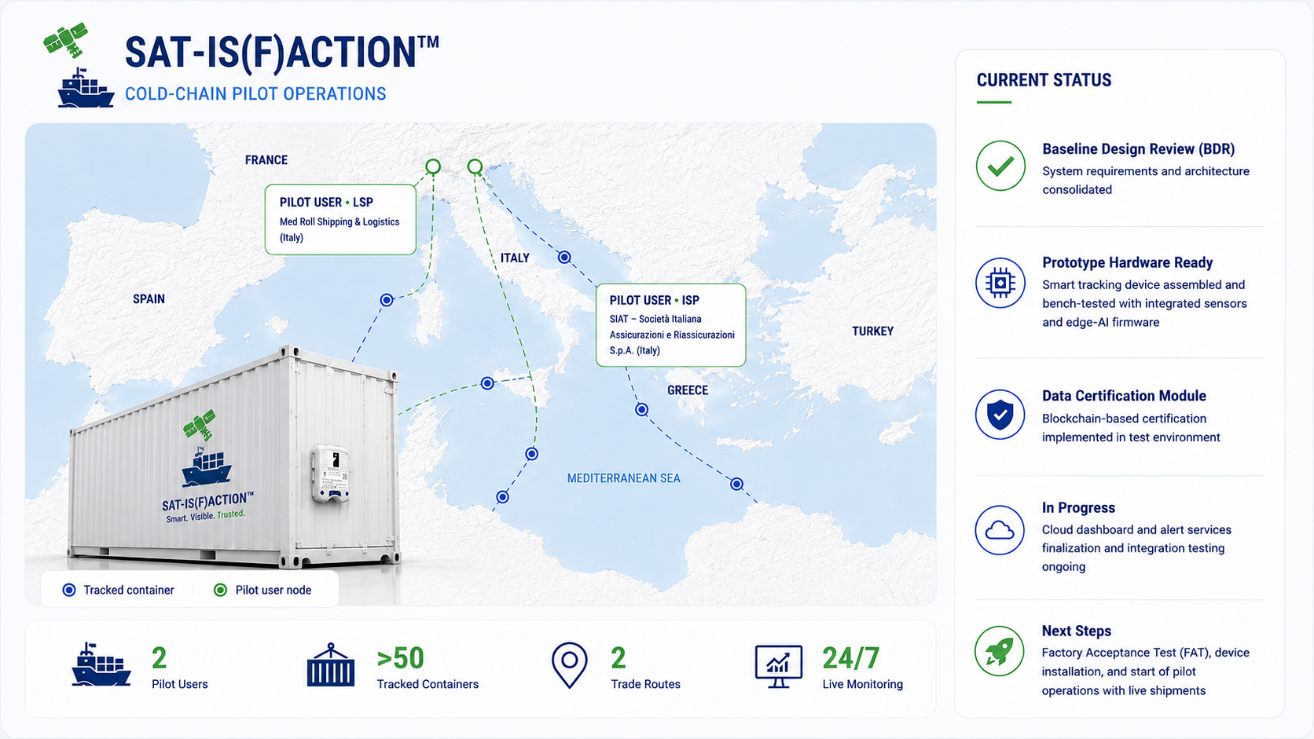
The SAT-IS(F)ACTION™ project has completed its Baseline Design Review (BDR). System requirements and architecture have been consolidated through joint sessions with logistics and insurance partners. Prototype hardware for the smart tracking device has been assembled and bench-tested with integrated sensors and edge-AI firmware. The data certification module based on blockchain technology has been implemented in a test environment.
Currently, the team is finalizing the cloud dashboard and alert services and preparing for integration testing of the end-to-end chain from device to platform. The Container Tracking Service (CTS) and Anomaly Detection Service (ADS) are being validated using real operational data from pilot users in Italy and on Mediterranean trade routes.
Next steps include the Factory Acceptance Test (FAT), installation of devices on selected refrigerated containers, and the start of pilot operations with live shipments under the supervision of project partners.

