



Objectives of the service
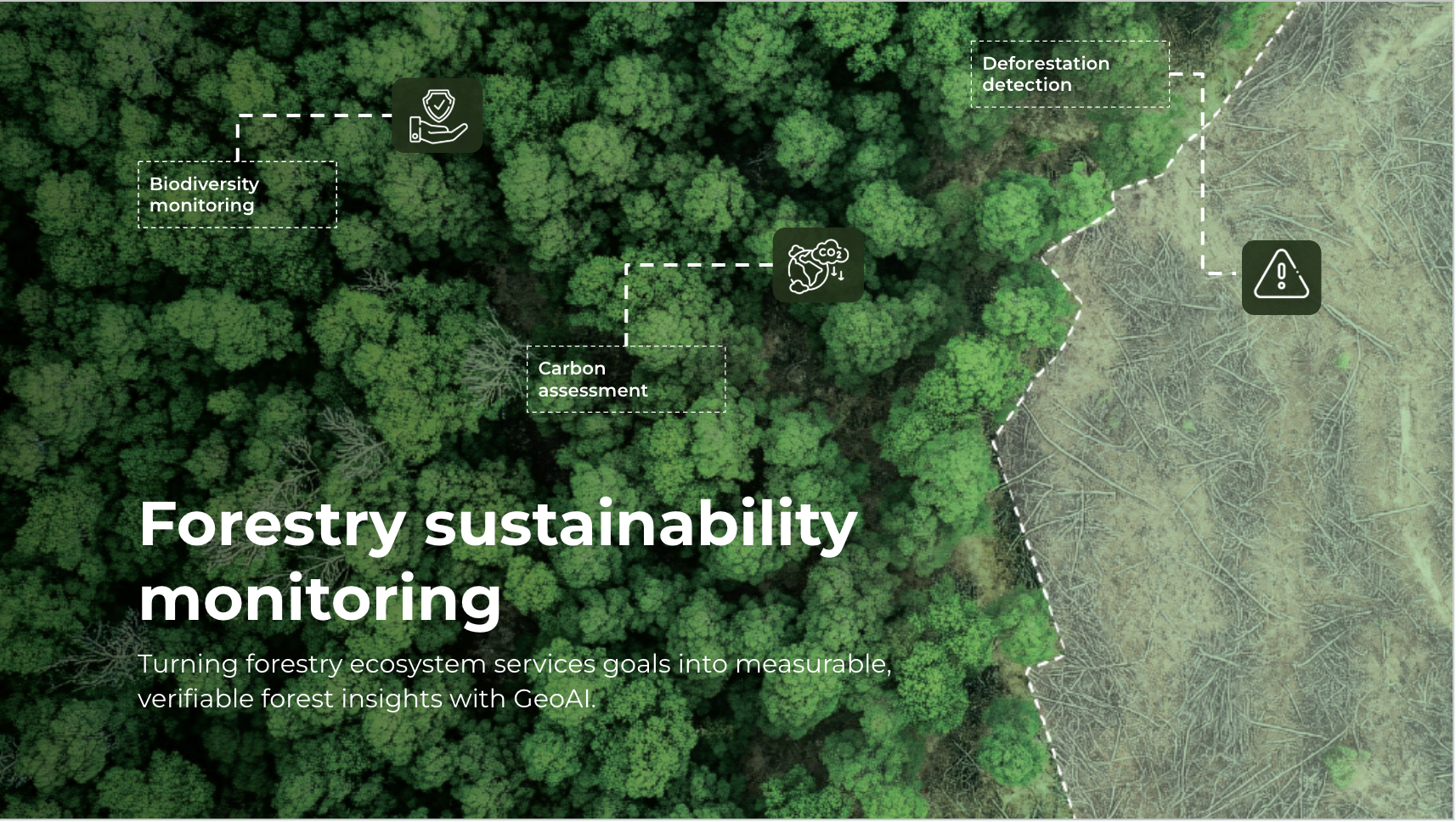
The key problem for users is the difficulty in tracing the origin of wood and verifying its sustainability, often complicated by resource-intensive, slow manual audits. Furthermore, many existing solutions lack the necessary detailed, customizable analysis required to go beyond basic compliance and actively improve sustainability practices. The solution is the PicterraTrace platform, an end-to-end geospatial AI system that provides stakeholders with the core technology for a scalable and integrated solution using machine learning on Earth Observation data. The core objectives of this activity are to develop a full end-to-end solution for monitoring forestry activities, measuring carbon levels, and mitigating deforestation, and to enable the integration of this solution with existing systems via API.
Users and their needs
The service is targeted at consumer goods companies with soft-commodities, wood or pulp and paper derived products, forest owner cooperatives, timber suppliers, traders of deforestation-free commodities under the EU Deforestation Regulation, forest certifiers, and conservation and restoration project developers globally.
Pilot users involved in the activity include the Forest Stewardship Council (FSC Inc.) and its regional partners in Germany, Canada, the Netherlands and East Africa, together with certificate holders in each region: a municipal forest authority in Germany, a county forest service in Ontario, a forest owners cooperative and its forestry consultancy in the Netherlands, a community forestry organisation in Tanzania, and a timber growers association in Uganda. Commercial pilot users include consumer goods and commodity companies operating in different soft-commodity supply chains. A research collaboration with Utrecht University examined carbon storage in certified and non-certified forest concessions in the Congo Basin.
Their needs include:
-
Access to reliable and verified sustainable wood sources
-
Streamlined and automated compliance with regulations such as the EUDR
-
Improved ability to verify data, ensure compliance and monitor large forest areas effectively
-
Accurate and timely data on forest conditions and carbon stocks to support conservation and offset projects
The key challenge for the project was ensuring the solution meets verification standards — indicators such as forest cover loss over the previous ten years and forest degradation detection — and that it integrates with user habits, usages and systems.
Service/ system concept
The service supplies users with critical data and insights derived from satellite imagery using a cloud-based geospatial AI solution and platform. The capability delivered is a full view of forestry activities that can be accessed via a user-friendly web interface or integrated into existing platforms (e.g., ERP, supply chain systems) via well-documented APIs. The system works by: 1. Ingesting diverse satellite data sources (global layers and high-resolution imagery). 2. Optional fine-tuning custom AI models using the Picterra GeoAI Forge platform. 3. Running these models via an Analysis and Processing Engine to generate automated results on deforestation, carbon and biomass stock, forest health (degradation / intactness), and species diversity (biodiversity scoring). The result is a comprehensive end-to-end solution for monitoring and risk mitigation.

Space Added Value
The solution utilizes Earth Observation (EO) imagery, specifically global/national land cover maps and high-resolution satellite imagery from 10m down to 30 cm resolution. The added value comes from combining this multi-source EO and geospatial data with the project team's advanced machine learning (ML) technology. This combination is superior to current methods because: * It provides the required scale and timeliness necessary for monitoring vast areas and tracking changes regularly, which is impractical for resource-intensive ground surveys. * It allows for the use of custom ML models on higher resolution imagery of different formats (multispectral, SAR, DEM), enabling significantly more detailed analysis and the elimination of false positives that often plague generalized, lower-resolution single open-source datasets.
Current Status
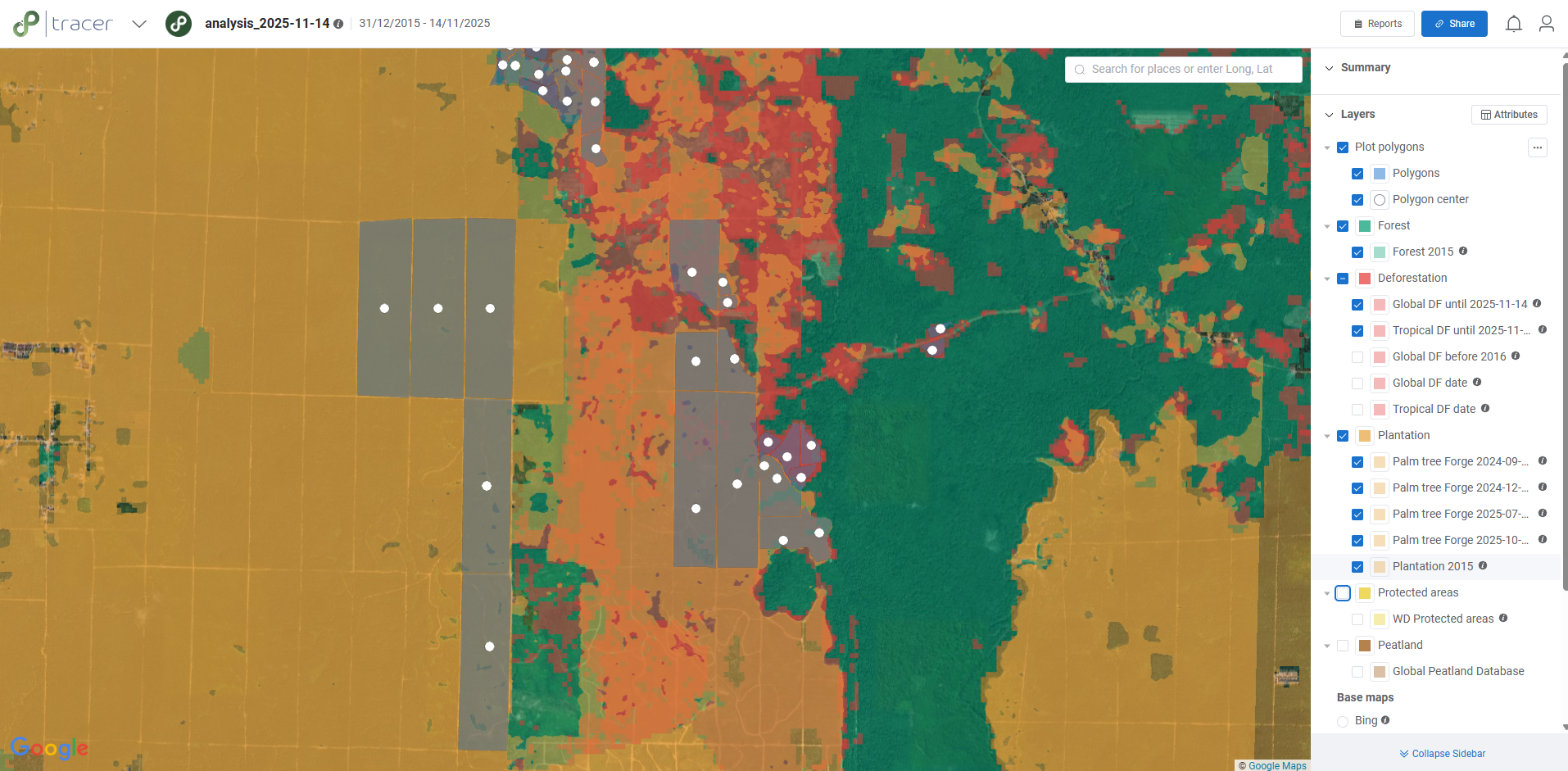
Final Status (Septembre 2026): The PicterraTrace demonstration project has been completed. During a six-month pilot phase from April to September 2026, the service was operated with real users across eight sites on four continents, with the Forest Stewardship Council participating both as channel partner and, through its certificate holders, as pilot user.
The sites spanned a wide range of forest types and management regimes: a 73-species mixed municipal forest in Germany, a 14 000-hectare municipal forest network in Ontario, community-managed reserves in Tanzania, reforestation areas in Uganda, small-scale revitalisation plots in the Netherlands, paired forest concessions in the Republic of Congo, and commercial woodlots in Zambia and Tanzania.
Carbon estimation was benchmarked against independently certified forest inventory at two sites on two continents, agreeing with both to within a few per cent at management-unit level. Wood-stock estimation was validated against destructive harvest, where an initial discrepancy was traced to a definitional gap between total standing biomass and harvested merchantable wood and corrected using internationally recognised conversion factors. A collaboration with Utrecht University tested whether certified forest concessions store more carbon than non-certified ones, and reported a null result together with its statistical constraints. All fourteen verification tests defined for the project were passed.
Pilot users rated the service positively on accuracy, relevance and value, and identified integration with their own geographic information systems as the principal constraint on adoption — now the leading item on the product roadmap.
The service was taken up commercially before the demonstration closed, with contracts covering all three analytical workflows: deforestation and regulatory compliance, carbon stock and sequestration, and biodiversity and habitat. A standardised carbon reporting product for forest certificate holders is planned for release in autumn 2026, and the land-use-change emissions capability is aligned to the GHG Protocol Land Sector and Removals Guidance taking effect in January 2027.
The Final Review was held on 29 September 2026.
Prime Contractor(s)
