



Objectives of the service

TruPaG addresses the challenge of finding available truck parking across Europe, helping drivers quickly identify suitable parking locations and reduce time spent searching.
The service provides parking occupancy insights for both highway and non-highway locations, expanding coverage beyond existing infrastructure-based data sources. Building on an operational solution already integrated with highway parking data in Germany, the project extends this capability to a broader network of parking areas.
To achieve this, the project explores different data-driven approaches using both historical and real-time truck movement data, with the aim of improving prediction accuracy and ensuring reliable parking guidance for drivers and transport companies.
Users and their needs
The primary users of the service are truck drivers and transport companies operating across Germany and Europe.
Truck drivers need reliable and timely information on available parking spaces to plan their journeys, comply with driving time regulations, and avoid unnecessary detours. A lack of accurate information often leads to long search times, increased stress, and parking in unsuitable or unsafe locations.
Transport companies require better visibility into parking availability to support route planning, improve operational efficiency, and ensure compliance with regulations.
Key user needs include:
- Clear and reliable information on available parking spaces
- Reduced time spent searching for parking
- Support in planning routes and rest periods
- Access to parking options both on and off highways
- Increased safety and reduced stress for drivers
Service/ system concept
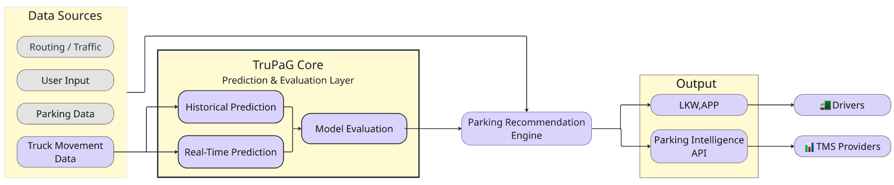
The service provides drivers with clear and timely information on available truck parking through the LKW.APP platform.
The system integrates multiple data sources, including routing and traffic data, user input, parking data, and truck movement data. These inputs are used within the TruPaG Core, where two prediction approaches are developed: one based on historical data and one based on real-time data.
Each approach is evaluated individually within a dedicated evaluation layer to assess its performance in terms of accuracy, reliability, and scalability under different conditions.
Based on this evaluation, the system generates parking recommendations through a dedicated recommendation engine. These recommendations are delivered to end users via the LKW.APP and made available to external systems through the Parking Intelligence API.
This approach ensures that parking guidance is continuously improved and provides drivers and transport operators with reliable and actionable insights for decision-making.
Space Added Value
The service leverages satellite navigation technologies, specifically GPS and Galileo, as described in the project proposal, to enable large-scale collection and analysis of truck movement data.
This space-based positioning data forms the foundation for both historical and real-time floating car data used in the project. It allows the system to capture vehicle trajectories across wide geographic areas, supporting the development of parking occupancy predictions and recommendations.
By relying on GNSS-based data, the service can operate independently of fixed ground infrastructure such as sensors or manual reporting systems, which are limited in coverage and scalability. This enables consistent data collection across regions and supports the extension of parking insights beyond highway locations.
As a result, space-based positioning is a key enabler for delivering scalable, data-driven parking guidance, improving efficiency for truck drivers and transport operators across Europe.
Current Status
The Critical Design Review (CDR) was successfully achieved on July 2026, marking the successful completion of the system and service design phase. Following the review, the project has progressed into the implementation and integration phase, with development of the core TruPaG platform, occupancy prediction services, and Parking Intelligence API well underway. At the same time, collaboration with truck drivers and transport companies continues to validate the solution, gather user feedback, and ensure the service meets operational needs ahead of the pilot deployment.
