ESA title

Public

New maritime partnership brings industry expertise to ESA

Collaboration between the space sector and industry is key to ensuring that space-based technology delivers real-world benefits. To strengthen this connection, the European Space Agency’s Business Applications and Space Solutions (BASS) programme has recently hosted a secondee from DNV as part of a new bilateral exchange initiative. The arrangement enables professionals to work across the two organisations, sharing expertise and exploring how space-based technologies can solve real-world challenges. An ESA secondee to DNV is also planned as a next step in the collaboration.

Haakon Molvig from DNV was the first secondee within ESA’s BASS programme, and he used his time at ESA to explore how satellite data can enhance navigation, safety and efficiency for Arctic transportation, as well as regulatory compliance in one of the world’s most extreme environments. He also explored how space data could support compliance with environmental regulations, particularly in tracking emissions and reducing pollution in the Arctic.

Haakon's work at ESA explored the benefits of using satellite data to help vessels plan safer and more efficient routes, reducing fuel consumption and the risk of accidents caused by unpredictable ice movement. Current ice charts are updated daily but cannot capture sudden changes in ice conditions. Satellites however can provide low latency data, allowing vessels to navigate more safely and efficiently. Increased connectivity in the Arctic could further enhance these capabilities, enabling continuous access to vital navigation and environmental data.

His findings reinforced the need for faster, more responsive ice navigation tools, as well as the role of satellite connectivity in improving operational efficiency. With data from satellites, Arctic shipping operators could reduce risks to personnel and vessels with the introduction of space-based technology. Haakon's secondment also provided ESA with valuable industry insights into Arctic shipping, while DNV explored new applications of space technology for maritime safety and sustainability.

Bringing industry into the BASS programme helps bridge the gap between space technology and key commercial sectors, providing a structured way for external experts to contribute their knowledge and gain valuable insight into space applications and helping to define use cases for space applications. Importantly, this type of secondment is not intended for seasoned experts, but for early-career professionals with strong potential. The goal is to develop new competences and broaden understanding—both of space-based applications and the needs of industry sectors like maritime.

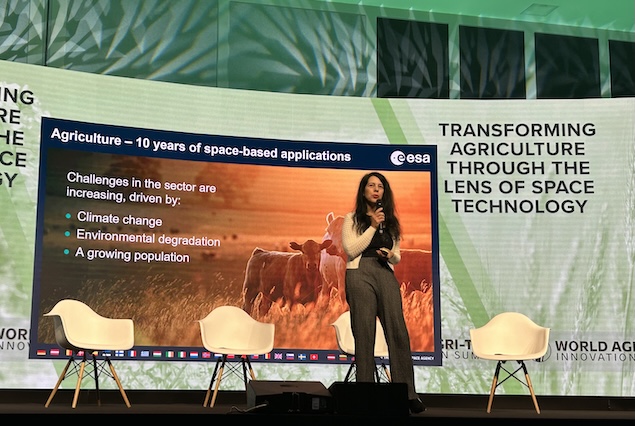
Haakon Molvig had the opportunity to attend conferences and events while on secondment at ESA

"Working at ESA was eye-opening to the opportunities space offers across industries,” said Haakon. “Satellite services are embedded in our everyday lives, but we rarely ever think about them. It was especially insightful working with Nil and other ESA professionals to map out the satellites and constellations that could enable future services in Arctic shipping: services we may one day take for granted in the same way. This experience has been invaluable and will stay with me as I analyse new business opportunities."

The bilateral exchange enhances collaboration between space and industry. Future secondees could explore how space-based solutions can address sector-specific challenges, helping businesses adopt satellite technology while giving ESA valuable industry insights.

"Haakon’s secondment demonstrated the value of bringing industry expertise into ESA, showing how space-based solutions can address sector-specific challenges,” commented Nil Angli, Business Application and Partnerships Officer at ESA. “This framework is designed to foster exactly these kinds of collaborations, where industry experts to work alongside ESA teams to develop innovative applications for space technology.”

Haakon's secondment is an example of how targeted industry engagement can support innovation and help translate space capabilities into practical solutions on Earth. By connecting early-career professionals with ESA teams, the initiative accelerates knowledge exchange and ensures ESA continues to develop technologies with real-world impact.

Sign up to the maritime bulletin

Read more about ESA's work in the maritime sector

Community reference
Posted to Hero article section
Teaser paragraph

Collaboration between the space sector and industry is key to ensuring that space-based technology delivers real-world benefits. To strengthen this connection, the European Space Agency’s Business Applications and Space Solutions (BASS) programme has recently hosted a secondee from DNV as part of a new bilateral exchange initiative. The arrangement enables professionals to work across the two organisations, sharing expertise and exploring how space-based technologies can solve real-world challenges. An ESA secondee to DNV is also planned as a next step in the collaboration.

Space data meets green cities: a triple win for ESA and Polish stakeholders in Łódź

Representatives from ESA’s Business Applications and Space Solutions (BASS) programme had a busy few days in Poland last week, with a commitment to urban green transition taking centre stage. Based in Łódź, the Urban Future week brought together more than 2,000 city leaders, change-makers and urbanists with three back-to-back events dedicated to sustainable development, climate protection and zero-emission technologies.

The 3rd edition of the Local Government Climate Congress was first, with the goal to connect urban decision-makers, businesses and the scientific community to better tackle the challenges of climate change in the urban environment. It was followed by Urban Future – a leading sustainable cities event with an online community of more than 50,000 urban change-makers – and the trio of events concluded with a focus on zero-emission mobility at the Łódź Manufaktura EV Experience.

Vienna House by Wyndham Andel’s in Łódź, venue of the Local Government Climate Congress and Urban Future.

ESA took centre stage on day one in a special panel session to discuss the huge potential of satellite data in supporting cities – and specifically Łódź – in adapting to climate change.


Dr Nick Appleyard, Head of the BASS programme at ESA, said: “Satellites have a huge role to play in supporting and facilitating the green transition. That is why ESA is here today: we're here to build partnerships with cities, with infrastructure operators, and with the whole supply chain of digital services.


“Much of the green transition is based on data, insight, and telecommunications – and this is where satellites come in, and we come in. We help SMEs build the services which help solve the challenges of our growing cities, grappling with ever-growing populations and the impacts from extreme climate events.”

Dr Nick Appleyard (ESA) discusses the transformative role of satellite data and technology in helping cities like Łódź adapt for urban climate resilience.

The session culminated with the signing of the first of three agreements between ESA and Polish representatives. With pens put to paper, the City of Łódź joined a rapidly growing number of cities from all over the world to be a part of the ESA BASS programme’s Task Force for Smart and Green Cities – a powerful collective driving the development and delivery of shared innovative sustainability projects, and setting the agenda to future-proof urban spaces with the support of innovative space technology.


“It's great to have a strong friendship and cooperation with the mayor of Łódź and with her team,” said Dr Appleyard. “There's so much that we can do which comes together in the city environment where all the utilities, all the transport networks and all the social parts of people's activities are all happening simultaneously and coordinate with one another."


The mayor of Łódź, Hanna Zdanowska, stated that “becoming part of ESA’s Task Force marks another step for Łódź towards international cooperation. We want to help shape green, smart cities – and we believe our local strengths can make a difference on a European scale.” Her remarks underscored the city’s commitment to leveraging innovation and collaboration to drive sustainable urban development.

Hannah Zdanowska, Mayor of Łódź, with Dr Nick Appleyard (ESA) shake hands after signing a partnership agreement under the ESA BASS Task Force for Smart and Green Cities.

Another significant partnership agreement was signed on the second day of Urban Future Week, marking a special economic collaboration between ESA, the Marshal’s Office of the Łódź Voivodeship, and Łódź Special Economic Zone (LSSE) - one of the 14 Special Economic Zones in Poland which has also been designated a European Digital Innovation Hub by the European Union.


The purpose of this Memorandum of Intent is to mutually support the growth of SMEs in the region by facilitating business connections, creating new initiatives, and promoting funding opportunities.


Tomasz Sadzyński, President of the Board of LSSE, said: “The Memorandum of Intent signed with the European Space Agency represents a great opportunity for our SMEs. We have a lot in our region using innovative technologies, for example in the intermodal transport space, and we look forward to be able to accelerate them to do even more and even better.”

Pictured from left to right: Tomasz Sadzyński (President of the Board, Łódź Special Economic Zone), Joanna Skrzydlewska (Marshal of the Łódź Region), and Piotr Wojtysiak (Vice-Marshal of the Łódź Region) during the signing of a Memorandum of Intent with ESA to support SME growth and innovation.

Completing the hat trick of agreements, a Memorandum of Understanding was signed at the EV Experience by ESA and the Polish Association for New Mobility (PSNM). Cooperation between ESA and PSNM will enable the exchange of knowledge and the implementation of joint projects, supporting the development of innovations in electromobility and the use of satellite data in transport.


Aleksander Rajch, co-founder and board member of PSNM, said: “This is a huge step for us - we want to be competitive, we want to be innovative, and this is why we need these kinds of partnerships. ESA brings an acumen that we could never reach on a local, smaller, more regional level.”

Aleksander Rajch (Co-founder and Board Member, PSNM) and Dr Nick Appleyard (ESA) shake hands following the signing of a Memorandum of Understanding to advance innovation in electromobility and satellite-supported transport solutions.

At the end of these busy few days in Poland, Dr Appleyard concluded: “There's a real energy and a feeling of positivity, cooperation, and social cohesion here, which we have really appreciated over the last three days. And as part of this, we've secured three cooperation agreements, which are going to become the focal points of our work in the city sector and mobility sectors.”

Subscribe to the Smart and Green Cities Bulletin

Community reference
Posted to Hero article section
Teaser paragraph

Representatives from ESA’s Business Applications and Space Solutions (BASS) programme had a busy few days in Poland last week, with a commitment to urban green transition taking centre stage.

All roads lead to Rome: ESA, ASI, and the Italian Coast Guard Collaborate to Explore Space-Enabled Logistics

We are stepping into a future of smarter, greener, and more connected logistics and the European Space Agency’s Business Applications and Space Solutions (BASS) programme is playing an important role in that transformation. Last week, key stakeholders from the logistics sector gathered at the Italian Space Agency (ASI) headquarters in Rome, in a joint initiative led by ESA, ASI and the Italian Coast Guard. The workshop delved into the logistics sector’s needs, challenges and trends, including efficiency, sustainability, and resilience. Speakers and participants investigated the potential roles of current and emerging space data in transforming this vital sector.

Giancarlo N. Varacalli (ASI) welcoming attendees to the Space-Enabled Solutions for the Future of Logistics Workshop.

Commander Pierluigi Milella of the Italian Coast Guard's keynote speech underscored the critical role of timing and collaboration in the logistics sector, focusing on the need to look beyond traditional approaches, including towards space, to discover new opportunities together. Commander Milella also highlighted the strategic significance of hosting the event in Italy, a country defined by its vast railway network and its geographic significance for the maritime sector.

His message was echoed by Nick Appleyard, Head of Business Applications and Solutions at ESA, who noted, “We have a great partnership with the Italian Coast Guard, with port authorities, the maritime industry, and many individual companies who are building services as part of this immensely complicated interoperating system which is keeping global trade moving.”

Rita Rinaldo, Head of Projects and Studies Implementation Division for ESA and Mauro Cardone, Head of Navigation Sector at ASI introduced ESA and ASI programmes, with a focus on how BASS can support the development of space-enabled services in this sector. These include innovative and commercially sustainable services that use satellite navigation, Earth observation, and satellite communications to improve supply chain visibility, optimise transport routes, and support greener and more efficient operations.

Rita Rinaldo, Head of Projects and Studies Implementation Division for ESA presenting the BASS programme to attendees.

Keynote speakers Marco Brancati, Senior Vice President of Leonardo Space, and Giuseppe Tomasicchio, Senior Manager at Telespazio, outlined how satellite technologies are driving innovation in logistics across Europe through enabling precise drone navigation, hybrid satellite and terrestrial networks. They also explained their involvement in monitoring underwater critical infrastructures such as pipelines, windfarms and subsea cables.

In the afternoon, two panel discussions brought together voices from across the logistics, maritime, and space sectors, highlighting the practical value of space-enabled innovation. The first set the tone for the day with insights into current challenges and opportunities in maritime and intermodal transport. The second explored how space technology is already helping companies improve operations, with speakers sharing concrete examples of how ESA support is enabling partnerships and accelerating innovation on the ground.

Pictured from left to right: Enrico Spinelli (ESA), Matteo Prantner (Italian Coast Guard), Edoardo D’Andrea (CONFITARMA), Sergio Prete (Port Network Authority of the Ionian Sea), and Paola Cossu (ALICE and FIT Consulting).

Frederick Ronse, CEO of Ovinto, noted how ESA’s BASS programme provided not only funding but also crucial credibility during his pitch at the industry panel section of the workshop. This support from BASS secured them a collaboration with SNCF Groupe and validation through ESA. The session demonstrated how BASS is helping businesses turn ideas into real-world solutions by offering funding and technical support to European industry. During this session, Paul Rizos, Senior Business Analyst at UK based company Darwin Innovation Group, shared how their successful collaboration with BASS has enabled them to deploy their connected and autonomous vehicle (CAV) service, which can help reduce road emissions within ports and harbours.

Pictured from left to right: Adriana G. Castriotta (ASI), Paolo Pagano (CNIT Laboratory at the Port of Livorno), Frederick Ronse (Ovinto), Paul Rizos (Darwin Innovation Group), Mirko Antonini (SpaceExe), Andrea Condotta (ALICE and Gruber Logistics), and Enrico Spinelli (ESA).

The workshop concluded with closing remarks from Nick Appleyard, who offered a concise and uplifting summary. He emphasised the importance of collective action in building a better future, reminding participants that at the heart of every innovation are people, and that our shared responsibility to the planet must guide our efforts.

“What is really needed,” he noted, “is for all of these different systems and all of these different parts of industry to work together... to interoperate, and for the people responsible to cooperate with each other.”

His words left a lasting impression, energising participants to face the sector’s challenges with clarity, purpose and a renewed sense of collaboration. The event fostered new partnerships and underscored the value of space-enabled innovation in improving logistics and agreement that the sector is well-positioned for meaningful progress, driving smarter, more sustainable transport systems.

Pictured from left to right: Enrico Spinelli (ESA), Matteo Prantner (Italian Coast Guard), Commander Pierluigi Milella (Italian Coast Guard), Rita Rinaldo (ESA), and Paolo Pagano (CNIT Laboratory at the Port of Livorno).

Organisations interested in developing space-enabled solutions can submit proposals through ESA BASS’s generic Open Call for Proposals, which continuously accepts projects aimed at developing commercial services that utilise space technology. In addition, the Space for Intermodal Transport call is currently open for proposals focused on the development of sustainable space-based services and applications for intermodal transport.

Access all event presentations here

Community reference
Posted to Hero article section
Teaser paragraph

Key stakeholders from the logistics sector gathered at the Italian Space Agency (ASI) headquarters in Rome, in a joint initiative led by ESA, ASI and the Italian Coast Guard.