GeoCodis
Slovenia


Slovenia

With European airports surpassing 2 billion passengers in 2025 -a figure expected to rise -the aviation industry now faces an increasingly complex operational environment. Airports must boost efficiency and sustainability, improve the passenger journey, and manage costs, all while upholding stringent safety standards and safeguarding critical infrastructure.
Throughout the workshop, representatives from airports and institutions exchanged views on a variety of challenges and needs affecting airports of all sizes, including the different perspectives of small/regional and major hubs. It became clear that innovative operational solutions, developed within robust regulatory frameworks, are crucial for meeting evolving airport needs. The discussions underscored the importance of integrating data from multiple technologies, with space-based data identified as a key enabler for achieving sustainability, safety and resilience objectives.
Rita Rinaldo, who leads the Applications, Projects and Studies Division at ESA, noted that the aviation sector is now poised for a step change.
“Yes, space technology is already well-established in the sector, but now is the moment to do much more. Satellite navigation, satellite communications and Earth observation data have a huge role to play in delivering the next generation of innovative solutions,” she stated.
Her message was unequivocal: space technology has moved from a supporting role to a strategic driver, shaping airport operations of the future. She also introduced the ESA ACCESS/BASS initiative, which is already supporting the development of innovative and commercially sustainable airport solutions powered by space technology. A number of successful space-based applications were showcased, including a cloud based system addressing the growing risk of illegal drone activity from Denmark, a cybersecurity testbed enhancing aviation resilience from Italy, a safety system improving airside mowing operations from Norway and autonomous ground-vehicle services from the UK.
The workshop also featured presentations on the ENAC approach to support innovation at airports, including the Sandbox tool and technology qualification, ADR’s innovation programme, and the Eurocontrol Air Transport Innovation Network (EATIN). As well as the BASS initiatives, a number of flagship projects emerging from the ADR and EATIN programmes were also highlighted, demonstrating tangible outcomes and future potential.
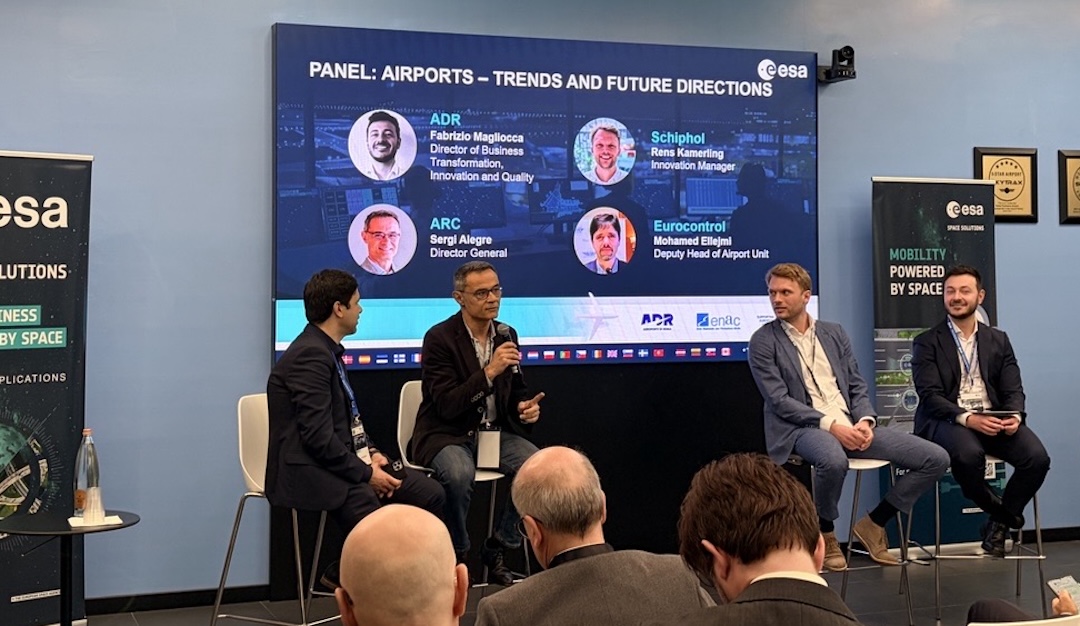
Throughout the day, collaboration was a central theme for identifying shared requirements and creating user-driven solutions, and attendees were encouraged to make the most of the networking. While there were many opportunities throughout the event, the main focus was the afternoon’s interactive working sessions. Here, stakeholders collaborated to consider space-enabled solutions in four strategic domains: optimised monitoring of airport assets and their surroundings; enhanced airside operations; advanced fleet management; and integrated logistics and mobility. These sessions sparked insightful discussions, enabling participants to tackle challenges collaboratively, exchange ideas and explore the potential of space technology in aviation.
The workshop concluded with a shared enthusiasm and a clear direction: Europe’s airports are ready to harness the full potential of space-enabled innovation. With promising ideas emerging around automation, autonomy and enhanced safety, the event has laid down strong foundations for ongoing collaboration and the evolution of future airport operations.
In his closing remarks, Enrico Spinelli, Applications Engineer within BASS, emphasised the importance of collaboration between airport stakeholders and the space ecosystem.
“Today we heard about needs, challenges, possible applications, ideas from airports, industry and institutions under the regulatory framework. Cooperation between airport stakeholders and the space ecosystem is the key ingredient to develop space-based solutions for airports with a widespread use. Today’s in-person workshop has been an important first step. Let’s keep looking forward - and thinking forward - together towards the airports of tomorrow.”

The services developed by INVENTA deliver interactive and immersive visitor experiences, including AR overlays that visitors can access on their mobile phones, geolocation services to improve accuracy and relevance of the displayed content, as well as remote 360° virtual exhibitions with multiplayer virtual visiting modes, enabling group visits and remote guided tours. On a practical level, the digital tools can be leveraged to optimise visitor flows and to improve accessibility to cultural heritage, while also enabling healthcare settings to offer remote cultural experiences to benefit patients.
Fully integrated cutting-edge technologies - Virtual Reality (VR), Augmented Reality (AR), 5G networks, satellite connectivity and satellite navigation/positioning– are at the heart of the initiative, bringing cultural heritage experiences to new and more diverse audiences, while delivering economic benefits for museums.
“The cultural heritage sector needs to evolve with the times, as well as find ways to be more resilient in the face of accessibility challenges, exacerbated by events such as the pandemic,” explains Giorgio Genta, Contractor Project Manager at ETT S.p.A. – Dedagroup.
“Our digital solution responds to this need, enhancing content accessibility, interaction, and the sustainability of cultural institutions and sites. The support and funding from BASS have been invaluable in helping us get to where we are today, not least in relation to the space technology that underpins our service.”
“Nowadays digital technologies are giving rise to a new form of protection and enhancement of cultural heritage, which accessibility is no longer anchored to physical spaces, but expands to new, boundless horizons, free from spatial and temporal constraints. It is now up to us to make the most of this opportunity," adds Massimo Migliorini, Head of Extended Reality Lab at LINKS FOUNDATION.
The four key aims of the INVENTA project are to:
- enhance visitor experience: virtually transport visitors into the past, allowing them to explore historical reconstructions and interact with exhibits, including those that are in hidden collections.
- improve accessibility: provide remote interactive guides tailored for diverse audiences, including remote visitors and people with accessibility needs. These solutions ensure that cultural heritage remains inclusive and available to all.
- future-proof cultural sites: help cultural sites develop new revenue streams by offering premium and optimised digital experiences by offering ready-to-use, scalable solutions.
- strengthen crisis preparedness: equip institutions with a robust digital presence that ensures continued visitor engagement during potential future disruptions, such as the pandemic.
While there are existing digital solutions for cultural institutions using some of the technologies, such as AR, VR or geolocation-based services, INVENTA differentiates itself by providing a comprehensive ecosystem that integrates them all together with a Content Management System (CMS) and a mobile app.
Museums involved in the pilot – including Doge’s Palace in Genova and the Museum of Oriental Arts in Turin – have reported positive feedback from visitors trialling the app. Doge’s Palace has since become a paying customer for the service.
“This achievement is a key goal and represents real commercial success for the INVENTA initiative, confirming its technical and economic viability and long-term sustainability,” says Claudia Maltoni, Senior Project Manager at ALPHA Consult and leader of the INVENTA business plan.

In addition to museums, the service was also tested in a hospital environment with patients in neuro-rehabilitation recovering from spinal surgery. The pioneering use of VR-based stimulation, for example offering patients immersive 360° video experiences from the Zoom biopark in Turin, opens new avenues for therapy and cognitive rehabilitation activities.
“INVENTA exemplifies the broad spectrum of business cases that BASS supports, demonstrating how space-enabled innovation can generate meaningful socio-economic impact,” says Davide Coppola, Head of the Space Applications Initiatives Section.
“By leveraging advanced space technologies, companies can significantly enhance and differentiate their service offerings. In this particular case, Earth observation satellites and the Global Navigation Satellite System (GNSS) play a pivotal role - providing high-resolution aerial imagery of monuments and cultural heritage sites, while enabling precise positioning services that enrich the visitor experience.”
United Kingdom
United Kingdom