

Portable 3D imaging technology reaches key milestones
December, 3 / 2025
From space to grassroots: deploying a satellite solution to improve food security and climate resilience
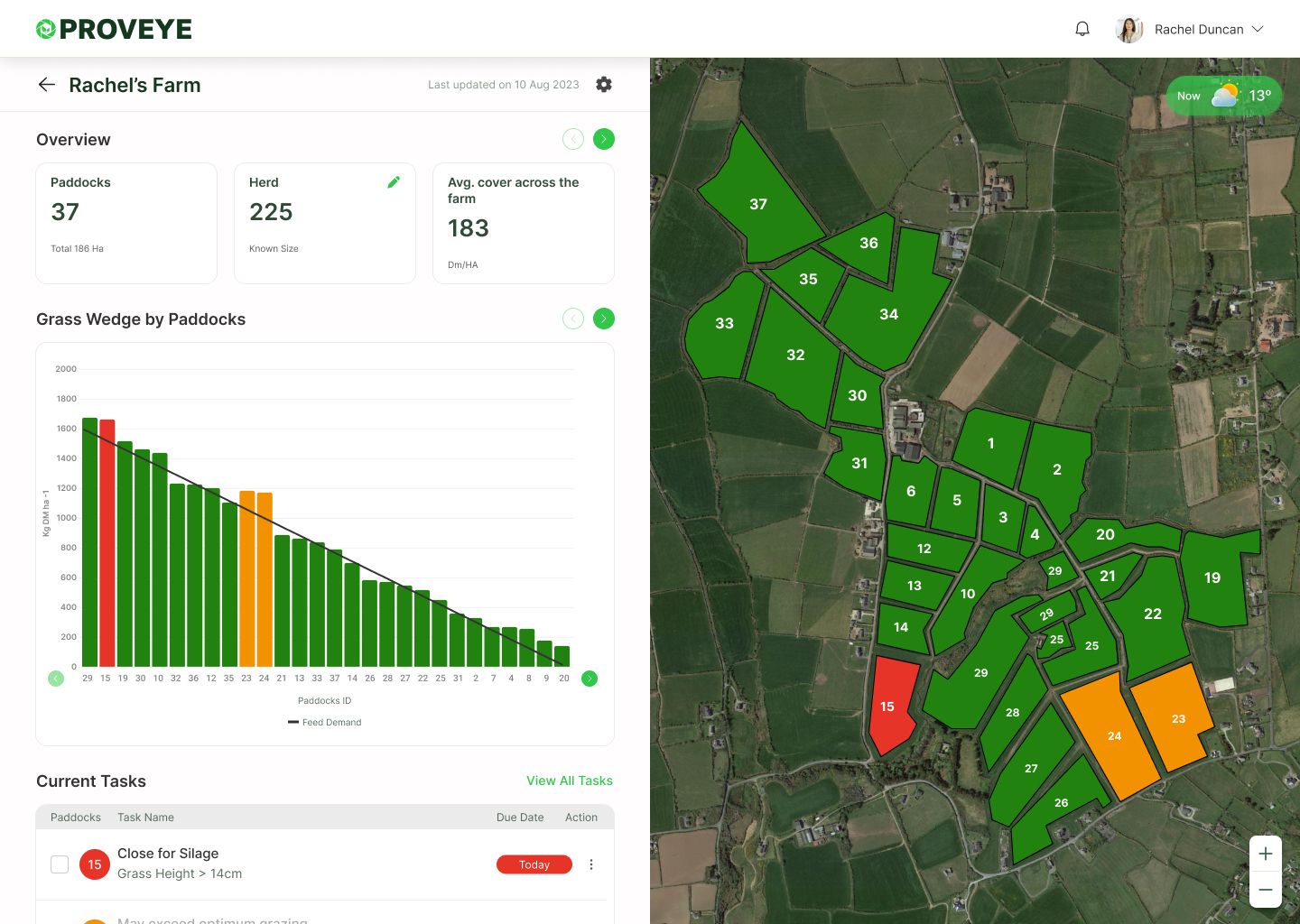
Rangelands – mainly consisting of grasslands used by livestock and wildlife to graze and forage - are critical to both food security and climate resilience. They cover some 40% of the Earth’s land surface, providing a third of the world’s biodiversity and a sixth of global food production. But rangelands are rapidly degrading and being lost, while increasing regulations are making grassland management more challenging for farmers. Irish company Proveye has been working with ESA’s Business Applications and Space Solutions (BASS) programme to develop satellite-enabled solutions which are helping to address these challenges.
Proveye has gone from strength to strength, first starting at an ESA Business Incubation Centre (BIC), and then moving on to BASS - first to evaluate market appetite and technical feasibility, and later to establish a commercial solution with the aim of generating sales and expanding into new markets.
Their first solution, ProvGrass, an Earth observation-enabled Platform-as-a-Service (PaaS), is designed to help farmers caught between pressures relating to food security on the one hand and increasing sustainability requirements on the other.
Grassland for dairy and beef farming is the biggest forage crop by area globally, as well as being the most challenging to monitor. At the same time, grass quantity and quality management is essential for profitable livestock production but existing solutions only cover a small area, demand much manual labour, have a high capital cost or only provide generalised regional measurements.
The emerging opportunity for ProvGrass is to supply the industry with a solution that enables it to measure, track, encourage and reward the adoption of more sustainable regenerative and productive practises for grassland.
ProvGrass offers:
- integration of satellite and UAV data in one platform for reliable and consistent data.
- quantity and quality metrics to inform the farmer of grass available now and into the future to satisfy the feed demand of the grazing herd
- automated, scalable delivery
- sensor-agnostic methods that make it adaptable to new data and technology of the future
ProvGrass is now attracting significant investments, securing large contracts and generating jobs. It was this first activity that sparked Proveye’s second solution ProvDMR, currently piloting with BASS on several sites in Ireland and Africa. It uses grasslands for above-ground carbon sequestration at scale, while also facilitating biodiversity management in grasslands to support regenerative farming.
Proveye CEO Jerome O’Connell explained: “We started with ProvGrass, and as we were engaging with customers through that, we kept hearing about the challenges of offsetting emissions.”
“Some 40% of Earth’s land surface is grass. We realised there is huge potential around carbon storage and biodiversity offsetting here, with grasslands a virtually untapped natural mechanism to store carbon for nature-based credits.”
“Using satellite imagery to additionally monitor and report on the improvement of biodiversity in grasslands bring greater integrity and higher value than carbon offsets only.”
The potential for generating nature-based credits from grasslands is currently limited by poor monitoring, reporting and verification capabilities, while existing biodiversity monitoring methods are manual, time-consuming, unreliable and unscalable.
The value added by ProvDMR is related to:
- the almost unlimited spatial coverage provided by ESA’s Sentinel 1 & 2 space assets
- lower operational costs compared to ground-based validation
- scalability from 1ha to global terrestrial land area
- capacity to integrate interpretation options including biomass, fire, stocking density, grazing activity, distribution of nitrogen-fixing vegetation, change in woody biomass, biodiversity, ecosystem health and human activity
Mr O’Connell said: “We have been on a journey with ESA for six years – and are still going. It is fair to say that the funding, support and validation have been fundamental to the business and products that we have developed, and the market penetration that we have been able to achieve. It would have been very difficult to do this without ESA.”
Davide Coppola, Head of Space Application Initiatives Section at BASS, said: “The core aim of BASS is to accelerate the commercialisation of innovative space-based applications and services while also delivering socio-economic impacts at scale. This shared journey with Proveye is a great example of delivering this in practice.”
Posted to Hero article section
Posted to Hero article section
CM25 delivers for business - launch of ACCESS signals a bright future for the European space sector

At this week’s Council Meeting at Ministerial Level (CM25) in Bremen, ESA Member States formally approved the new ACCESS programme, ensuring that European businesses will continue to benefit from the growth, innovation and dynamism brought by the commercialisation of space.
As part of the combined budget of €22.3 billion agreed for ESA by the Member States, Associate Members and Cooperating States, a total of €306 million has been agreed for ACCESS. This comprises €169 million subscription to ScaleUp and €137 million subscription to Business Applications and Space Solutions (BASS). As the flagship commercialisation programme from ESA, ACCESS will accelerate the commercialisation and competitiveness of the European space sector, in line with ESA’s Strategy 2040.
The context for CM25 is a complex one, set against a volatile backdrop of geopolitical instability, rapid technological change and unprecedented access to space. As ESA Director General outlined earlier this week, “CM25 is more than just another Ministerial, it is a moment of radical decision-making,” and the investment in ACCESS reflects a wider European commitment to space, and recognition of the urgent need for Europe to strengthen its presence in the global space market.
ACCESS will continue to deliver support through the established ScaleUp and BASS elements. It offers enhanced financial, business and technical support for ideation, incubation, acceleration and market deployment of innovative products and services across the space value chain. It connects businesses, investors, suppliers and potential customers in space markets and the wider economy for the benefit of Europe.
New opportunities for European industry
The investment from the Member States this week means that the ScaleUp and BASS elements, as part of ACCESS, will continue to support Europe’s space sector. For ScaleUp this means new and renewed BICs and Phi-Labs, and improved dealflow through Marketplace. For BASS this means new thematic campaigns tuned to the priorities of the Member States, additional and improved funding structures to facilitate innovation and growth, and the expansion of activities across all sectors, including safety and security.
Community reference
Posted to Hero article section
Posted to Hero article section