

ESA Launches “Space for Logistics and Resilient Infrastructure” Task Force at Brussels Summit
Driving Sustainable Change in European Logistics
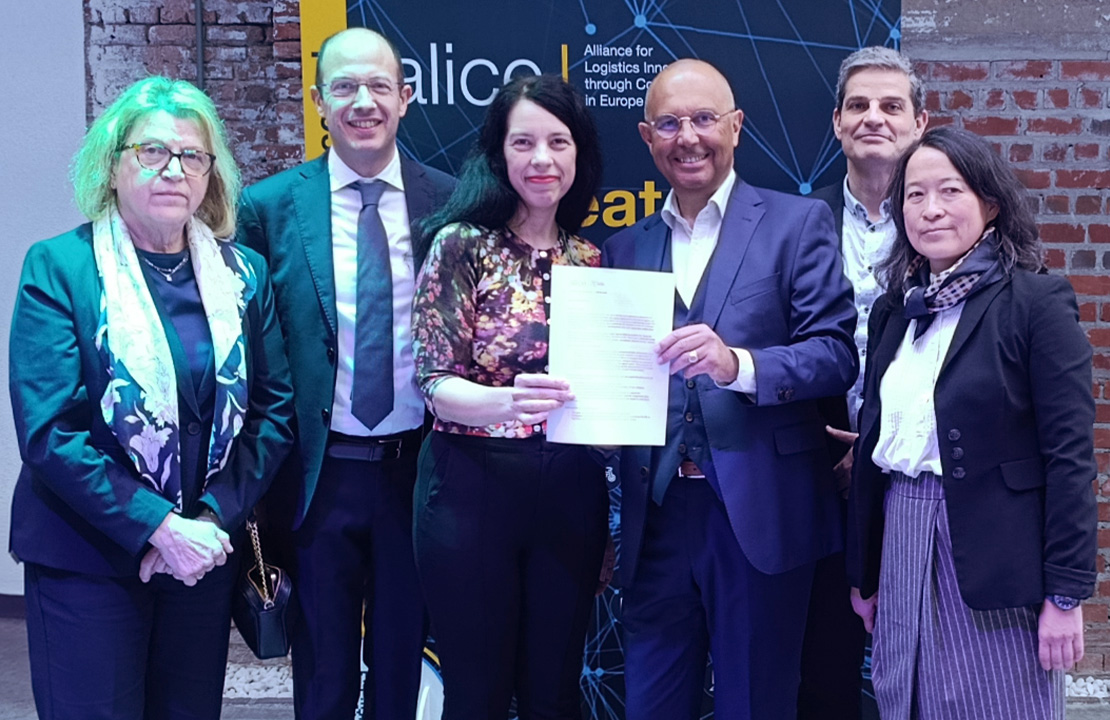
 The European Space Agency has unveiled the “Space for Logistics and Resilient Infrastructure” Task Force, a groundbreaking initiative designed to help European industries harness space technologies to address real sustainability, efficiency and resilience challenges in logistics. The official announcement took place at the Leaders in Logistics Summit in Brussels on 18 March, 2026.
At a time when logistics operators face increasing regulatory pressure to decarbonise, while also ensuring operational continuity amidst climate and geopolitical risks, space-enabled data and services offer a unique and scalable way to strengthen decision-making and infrastructure resilience.
ESA Business Applications and Space Solutions (BASS) has long identified the logistics sector as a priority for space applications, engaging with several stakeholders to develop innovative space-based solutions that promote the green transition and the adoption of space and non-space technologies. These efforts have culminated in the creation of this Task Force, which already boasts key European partners including ALICE (Alliance for Logistics Innovation through Collaboration in Europe), ITS Norway, Limowa, Logistics in Wallonia, Vil, and the Fundación Valenciaport, with further organisations expected to join.
The Task Force will address several challenges, where space applications can be instrumental. These include the digitalisation and optimisation of the tracking and monitoring of goods, the delivery efficiency for last mile deliveries, the development of autonomous solutions, the planning of sustainable infrastructures, and the resilience of transport networks and supply chains. The Task Force will consolidate the needs and requirements of stakeholders, and will promote through ESA BASS funding the development of innovative and commercially sustainable solutions that highlight social, economic and environmental benefits for members and the overall logistics sector. Collaboration amongst Task Force members will also support enhanced sustainability and resilience within the sector’s infrastructure, drawing from the collective expertise and discussions between participants.
International regulations will serve as a guiding framework for new applications and services, and the Task Force will also leverage the guidance and experience of ALICE as European Technology Platform (ETP) for logistics innovation. Safety, resilience and security of critical infrastructure – including supply chains - will remain a central theme, with the Task Force also working to promote cross-industry dialogue and to provide a platform to scale up sustainable solutions powered by space data and technology.
ESA’s overarching goal for the Task Force is to support the green transition of the sector into a sustainable future. This will include promoting innovation and the uptake of new operational and close-to-market solutions which integrate space and non-space data, as well as positioning the Task Force as a catalyst for improving the logistics sector and making it greener.
Enrico Spinelli, Applications Engineer at ESA who is leading the initiative, said: “The Task Force represents a unique opportunity to showcase the vital role of space assets in the digital and sustainable transformation of the logistics sector. By promoting, with our partners, the development and validation of new and operational solutions based on space technologies, we can support innovation and collaboration at the core of this transformation. Embracing new technologies and adapting to evolving regulations will shape the future of logistics throughout Europe.”
Dr. Fernando Liesa, the Secretary General of ALICE, said: “ALICE is proud to have instrumentally contributed to the establishment of this Task Force, leveraging our network and that of our members, including ports as well as regional and national clusters. Space-based assets and technologies offer a significant opportunity to develop solutions that address the sector’s challenges, needs and emerging opportunities. By aligning space-enabled applications across ports and hubs, transport networks and wider supply chain operations, this initiative lays a strong foundation to support the sector’s green and digital transition. We look forward to welcoming partners who wish to share their needs and opportunities, as well as those developing space-based solutions.”
Community reference
Posted to Hero article section
Posted to Hero article section
Connecting space to the energy transition at SET Tech Festival

From exciting start-up awards to insightful panel discussions and meaningful networking, ESA’s Business Applications and Space Solutions (BASS) team had a busy few days at the heart of the action for the Start-Up Energy Transition (SET Tech) Festival on 17 March. The Berlin event celebrated its 10th year in driving global energy innovation and climate solutions.
This 2026 edition of the SET Tech Festival, organised by the German Energy Agency (dena), a BASS Energy Task Force member, marks a decade of bringing together ideas and partnerships that are helping to shape the global energy system, while creating opportunities for innovative start-ups.

"Over the last 10 years the SET Tech Festival has grown into more than a conference,” reflects Corinna Enders, dena CEO. “It has become a global platform where innovation meets implementation, a place where start-ups, investors, policy-makers, industry leaders and researchers come together to share knowledge and experience and work together on our shared goal to turn ideas into solutions.”
As a springboard for businesses and innovative solutions, the Festival has a strong synergy with ESA BASS.
“It is fantastic to be so closely involved with SET Tech,” explains Asimina Syriou, Energy Lead for ESA BASS. “The Festival strongly aligns with our work at ESA BASS—supporting innovators to develop breakthrough solutions that respond directly to market needs and deliver real impact.”
The role of space in critical energy infrastructures
Speaking to a busy room of corporate leaders, investors and start-ups looking to make new connections and to find innovative ways to drive the energy transition, Rita Rinaldo, Head of Applications Projects and Studies Division at ESA BASS, took to the stage for the “Critical Energy Infrastructures: A Space for Innovation?” panel discussion.
“What is clear is that space is a critical infrastructure per se and as such requires to be secure and protected. At the same time, space infrastructures and data are crucial in increasing resilience in many other sectors, including the energy sector,” says Ms Rinaldo.

Ms Rinaldo continues: “Thanks to satellite connectivity networks, we can ensure continuity of operations as a back-up to terrestrial networks. Precision-timing and positioning information are essential for digital grid sub-stations. And thanks to satellite Earth observation data we can support the monitoring of infrastructures in the face of a broad range of threats.
Our societies are confronted with threats that seem to be coming more rapidly one after the other, and affecting supply chains and infrastructures – there is clearly a need to improve preparedness, response times and flexibility. Space is essential to address these challenges.”
Selecting the Start-Up Energy Transition Award winners
Fifteen finalists from all over the world delivered compelling pitches in five categories aligned with the Festival’s core themes of renewable energy, mobility and sustainable technology.
Sitting on the SET Awards Jury, Ms Syriou had the challenging task of assessing the entries alongside a distinguished group of experts from across the sector.

SET Tech Awards Jury Day: Asimina Syriou, Energy Lead for ESA BASS, alongside fellow jury members
“I was truly impressed by the quality and diversity of the pitches – there was a strong sense of purpose and innovation throughout the day. Selecting the winners was not easy, but the final choices reflect solutions with clear potential to address real market needs. It will be exciting to see how these ideas develop and scale in the future,” says Ms Syriou.
“The SET Awards are not only about recognition but they are also about visibility, connection and opportunity,” adds Ms Enders. “It helps young companies to gain access to partners, investors and markets that can accelerate the technologies. Many companies that first stood at this stage have now had great success and have grown into influential players. This is the real success story of the SET Awards.”
The 2026 winners were announced at the Awards Ceremony on the evening of the Festival:
- Mykor, UK (Category: Building & Construction)
- Finmile, UK (Category: Mobility & Transportation)
- Biomassters, Rwanda (Category: Quality Energy Access & SDG 7)
- Cyclic Materials, Canada (Category: Industry)
- Flower, Sweden (Clean Energy & Storage)
Supporting start-ups with space-enabled applications
Start-ups are at the heart of SET Tech Festival, and ESA BASS was pleased to share its booth with seven companies currently or recently engaged with BASS activities. These companies are developing innovative applications to develop space-enabled applications within the energy sector, and the Festival provided a valuable platform to showcase their work while expanding their customer and investor networks.

Together with dena, BASS also hosted a well-attended information session highlighting the range of BASS funding opportunities available, and offering practical guidance for innovators to scale up their solutions.
To conclude the busy few days Ms Syriou said: “It’s been a truly energising few days—supporting dynamic new-generation of companies, sparking fresh opportunities for innovators, and watching start-ups build the connections that will turn bold ideas into real-world, market-ready solutions for the energy transition.”
Pia Dorfinger, Start-up Ecosystem Director at dena, echoed this sentiment with these final words: “I always walk away form SET Tech Festivals so refreshed, with so many ideas. It such a great mix of reunion with people who come here every year but at the same time always having these fresh new ideas and connections.
In the last decade the sector has grown and we have come a long way. The world keeps changing and evolving, and there is still so much to do, but we have seen is that we are on a trajectory that is unstoppable.”
Posted to Hero article section
Posted to Hero article section
Space for Logistics and Resilient Infrastructure Task Force
SPACE FOR LOGISTICS AND RESILIENT INFRASTRUCTURE TASK FORCE
Addressing the challenges of the logistics sector
The European Space Agency has unveiled the “Space for Logistics and Resilient Infrastructure” Task Force, a groundbreaking initiative designed to help European industries harness space technologies to address concrete sustainability, efficiency and resilience challenges in logistics.
Cost-effective advertising spending with space-enabled geotargeting

Delivering better return on investment (ROI) and higher conversion rates for advertising campaigns – that is the premise at the heart of the BeSpatial.AI geotargeting solution, developed by Hungarian company HOLISTIcrm Kft in partnership with GeoX Kft, and with the support of ESA’s Business Applications and Space Solutions (BASS). The innovative service integrates earth observation data with adaptable Gen AI-algorithms, delivering high-precision optimisation of advertising locations, significantly surpassing traditional demographic or regional targeting methods.
By incorporating remote sensing data from satellite data sets, BeSpatial.AI has significantly increased targeting performance, enabling the creation of ‘best target circles’ within a geographical area. These ‘best circles’ cost up to 16 times less than conventional methods and have provided an increase of up to 220% in return on advertising spend (ROAS) in A/B testing.
Fully GDPR-compliant, BeSpatial.AI geotargeting works by creating anonymised and aggregated spatial profiles of people within 100m² grids, using more than100 variables, including purchasing power, building types, mobility patterns, demographics and changes in land use. Data from satellite earth observation, census data, tourism indexes, traffic and mobility data and many other sources are combined to provide these profiles.
“What truly sets BeSpatial.AI apart is our ability to integrate satellite imagery with automated machine learning to pinpoint high-potential locations with unprecedented precision. The invaluable support from ESA BASS was instrumental in bringing this vision to life,” explains Csongor Fekete, founder of HOLISTIcrm.
“The customer-specific algorithms make geotargeting fully dynamic across both digital platforms and offline channels. Because the platform is accessible and affordable even for SMEs, we are empowering businesses of all sizes to maximize the return on every advertising cent.”
The solution is particularly attractive to businesses that engage extensively in digital marketing, such as:
- Marketing agencies and advertising platforms – creating highly targeted and localised campaigns
- Financial Services Institutions (FSIs) - enabling optimisation of call-centre operations by prioritising high-affinity areas
- Insurance, retail and e-commerce companies – identifying new high-potential locations for advertising and expansion, based on data from their current customer base
- Direct sales networks – identifying optimal locations for recruiting agents
In a sign of the strong market interest, BeSpatial.AI has already realised sales and has a framework agreement with a major international reseller partner, rolling out to 35 countries. The company has its sights set on acquiring critical country specific spatial data sets to further deepen geotargeting precision to meet diverse regional requirements all over the world.
“BeSpatial.AI geotargeting is a great example of how satellite technology, in this case Sentinel-2 earth observation images and anonymised GNSS-based mobility data, can bring efficiencies to businesses here on Earth,” says Ana Raposo, Business Applications and Partnerships Officer at ESA BASS.
“It is a pleasure to be able to help bring to fruition innovative solutions such as this one and witness the growth of the services to several geographies”.
Posted to Hero article section
Posted to Hero article section