ESA title

  • ESA-STAR REFERENCE 4-40034
  • Activity Proof-of-concept, Pilot Projects

This is an Open Call for Proposals, meaning that it is an always open invitation for businesses to apply for a funding activity relating to a space-enabled application or service for any industry, market or topic. 

Proof-of-concept Studies 

These studies aim to reduce risks and validate the market opportunity by designing the service concept, engaging users, and developing a Minimum Viable Product (MVP). 

Space for SMART Airports Workshop


The European Space Agency (ESA), Eurocontrol and the Italian Civil Aviation Authority (ENAC) are pleased to announce the Space for SMART Airports workshop on 12 February 2026. This free event, which will take place at the ADR/Innovation Hub in Rome/FCO airport, is an opportunity to explore airport needs and priorities in relation to operational efficiency, resilience and sustainability, and to investigate possible roles for space technologies in supporting innovative solutions for smart airports.


The event will involve airport managers and operators, airport service providers, industry representatives, institutional authorities, research entities and key aviation stakeholders. The focus will be to discuss and analyse airport requirements and trends in relation to key operational challenges and sustainability goals. Delegates will explore opportunities for innovation addressing applications such as:

  • optimised monitoring of airports assets and airports surroundings
  • automation in airside operations
  • fleet management
  • mobility for passengers and goods
  • integrated logistics

Emerging solutions enabled by space data and services, as well as their potential for commercial exploitation will be discussed. These include new business models, data analytics tailored for aviation, and innovative partnerships between public and private sectors. ESA Business Applications and Space Solutions (BASS) funding opportunities to develop innovative and commercially sustainable applications for smart airports, supported by space technologies, will be also presented.

The event will provide networking opportunities for attendees, fostering collaboration and knowledge exchange between regulatory authorities, technology providers, and aviation/airport operators. By bringing together a diverse audience of stakeholders, the workshop aims to spark dialogue and inspire actionable ideas, while also match-making between demand and supply to shape the next generation of airport technologies and services.

Agenda 

10:00 – 10:30  Registration

10:30 – 10:45  Welcome and introductions 

                          ADR, Emanuele Calà, Senior Vice President, Transformation & Technology, Aeroporti di Roma

                          ENAC, Davide Drago, Director for Coordination, Standardisation and Airport Regulation

                          ASI, Roberto Formaro, Director of the Engineering and Technology Directorate

10:45 – 11:00  ESA ACCESS/BASS programme and space applications for smart airports

                          ESA, Rita Rinaldo, Head of Applications and Studies Division

11:00 – 12:30  Panel: Airports - Trends and Future Directions (Moderator: Enrico Spinelli, Applications Engineer, ESA)

                          ADR, Fabrizio Magliocca, Director of Business Transformation, Innovation & Quality

                          Schiphol, Rens Kamerling, Innovation Manager

                          ARC, Sergi Alegre, Director General

                          Eurocontrol, Mohamed Ellejmi, Deputy Head of Airport Unit

12:30 – 14:00  Networking Lunch

14:00 – 14:45  Industry Session & Innovative Solutions (Moderators: Fausto Vieira, HE Space for ESA, and Letizia Petrarca, ADR Innovation Hub & Intrapreneurship)

                            ASB (Autonomous Safety Barrier), Roar Bjerke, CEO Autroni

                            Darwin Shuttle, Daniela Petrovic, CEO Darwin Group

                            Aeroficial Intelligence, Markus Stadlmair, CTO

                            Assaia, Jan Willem Kappes, Chief Commercial Officer

                            Outsight, Raul Bravo, Founder

                            Eurocontrol, Paolino De Falco, Project Engineer at the EUROCONTROL Innovation Hub

14:45 – 16:00  Working sessions (additional information will be provided to registered participants)

16:00 – 16:30  Summary and Wrap Up Sessions

                          Feedback from working sessions by selected speakers

                          Conclusions (ESA)


Registrations have now closed. 


Community reference
Posted to Hero article section
Teaser paragraph

The European Space Agency (ESA), Eurocontrol and the Italian Civil Aviation Authority (ENAC) are pleased to announce the Space for SMART Airports workshop on 12 February 2026. This free event, which will take place at the ADR/Innovation Hub in Rome/FCO airport, is an opportunity to explore airport needs and priorities in relation to operational efficiency, resilience and sustainability, and to investigate possible roles for space technologies in supporting innovative solutions for smart airports.

How space-driven international collaborations are accelerating maritime decarbonisation

Protecting our planet and mitigating the worst effects of climate change are a key element of ESA’s Strategy 2040. Whilst the environmental impact of industry and transportation are well-documented, fewer people realise that the maritime sector in Europe is responsible for around 4% of total greenhouse gas (GHG) emissions.

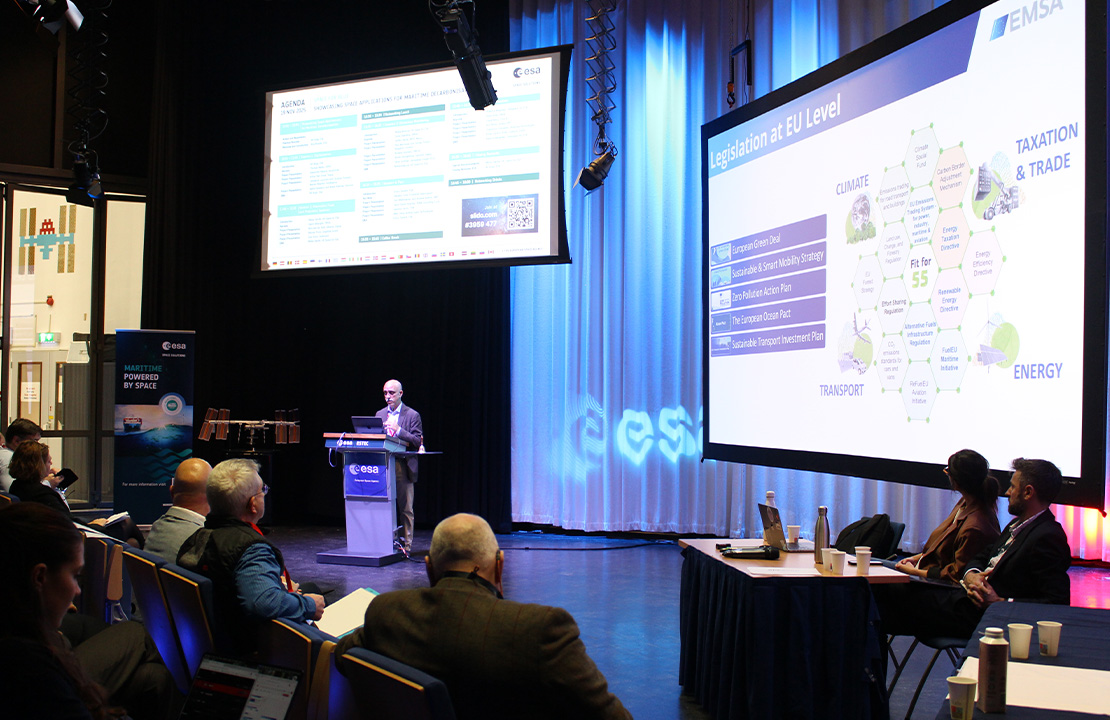
Although the total maritime emissions in Europe have started to fall since 2022, the journey to net zero remains significant. No single nation can achieve this alone, so collaboration is key. To that end, companies and experts from 20 nations recently came together at ESA's European Space Research and Technology Centre (ESTEC) for the ‘Showcasing Space Applications for Maritime Decarbonisation Workshop,’ to share details of innovative projects and services using space assets, data and technologies to address decarbonisation challenges in the sector. These projects are being developed in response to ESA’s Business Applications and Space Solutions (BASS) Maritime Decarbonisation thematic funding call, which closed earlier this year.

“Space data is a key enabler and has a major role to play in maritime decarbonisation,” said Rita Rinaldo, Head of Applications, Projects and Studies Division at ESA, in her opening remarks, explaining how BASS has already supported more than 100 projects in the maritime sector over the past ten years. “At ESA BASS, one of our key roles is to facilitate dialogue between communities, and to provide the opportunity for key players in the sector to come together, share experiences and make connections,” she continued, a theme that Nil Angli, Maritime Lead for ESA, reinforced.

“Today is not about ships or even spaceships,” Mr Angli said. “Today is about partnerships and working together to accelerate the green transition in the maritime sector.”

Members of the Maritime Sustainability Task Force, established in early 2024, convened ahead of the workshop, with several members delivering keynote speeches throughout the day. This included new member Salvador Furio, Development Director from Fundación ValenciaPort, Europe’s fourth largest port. He outlined the role of space applications in the port’s goal of achieving net zero emissions by 2030. His speech set the scene for the presentations on space-enabled solutions for ports, including sedimentation forecasting in ports, infrastructure maintenance, a 5G and satellite-based tool for assisted and autonomous shipping, and circular economy pathways for turning emissions waste into valuable resources.

In a keynote on Digitalisation, Thomas Mellor, Head of Technical Partnerships at the UK Hydrographic Office (UKHO), outlined how new regulations and standards are also driving the move to decarbonisation in the sector, including the new IHO S-100 universal data framework designed by the UKHO.

The four projects in this session showcased how space data is optimising routes to cut fuel consumption, improving safety through enhanced connectivity, and using physics-informed AI to make maritime data more efficient and actionable.

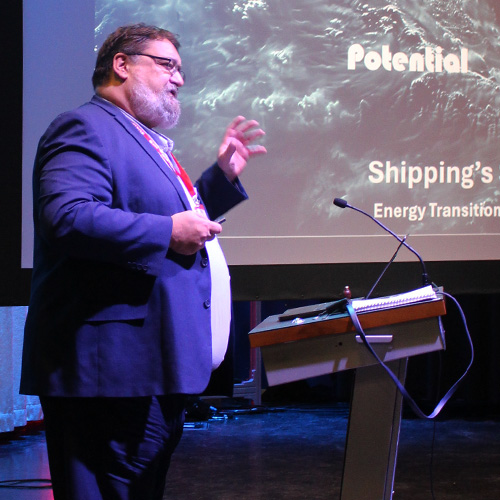
Gavin Allwright, Secretary General of the International Windship Association (IWSA), and one of the founding members of the Maritime Sustainability Task Force, outlined the rapid growth of the wind propulsion and alternative fuels market over the past ten years, and the growing investment in wind technologies in his “Win-win-wind’ keynote speech. The presentations that followed echoed these sentiments, sharing details of innovations around digital ships, airborne wind energy systems (kite) and technologies to convert CO2 into limestone.

The European Maritime Safety Agency (EMSA), also a member of the Maritime Sustainability Task Force, led two afternoon sessions, focusing on emissions monitoring and automation.

Samy Djavidnia, Senior Project Officer at EMSA, stressed the need for collaboration among regulators, operators, industry, space agencies and researchers to unlock trusted and usable data for emissions reduction. Presentations covered space-powered solutions for monitoring pollutants such as CO2, methane, nitrogen oxides and VOCs—including innovations to track the shadow fleet using Automatic Identification System (AIS) and remote sensing.

Finally, Peter Kirov, Head of Safety, Security and Surveillance at EMSA, spoke about the strategic partnership between EMSA and ESA, and the significance of this ongoing collaboration in addressing some of the major challenges facing the maritime sector. He went on to introduce the Automation session, which showcased applications that use space assets to enhance navigation, maintenance and safety for autonomous and semi-autonomous vessels—while delivering both commercial benefits and emissions reductions.

“Showcasing Space Applications for Maritime Decarbonisation" is the third event in the Space for Blue series of workshops. These events aim to bring key stakeholders together to discuss how space can be a powerful catalyst for maritime—enabling smarter decisions, stronger partnerships and a faster transition to a sustainable future for the sector, not only in Europe but on a global scale.

BASS intends to strengthen the support to companies wishing to propose innovative business ideas using space data and assets for maritime decarbonisation and optimisation of operations at sea and in ports. It will also strive to match-make the aspirations, capabilities and needs of space and maritime ecosystems.


Community reference
Posted to Hero article section
Teaser paragraph

Companies and experts from 20 nations recently came together at ESTEC for the ‘Showcasing Space Applications for Maritime Decarbonisation Workshop,’ to share details of innovative projects and services using space assets, data and technologies to address decarbonisation challenges in the sector. These projects are being developed in response to ESA’s Business Applications and Space Solutions (BASS) Maritime Decarbonisation thematic funding call, which closed earlier this year.