


One weed at a time: Transforming organic dairy farms with space-enabled robots
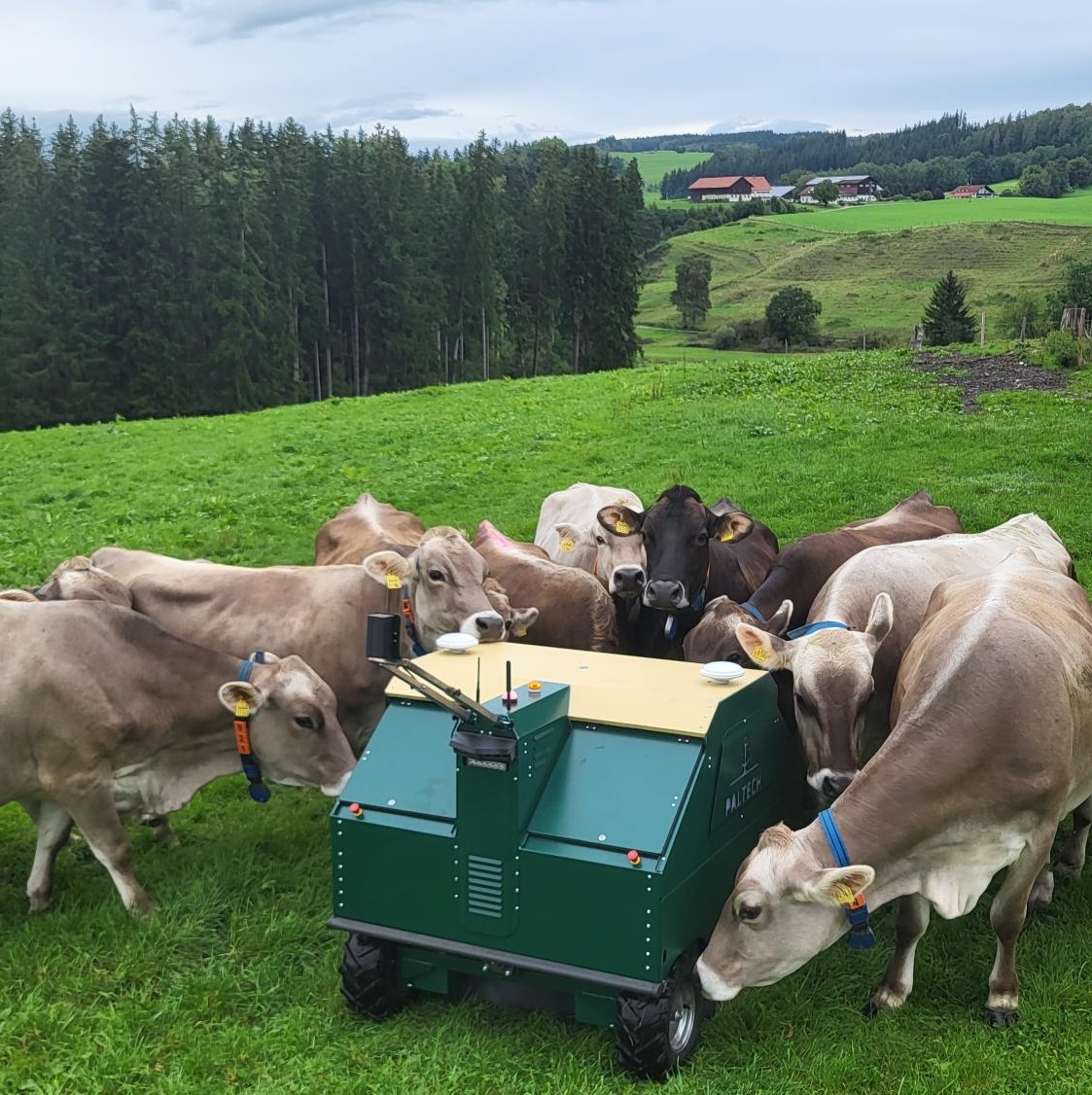
 Organic dairy and horse farms depend on high-quality pastures, yet many of them face a persistent and costly challenge: the spread of tap-rooted weeds such as dockweed. These weeds reduce forage quality and therefore milk production and can also cause severe health risks to livestock. German start-up Paltech GmbH identified a gap in the market for a herbicide-free solution, and with support from ESA’s Business Applications and Space Solutions (BASS) and the German Space Agency (DLR), developed EM-GROW - an innovative service powered by robotics, GNSS-based localisation and an AI-driven plant detection system.
Grassland-based livestock farming plays a central role in the agricultural landscape in many parts of Europe, and the organic farming sector is growing, driven by increasing demand. Nearly 85% of organic grassland farms report issues with dockweed infestation, and manual removal - still the dominant method - requires up to 500 hours of labour per hectare. It is against this backdrop that the EM-GROW solution was developed, addressing the core needs of the target market: improved yield, reduced labour and compliance with organic farming standards.
“Not all green in fields is good for cows, and some large weeds such as dockweed can cause considerable yield losses. These weeds spread quickly and take over edible grass, while their taproots, reaching depths of up to 1.5 meters, make manual removal a strenuous and time-consuming task for organic farmers. Existing solutions for weed control in permanent grasslands either fail to scale, require large amounts of water or energy, or are incompatible with organic guidelines,” explains Felix Schiegg from Paltech GmbH.
“We developed EM-GROW to provide farmers with an efficient, environmentally friendly and labour-saving alternative to manual weed control, combining advanced technology with a practical service model that fits the workflows and economic constraints of farmers.”

The EM-GROW solution was initially offered as a Robots-as-a-Service (RaaS) model, but with the robots now subsidised by the Bavarian state in Germany, the business model has been adjusted to produce and sell the product directly to farmers too – enticing this sector to benefit from technological innovation and automation, relieving the impact of labour-intensive and costly manual tasks.
Key features of EM-GROW include autonomous reseeding to support grass regrowth, low resource consumption (no water, no fuel), and digital reporting of treated areas and extracted weeds. Other benefits include a wide application window of more than 200 days per year, with the robots capable of operating both day and night.
Early field tests and demonstrations with organic farmers, dairy associations and conservation authorities in Germany and Austria helped refine the service concept and user needs, followed by a pilot stage validating the system in real operating conditions.
“A user-centred approach has been central to us to ensure that EM-GROW delivers both practical value and scalability – using EM-GROW is 20% cheaper than paying someone on minimum wage to do this work, while offering a 99% time saving and more than 95% effectiveness in removing the weeds,” Mr Schiegg said.
The future is looking bright for EM-GROW, and Mr Schiegg says applying for an ESA BASS funding programme made all the difference: “Without the help of ESA and DLR, we would not have been able to get where we are today – their support has been particularly vital to help us successfully reach our customers with our space-enabled solution.”
Asimina Syriou, Applications Engineer for BASS, said: “The goal of a BASS demonstration project is to help businesses establish and validate the technical feasibility and commercial viability of their space-enabled product, as well as the market appetite for it – this is exactly what has been achieved with EM-GROW's fully autonomous herbicide-free weed control solution. The foundations for a scalable commercial rollout have been laid, and I look forward to seeing how they continue to grow.”
“EM-GROW is a very interesting application that combines highly complex technological development with the use of space data. It is an easy-to-understand and illustrative example that demonstrates to decision-makers to why we like to support this programme,” added Anke Freimouth from DLR.
Community reference
Posted to Hero article section
Posted to Hero article section
Japan and Europe – working together to create new satellite-driven markets for smart cities

Register
ESA’s Business Applications and Space Solutions (BASS) team, and the Japanese Space Agency (JAXA), will hold a joint webinar titled “Japan and Europe – working together to create new satellite-driven markets for smart cities” on 24 September.
The webinar will foster strategic collaboration between European and Japanese companies, enabling the development of innovative space solutions in smart city markets, international growth and access to new markets.
Background
Cities and urban areas are currently home to over half the world’s population. According to the UN, nearly 70% of the expected population of 10 billion are projected to be living in cities by 2050. This growth brings significant challenges including:
- Environmental pressures
- Infrastructure needs
- Quality of life issues
- Sustainability
Smart and green cities are addressing these challenges by improving operational efficiency, citizen welfare, and government services in sustainable and innovative ways. Data and information are the core components for the implementation of smart cities solutions – and space-based technologies are playing a crucial role in supporting this transformation
Purpose of the webinar
- To introduce BASS supported services with a particular focus on smart city-related applications such as urban planning, mobility , climate resilience, and infrastructure management
- To introduce CONSEO and JAXA supported solutions for smart city development and urban innovation.
- To promote collaboration between European and Japanese companies by leveraging their respective strengths in smart city markets, ultimately leading to the creation of concrete business projects
Who should attend?
European and Japanese companies providing services for cities and willing to establish international cooperation
Agenda
The webinar will consist of two parts:
Part 1:
Introduction of initiatives led by ESA BASS (Business Applications and Space Solutions) Programme, CONSEO and JAXA to promote the use of satellite-based solutions for smart cities.
- Introduction of the ESA BASS Programme, Rita Rinaldo, Head of Applications Projects & Studies Division, European Space Agency.
- Introduction of JAXA, Yusuke MURAKI Advisor to the Director Earth Observation Program Strategy Office Space Technology Directorate 1, Japan Aerospace Exploration Agency.
Part 2:
European and Japanese companies will take the stage to present their services, particularly those related to smart city solutions, as well as their proposed models and ambitions for Japanese–European collaboration and their specific cooperation proposals.
European Companies
- Mohammad Iranmanesh , ConstellR
- Steven Smolders , GIM
- Harriet King, Valerann
- Juergen Born, Spatial Business Integration
- Kristin Pettersen Grenan, Airmine
- Federico Franciamore, Space4Good
Japanese Companies
- Iain MacInnes, Synspective Inc. (株式会社Synspective)
- Goro Kumasu, Nippon Koei Co., Ltd. (日本工営株式会社)
- Ken Tsutsui, Marble Visions (株式会社Marble Visions)
- Yumiko Nagai, New Space Intelligence (株式会社New Space Intelligence)
- Azuma Takano, PASCO Corporation (株式会社パスコ)
- Keitaro Asaba, Tenchijin Inc. (株式会社天地人)
- Yuki Homma, SpaceShift Inc. (株式会社スペースシフト)
Webinar contributors:
- ESA Business Applications and Space Solutions (BASS) help businesses from all corners of Europe to harness space technology to improve life on Earth. BASS is working with and supporting urban authorities and businesses to find the most effective innovative solutions to the challenges they are facing, and at the same time to help them tap into the global smart cities market. Moreover, through its Space for Smart and Green Cities Taskforce, BASS is supporting international collaboration, partnerships and innovation, paving the way for a more sustainable future, while unlocking the commercial potential in the sector.
- JAXA is Japan’s national aerospace agency, responsible for space exploration, satellite development, Earth observation, and aeronautics research. As the secretariat of the Consortium for Satellite Earth Observation (CONSEO), JAXA supports initiatives that promote innovation, data utilisation, commercialisation, and cross-sector partnerships, helping translate Earth observation capabilities into practical solutions for societal and economic challenges.
- CONSEO (CONSEO) gathers players from industry, academia and governments to shape the future of Satellite EO and realise it through co-creation. Its mission is to deliver recommendation of the overall strategy of EO satellite for the Japanese society. CONSEO actively promotes the co-creation among its members for the establishment of a resilient Satellite EO ecosystem.
Community reference
Posted to Hero article section
Posted to Hero article section